By clicking “Accept All Cookies”, you agree to the storing of cookies on your device to enhance site navigation, analyze site usage, and assist in our marketing efforts. View our Privacy Policy for more information.
How to Turn a No From an Investor Into a Future Yes
by
Oluwadamilare Akinpelu
Most investor rejections are not permanent. They are timing rejections: the company was not at the right stage, the round was not the right size, or the market thesis had not yet played out. Founders who stay in the relationship with a consistent update cadence, demonstrate real progress, and re-engage at the right moment convert a significant number of early passes into later investments.
Getting a no from an investor feels like an ending. In most cases, it is not. It is a pause.
Investors pass on companies for specific reasons, and many of those reasons change over time. Too early. Wrong stage. The thesis did not fit yet. No bandwidth in the current fund cycle. Each of these is a timing rejection, not a permanent verdict on the company. Founders who understand this treat the relationship differently, and convert a meaningful share of early passes into later investments.
Why investor rejections are usually not final
Most venture investors maintain some version of a watch list: companies they passed on that they are still paying attention to. A company that was different and too early for their fund eighteen months ago that might be a match right now. The founders who end up on that watch list are the ones who handled the rejection well, stayed in contact without being a nuisance, and continued to demonstrate progress.
Understanding the reason for the pass is the first step. Is that VC being diligent or just being polite? It covers how to read the difference between a genuine timing pass and a polite permanent no, because the response to each is different.
Lorem ipsum dolor sit amet, consectetur adipiscing elit. Suspendisse varius enim in eros elementum tristique. Duis cursus, mi quis viverra ornare, eros dolor interdum nulla, ut commodo diam libero vitae erat. Aenean faucibus nibh et justo cursus id rutrum lorem imperdiet. Nunc ut sem vitae risus tristique posuere.
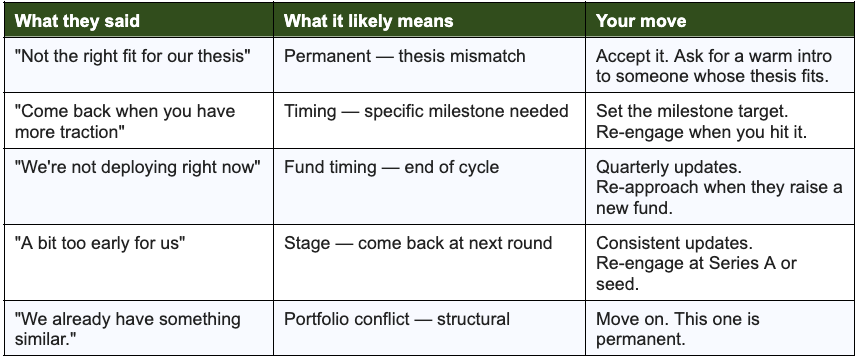
Not all rejections are the same. Each type has a different right response:
How to read the type of rejection you received
How do you respond to an investor rejection?
Send a brief, professional thank you within twenty-four hours. Something like, "Thank you for taking the time to review the deck. I understand the timing is not right. I will keep you updated as we hit milestones, and I hope our paths cross again." No pressure. No argument. No attempt to change their mind in the same email.
Ask one specific question if the rejection was vague: "Is there something specific that would change the picture for you, or is this mainly a timing issue?" This is not an attempt to reverse the decision; it is an attempt to understand whether there is a real path back, and if so, what it looks like. Accept whatever they give you and do not push further.
Be careful about taking every piece of investor feedback as direction to pivot. Feedback from multiple investors pointing to the same issue is worth taking seriously. Feedback from one investor that contradicts everything else you are hearing probably reflects their specific view rather than a general truth.
How do you stay on an investor's radar after a rejection?
Send a brief quarterly update, three to four bullet points covering the headline metrics, a key win, and where you are headed next. Keep it short enough to read in thirty seconds. Investors who receive regular updates from companies they passed on stay engaged with those companies' progress in a way that periodic "I wanted to reconnect" emails do not achieve.
The update should show progress against the specific concern they raised. If the investor passed because traction was thin and six months later your MRR has tripled, leading with that number in the next update is the right move. You are not explicitly reopening the conversation; you are demonstrating that the reason they passed has changed.
Pitchwise lets you track whether an investor re-engages with your deck after receiving an update. An investor who opens the deck again after months of silence is signalling renewed interest. That is the moment to reach out proactively rather than waiting for them to come to you. Investor engagement signals that predict a term sheet: map what those re-engagement patterns typically mean.
When is the right moment to re-engage an investor who said no?
Three triggers work reliably. Reach out specifically around one of these rather than just asking for another meeting:
✓ Tip: 1. A milestone that directly addresses their reason for passing. 2. A new round with a lead investor already committed and independent validation they will respond to. 3. A major external signal: significant customer win, press moment, or industry validation that changes the context around the company.
Can an investor change their mind after saying no?
Yes, frequently. Most passes are timing rejections rather than permanent verdicts. An investor who said no because you were too early may be very interested eighteen months later with real growth behind you. The founders who convert early passes into later investments are the ones who stayed in the relationship and continued to demonstrate progress.
How should you respond to an investor rejection?
Send a brief thank you within twenty-four hours, ask one specific question about what would need to change for them to reconsider, and then let it rest. Do not argue against the rejection in the same email. Leave the door open cleanly and follow up only when you have something meaningful to share.
How do you stay on an investor's radar after rejection?
Send a quarterly update of three to four bullet points – key metrics, a major win, and what is coming next. If the investor raised a specific concern when they passed, let your progress against that concern lead the update. Consistency over time converts more passes than any single follow-up email.
When is the right time to re-engage an investor who previously said no?
When you hit a milestone that directly addresses their reason for passing, when you have a new round with a lead investor already committed, or when a major external signal changes the context around the company. Reach out specifically around that signal rather than just asking for another meeting.
Lorem ipsum dolor sit amet, consectetur adipiscing elit. Suspendisse varius enim in eros elementum tristique. Duis cursus, mi quis viverra ornare, eros dolor interdum nulla, ut commodo diam libero vitae erat. Aenean faucibus nibh et justo cursus id rutrum lorem imperdiet. Nunc ut sem vitae risus tristique posuere.
Lorem ipsum dolor sit amet, consectetur adipiscing elit. Suspendisse varius enim in eros elementum tristique. Duis cursus, mi quis viverra ornare, eros dolor interdum nulla, ut commodo diam libero vitae erat. Aenean faucibus nibh et justo cursus id rutrum lorem imperdiet. Nunc ut sem vitae risus tristique posuere.