By clicking “Accept All Cookies”, you agree to the storing of cookies on your device to enhance site navigation, analyze site usage, and assist in our marketing efforts. View our Privacy Policy for more information.
Notion vs Google Drive vs Pitchwise for Data Rooms (2026)
by
Pitchwise Team
Quick verdict: Use Google Drive if you're pre-seed with no institutional investors yet. Use Notion if you're organising internally but not sharing externally. Use Pitchwise if you're in an active raise and need to know who's reading what — 89% of investors now require secure digital data room access.
You've just had a promising intro call with an investor. They're interested, the chemistry is good, and then comes the inevitable request: "Can you send over your data room?" You freeze. Your financials are scattered across Google Sheets, your legal docs are buried in email attachments, and you're not even sure what a proper data room should contain.
This moment separates founders who move fast through due diligence from those who watch deals stall because they weren't prepared. According to recent industry research, 89% of investors now require secure digital access to due diligence materials via a virtual data room, making this a critical infrastructure decision for any founder raising capital.
But here's where it gets tricky. You have options—free tools like Google Drive and Notion that you're already using, or purpose-built platforms like Pitchwise designed specifically for fundraising. Each serves a different need, and choosing the wrong one can cost you weeks of fundraising time or, worse, signal to investors that you're not ready for institutional capital.
This guide breaks down exactly when to use each tool, what you're gaining and losing with free options, and how to make the smart choice for your specific fundraising stage.
Google Drive: easy to use, but misaligned with fundraising workflows
Let's start with what most founders use by default: Google Drive. It's free and familiar, and you're probably already storing documents there. Platforms like Google Drive are popular choices for early-stage data rooms because they're easily accessible and integrate seamlessly with Google Docs, Sheets, and Slides.
But when you share a Drive folder with an investor, you are effectively asking them to navigate your internal file structure. They can open documents in any order, download files, forward them without your knowledge, and access versions that may no longer reflect your current thinking.
Even when your folders are neatly organised, the experience rarely feels curated. It feels functional, not deliberate. More importantly, Drive gives you no visibility into behaviour. You don’t know whether documents have been opened, which ones were reviewed carefully, or where attention stopped. You’re left guessing, which often leads to over-following up or under-following up.
Drive doesn’t actively harm your process. But it quietly forces you to hold the entire workflow in your head. That becomes exhausting as the number of conversations grows.
Lorem ipsum dolor sit amet, consectetur adipiscing elit. Suspendisse varius enim in eros elementum tristique. Duis cursus, mi quis viverra ornare, eros dolor interdum nulla, ut commodo diam libero vitae erat. Aenean faucibus nibh et justo cursus id rutrum lorem imperdiet. Nunc ut sem vitae risus tristique posuere.
Notion: more structured, but still not built for investor dynamics
Notion often feels like the next step up. It has become incredibly popular among startups, and for good reason. Notion is mainly created for collaboration and creating documents, but more and more startups are creating memos and sharing documents with it, so it can be used as a virtual data room. Some founders love it because it feels modern, looks professional, and offers more structure than a basic folder system.
The limitation begins to appear when you start scaling your outreach or entering more serious diligence. Notion is still fundamentally a collaboration tool, not a fundraising tool. It assumes readers will explore thoughtfully. That’s not how most investors consume materials during screening. They skim quickly, open selectively, and move on fast.
Permissions also become difficult to manage once you have dozens of stakeholders at different stages. And like Drive, Notion offers no meaningful insight into engagement. You still don’t know what’s being read, what’s being skipped, or where confusion might exist.
Notion improves organisation. It does not improve feedback loops. In a process that depends heavily on timing and signals, that missing layer becomes significant.
The real shift with Pitchwise: from storing documents to designing the fundraising experience
Think about what you're actually sharing: your financial projections, your cap table showing exactly how much equity everyone owns, customer contracts with revenue numbers, and potentially trade secrets about your product. A data room is not just a storage system. It’s part of the interface between your company and external decision-makers.
Pitchwise gives founders a secure, trackable, and actionable way to organise and share due diligence materials with investors. You control exactly how investors access your data room—require email verification, disable downloads, and revoke links. Upload your financials, legal documents, contracts, and other sensitive materials into organised folders, create a custom-branded data room with your logo and colours, and share a custom link instead of a generic Google Drive URL.
You can also track which specific documents investors are reviewing and how much time they spend on each section. You see who viewed which documents, how many times, where they're located, and how long they spent reviewing each file, with real-time notifications keeping you in the loop. When an investor spends 20 minutes on your financial model but skips your legal docs, you know they're focused on unit economics, and you can prepare accordingly for your next call.
When someone returns to review your cap table three times, you know due diligence is getting serious and should prioritise that relationship. These aren't vanity metrics; it's actionable intelligence that helps you qualify investor interest and refine your follow-up strategies for better results.
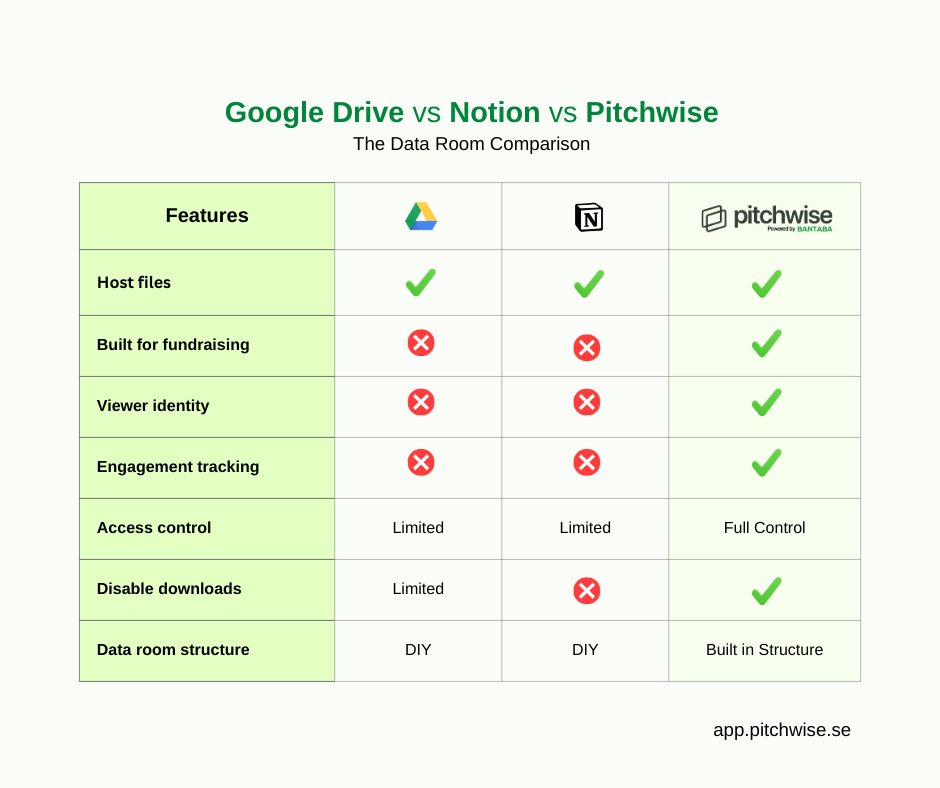
Comparison between Google Drive, Notion, and Pitchwise.
Why this matters more in today’s market
Fundraising today is slower, more selective, and more crowded than it was a few years ago. Investors screen more opportunities and spend less time on each one. Diligence starts earlier. Attention is fragmented.
In this environment, clarity becomes a competitive advantage. Not because investors consciously reward tooling, but because they respond to what feels easy, coherent, and credible.
A messy process can make a strong company feel risky. A clean process can make a strong company feel easier to trust. That perception gap matters more than most founders realise.
This isn’t about declaring Drive or Notion “bad”. They are excellent tools for their intended purposes. Many serious founders will use all three tools in parallel.
The mistake is assuming they serve the same job.
Google Drive is great for internal storage.
Notion is great for internal knowledge and documentation.
Pitchwise is designed specifically for external fundraising workflows.
Once you recognise that distinction, the decision becomes less about features and more about fit. The real question is not “Which tool is nicer?” It’s “Does my current setup make my fundraising process clearer or more fragile?” If the answer is unclear, that’s usually a sign that the infrastructure could be stronger. Get started with your data room set up today: app.pitchwise.se
Lorem ipsum dolor sit amet, consectetur adipiscing elit. Suspendisse varius enim in eros elementum tristique. Duis cursus, mi quis viverra ornare, eros dolor interdum nulla, ut commodo diam libero vitae erat. Aenean faucibus nibh et justo cursus id rutrum lorem imperdiet. Nunc ut sem vitae risus tristique posuere.
Lorem ipsum dolor sit amet, consectetur adipiscing elit. Suspendisse varius enim in eros elementum tristique. Duis cursus, mi quis viverra ornare, eros dolor interdum nulla, ut commodo diam libero vitae erat. Aenean faucibus nibh et justo cursus id rutrum lorem imperdiet. Nunc ut sem vitae risus tristique posuere.





.png)
.png)