By clicking “Accept All Cookies”, you agree to the storing of cookies on your device to enhance site navigation, analyze site usage, and assist in our marketing efforts. View our Privacy Policy for more information.
Fundraising today is increasingly global, fast-paced, and competitive. Founders aren’t just sending their pitch decks to local investors anymore; they’re pitching across continents, across time zones, and often across cultures. And because of that shift, the tools founders rely on have become just as important as the story they’re telling.
Two products that frequently appear in founder conversations are Papermark and Pitchwise. At a glance, they look similar: both allow founders to upload a deck, generate a secure link, and get insights into how investors engage with it. But beyond those surface similarities, the two tools are built with very different philosophies and use cases in mind.
Papermark: A Minimalist, Modern Way to Share a Deck
Papermark is best described as a clean, efficient tool for sending investor materials without friction. It was created as a lightweight alternative to traditional document-sharing services, offering a simpler and often more affordable way to distribute pitch decks and track engagement.
Founders who prefer Papermark usually appreciate its focus on essentials. The platform allows you to upload your deck, generate a secure link, and see which slides investors viewed and for how long. Its interface is uncluttered and intuitive, and the open-source foundation appeals to technical teams or companies with strict data control requirements.
For a founder who already has:
a polished deck,
a well-structured outreach pipeline, and
an understanding of how to manage investor conversations,
Papermark fits neatly into the workflow. It doesn’t get in the way, and it doesn’t overcomplicate things.
However, its strength — simplicity — is also its limitation. Papermark doesn’t go beyond viewing and tracking. It doesn’t capture investor intent, guide founders on next steps, or provide supporting materials to strengthen the pitch itself. It functions well as a document viewer, but it stops short of helping founders run a fundraising process.
Virtual Data Rooms
Papermark's data room costs $179. Pitchwise's costs $24.
Lorem ipsum dolor sit amet, consectetur adipiscing elit. Suspendisse varius enim in eros elementum tristique. Duis cursus, mi quis viverra ornare, eros dolor interdum nulla, ut commodo diam libero vitae erat. Aenean faucibus nibh et justo cursus id rutrum lorem imperdiet. Nunc ut sem vitae risus tristique posuere.
Pitchwise: A Platform Designed for the Full Fundraising Journey
Pitchwise approaches the problem from a different angle entirely. Instead of focusing narrowly on document sharing, Pitchwise positions itself as an end-to-end fundraising platform, giving founders not just a link but a structure and a set of tools that help turn investor interest into real conversations.
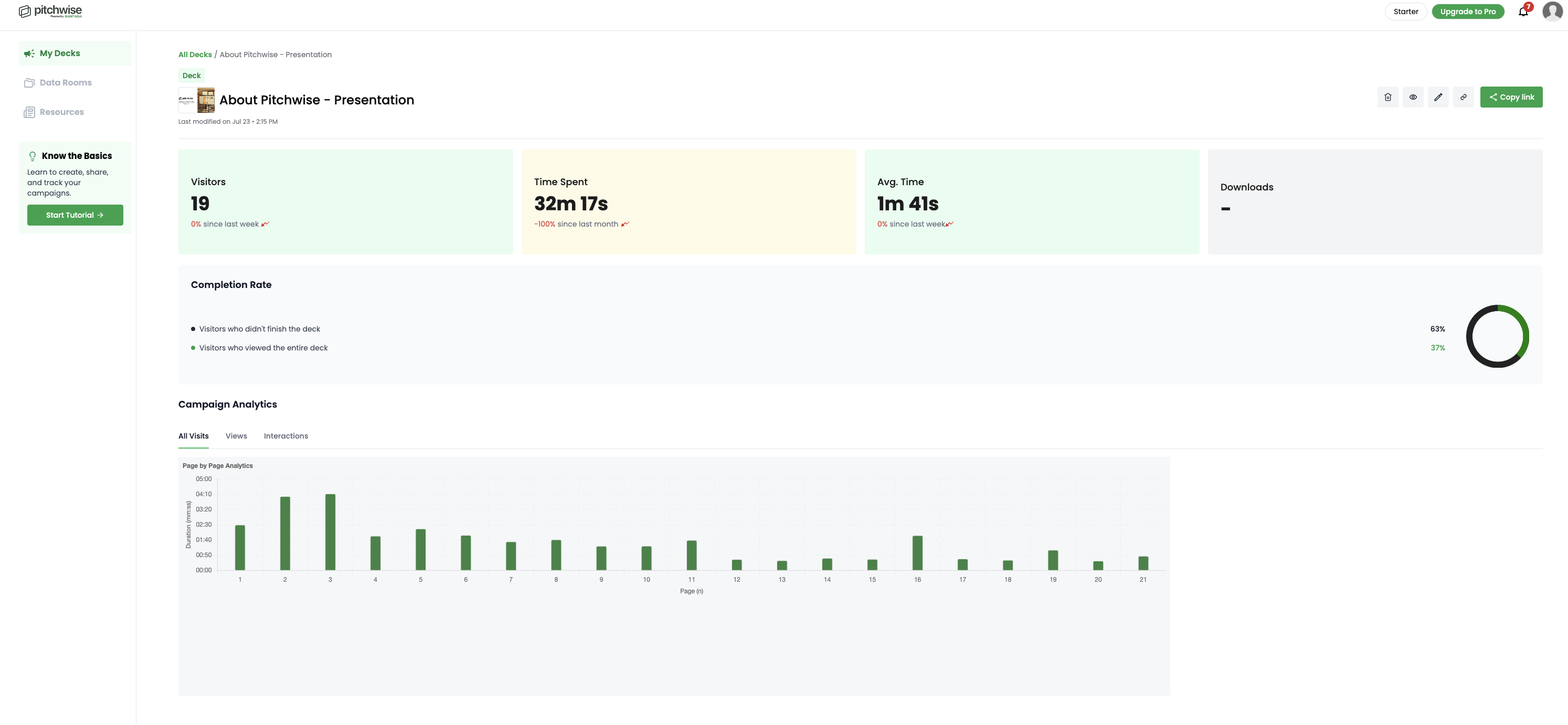
Structured Pitchwise Analytics for Decks
At its core, Pitchwise includes the same essentials Papermark offers: secure deck sharing, access control, and engagement analytics. But the similarities end there. Pitchwise extends into areas directly connected to investor conversion, storytelling, and fundraising readiness.
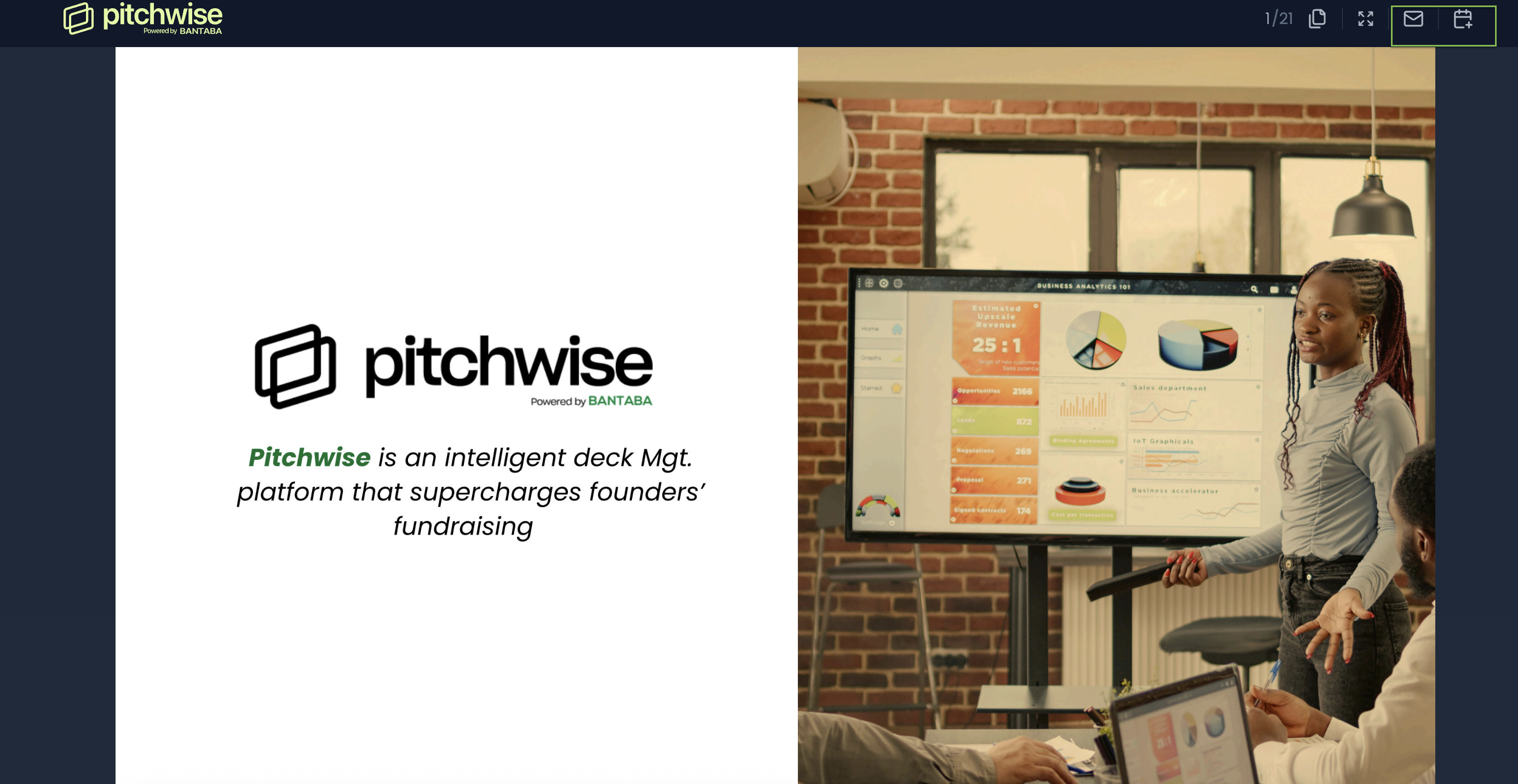
For example, Pitchwise allows founders to embed calls to action within the deck itself. Investors can schedule a call, ask a question, or signal interest the moment they’re engaged — without switching tabs or digging for a calendar link. This seemingly small detail solves a major drop-off point in investor outreach: most interest fades when friction appears.
Investors can send a message or schedule a call with the founder straight from the pitchdeck
Pitchwise also supports the creation of Teasers and one-pagers, which are short, powerful overviews that founders can send to accelerators, angel groups, scouts, or cold contacts. In global fundraising environments where attention spans are short and first impressions matter, teasers improve response rates and streamline early conversations.
And then there’s the resource ecosystem. Pitchwise includes more than 50 templates, guides, and tools covering pitch deck structure, investor research, fundraising strategy, legal basics, and more. For founders navigating their first round — or raising across continents where expectations differ — this library becomes a built-in support system rather than a scattered collection of external links.
What becomes clear when using Pitchwise is that the platform wasn’t built to send files.
It was built to move founders closer to meetings, clarity, and commitments.
Where the Platforms Diverge: The Differences That Matter
When comparing Pitchwise and Papermark, it’s not helpful to focus only on features. Both platforms share links. Both track views. Both offer a secure way to handle sensitive investor materials.
The real distinction is philosophical:
Papermark focuses on delivery.
Pitchwise focuses on progression.
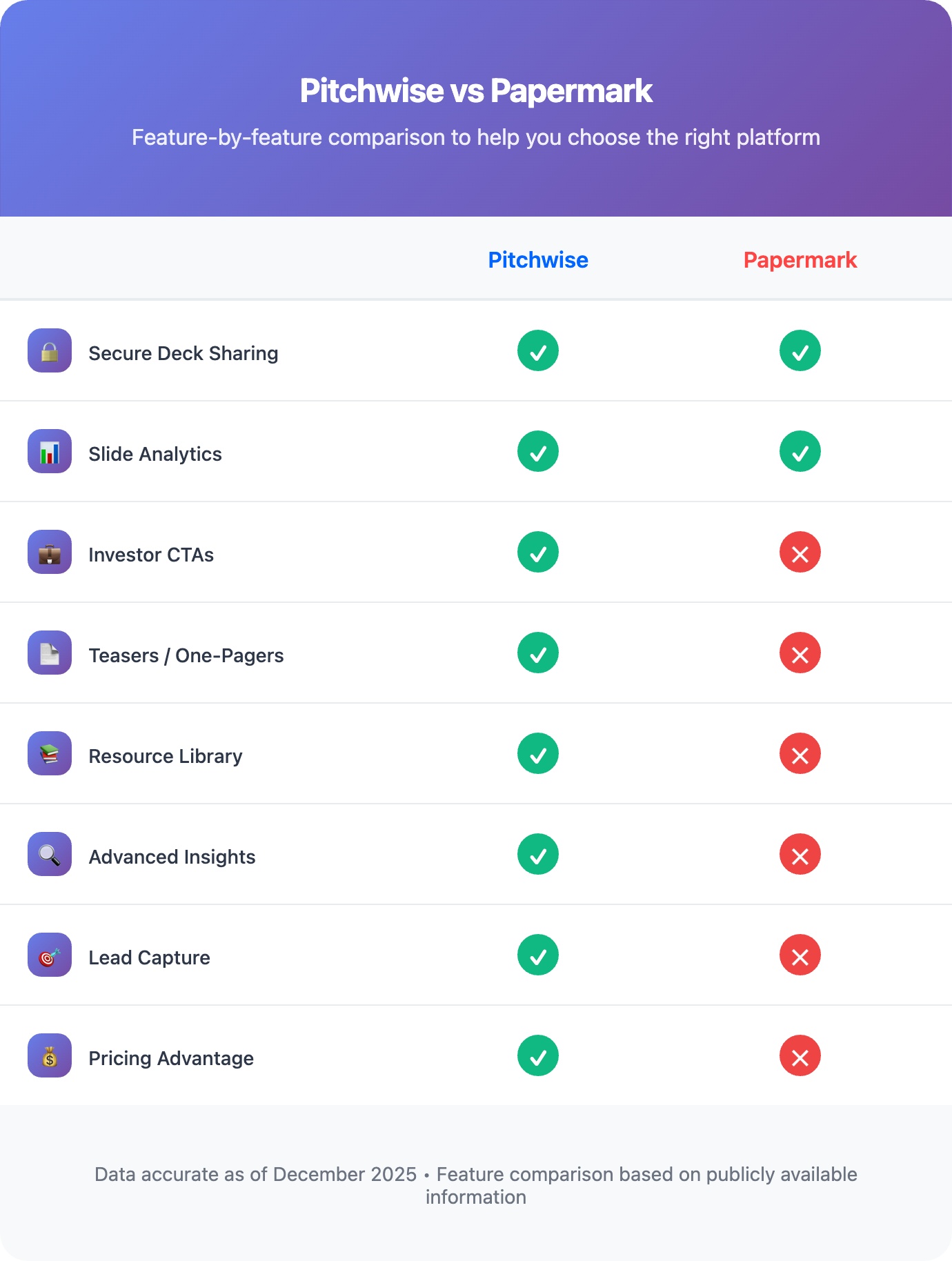
Pitchwise vs Papermark
Papermark answers:
“Did someone view my deck?”
Pitchwise answers:
“What does their engagement mean, and how do I convert it into a conversation?”
These differences show up in practical ways:
Pitchwise’s CTAs encourage immediate action inside the deck.
Teasers help founders open doors with high-volume outreach.
Engagement insights highlight where the story resonates and where it doesn’t.
Pitch templates and investor resources support founders who are still refining their pitch.
Pitchwise is priced significantly lower than comparable Papermark tiers ($24 vs $70 per month for Pro plans), making it more accessible for early-stage startups.
Both platforms serve founders, but Papermark is perfect for the founder who wants something clean and efficient, with minimal layers, while Pitchwise is better for the founder who wants structure, support, signals, and conversion tools because they aren’t just sharing a deck; they’re trying to close a round.
So, Which Should You Choose?
If your primary needs are simply to send your deck and know it was viewed, Papermark does that extremely well. It is modern, minimal, and reliable.
But if you’re actively fundraising — reaching out to investors in different countries, refining your pitch, trying to understand investor intent, or optimising for call bookings and engagement — then Pitchwise offers capabilities that materially improve your chances.
Fundraising is not just about distribution. It’s about narrative, timing, signal quality, and conversion. Pitchwise was built with those realities in mind.
Lorem ipsum dolor sit amet, consectetur adipiscing elit. Suspendisse varius enim in eros elementum tristique. Duis cursus, mi quis viverra ornare, eros dolor interdum nulla, ut commodo diam libero vitae erat. Aenean faucibus nibh et justo cursus id rutrum lorem imperdiet. Nunc ut sem vitae risus tristique posuere.
Lorem ipsum dolor sit amet, consectetur adipiscing elit. Suspendisse varius enim in eros elementum tristique. Duis cursus, mi quis viverra ornare, eros dolor interdum nulla, ut commodo diam libero vitae erat. Aenean faucibus nibh et justo cursus id rutrum lorem imperdiet. Nunc ut sem vitae risus tristique posuere.