By clicking “Accept All Cookies”, you agree to the storing of cookies on your device to enhance site navigation, analyze site usage, and assist in our marketing efforts. View our Privacy Policy for more information.
Pitchwise vs Peony 2026: Which Is Right for Your Team?
by
Pitchwise Team
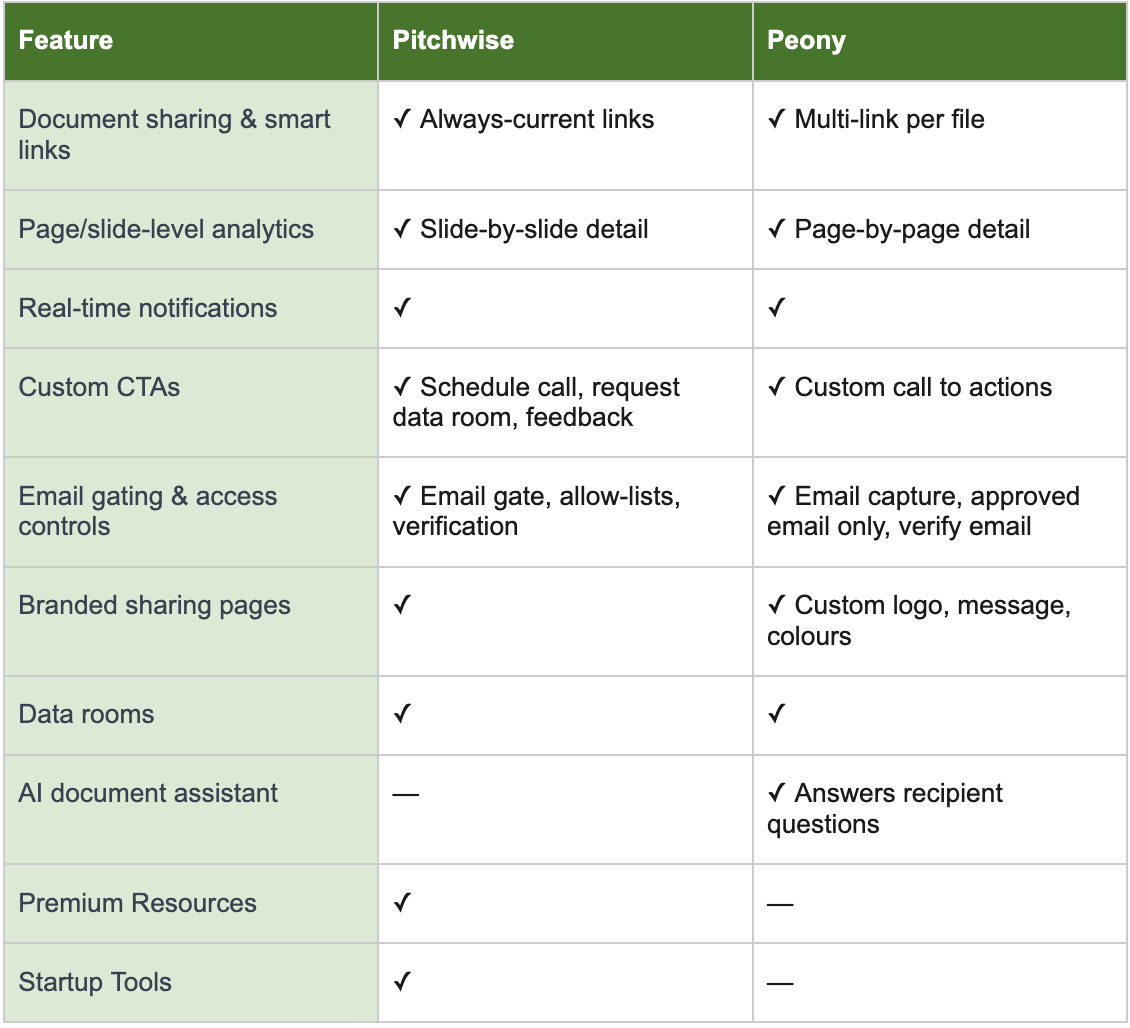
Quick verdict: Pitchwise and Peony overlap heavily on core features—both offer secure document sharing, data rooms, page-level analytics, and access controls. Where they diverge: Pitchwise leads onhigh-stakes specific workflows (deck sharing, investor CTAs, slide analytics) and pricing. Peony leads on AI features, and e-signature.
If you're comparing Pitchwise and Peony, data rooms are probably where you're starting. Both platforms let you create secure rooms, control who has access, and track how stakeholders engage with the documents inside. In that specific use case, they're genuinely competitive.
But data rooms are where the comparison starts, not where it ends. Once you look at what each platform does beyond the room itself and what you're paying for it, the picture looks quite different.
What Both Platforms Do Well
Before getting into differences, it's worth being direct about where these platforms genuinely overlap, because it matters for the decision.
Secure document and deck sharing via smart links
Page-level and slide-level engagement analytics — who read what, for how long, which pages
Data room creation with permissions and engagement tracking
Audit logs and access history
Custom CTAs on shared documents
Free plans to get started
If you're choosing purely on these core capabilities, either platform can serve you. The decision comes down to what else you need and what you're paying for it.
Lorem ipsum dolor sit amet, consectetur adipiscing elit. Suspendisse varius enim in eros elementum tristique. Duis cursus, mi quis viverra ornare, eros dolor interdum nulla, ut commodo diam libero vitae erat. Aenean faucibus nibh et justo cursus id rutrum lorem imperdiet. Nunc ut sem vitae risus tristique posuere.
These capabilities reflect the specific workflows where Pitchwise's feature set makes a measurable difference compared to what Peony offers in the same area.
High-stakes workflow design
Pitchwise is built specifically around the workflow of sharing a document and driving the recipient to take the next step. The CTA and next-step workflow, where a viewer can schedule a call, request a data room, or give feedback directly from within the document viewer, are woven into the sharing experience itself. You share the deck, the investor engages, and Pitchwise gives them a frictionless path to the next conversation without leaving the page.
This applies equally to sales proposals, partnership agreements, board updates, and investor due diligence materials – any scenario where the document share is part of an active process, not just a delivery. Peony also offers custom CTAs, but Pitchwise's CTA workflows are more purpose-built around moving the recipient relationship forward.
Slide-level analytics built for investor and sales conversations
Both platforms offer page-level analytics, but Pitchwise's are designed specifically around understanding engagement in the context of a pitch or proposal — which slides an investor lingered on, where they dropped off, whether they returned for a second look, and what that pattern tells you about their level of interest. This engagement analytics guide explains in detail how to read these signals to time follow-ups and refine your deck.
Pricing — significantly lower at every tier
Pitchwise is cheaper than Peony at every comparable plan level, and the gap is meaningful:
Pitchwise is cheaper than Peony at every comparable plan level
For a solo founder or individual contributor, Pitchwise costs roughly half what Peony charges at comparable tiers. That gap matters, especially for early-stage teams managing tight budgets.
Peony is a stronger product in several areas that matter, depending on your workflow.
AI features are genuinely built in
Peony's AI capabilities go significantly beyond analytics. The AI document assistant answers recipient questions automatically—if an investor or counterpart has a question about a specific clause in a contract or a line item in a financial model, Peony can respond without you needing to be available.
E-signatures remove a tool from your stack
Peony includes legally binding e-signatures with AI-assisted field detection, attorney-approved NDA and contract templates, and full audit trails. If your document workflow ends in a signed agreement — whether that's an NDA, a client contract, or a partnership term sheet — Peony handles it without requiring DocuSign or PandaDoc.
Which Team Should Choose Which Platform
The distinction between the two platforms comes down to which workflows are most central to how your team actually operates, not which one has the longer feature list.
Pitchwise is the stronger choice if:
You share high-stakes documents across multiple team types — investors, clients, partners, and the board — and want unified tracking and access control
Pricing matters. Pitchwise is significantly cheaper, especially for small teams
You want a 14-day full-feature trial before committing to any paid plan
Your primary need is knowing who read what, acting on that signal quickly, and making it easy for them to take the next step
You are a startup founder/operator, and you want access to premium startup tools, resources and investor lists.
Peony is the stronger choice if:
You need e-signatures built in and want to avoid maintaining a separate signing tool
AI-powered document management — auto-organisation, recipient Q&A, natural language search — is important to your workflow
Bottom Line
Both are serious platforms for high-stakes document sharing, both have analytics, both have data rooms, and both are used by founders and professional teams.
The honest differentiator is focus. Pitchwise is sharper on the external document workflow — the combination of deck sharing, CTAs, slide-level analytics, and data rooms is purpose-built for how high-stakes conversations actually work. And it costs less.
Peony has invested more heavily in AI, e-signatures, and file management infrastructure — making it a stronger choice if those capabilities are central to what you need rather than nice-to-haves.
If you're early-stage and primarily raising or selling, start with Pitchwise. Try Pitchwise for free at app.pitchwise.se — 14-day trial, no credit card required.
Lorem ipsum dolor sit amet, consectetur adipiscing elit. Suspendisse varius enim in eros elementum tristique. Duis cursus, mi quis viverra ornare, eros dolor interdum nulla, ut commodo diam libero vitae erat. Aenean faucibus nibh et justo cursus id rutrum lorem imperdiet. Nunc ut sem vitae risus tristique posuere.
Lorem ipsum dolor sit amet, consectetur adipiscing elit. Suspendisse varius enim in eros elementum tristique. Duis cursus, mi quis viverra ornare, eros dolor interdum nulla, ut commodo diam libero vitae erat. Aenean faucibus nibh et justo cursus id rutrum lorem imperdiet. Nunc ut sem vitae risus tristique posuere.