By clicking “Accept All Cookies”, you agree to the storing of cookies on your device to enhance site navigation, analyze site usage, and assist in our marketing efforts. View our Privacy Policy for more information.
Pitch Deck Analytics: How to Spot Investor Interest Before They Call
by
Oluwadamilare Akinpelu
You send your pitch deck to thirty investors. Five replies. Two ask for a follow-up meeting. The other twenty-three go silent. What happened in that silence? Without analytics, you will never know – and you will waste weeks chasing people who never opened the email while under-investing in the two or three who read every slide twice.
Engagement analytics change this completely. When you share your documents through a tracking-enabled platform, every interaction becomes a data point: who opened it, when, for how long, which slides they dwelt on, and whether they forwarded it to a colleague. That data does not replace founder instinct – but it sharpens it into something you can act on.
This guide explains exactly how to read pitch deck analytics to identify genuine institutional interest, how to structure your follow-up around what the data shows, and how platforms like Pitchwise help founders turn document intelligence into a disciplined fundraising pipeline.
Why Engagement Analytics Matter More Than Open Rates
Most founders who share pitch decks by email attachment have no visibility at all: they cannot confirm whether the deck was opened, let alone which parts landed. Even a simple read receipt only tells you the email was opened, not whether the attachment was touched.
Document-level analytics operate differently. When you share a deck through a tracking platform, you generate a unique, instrumented link. Every time an investor opens that link, the platform records it. The result is a layer of behavioural data that sits beneath the surface of a fundraising conversation, invisible to the investor but fully available to you.
Document-level analytics on the Pitchwise platform
According to DocSend's pitch deck engagement data, the average time investors spend reviewing a pitch deck is around two and a half minutes. That number is your baseline. Anything significantly above it deserves your immediate attention.
Lorem ipsum dolor sit amet, consectetur adipiscing elit. Suspendisse varius enim in eros elementum tristique. Duis cursus, mi quis viverra ornare, eros dolor interdum nulla, ut commodo diam libero vitae erat. Aenean faucibus nibh et justo cursus id rutrum lorem imperdiet. Nunc ut sem vitae risus tristique posuere.
The Five Analytics Signals That Indicate Real Interest
Not all engagement data carries equal weight. Here are the five signals that most reliably predict a serious investor, in roughly ascending order of conviction:
1. Time on Deck: Above the Baseline
Under two minutes typically indicates low interest, which means the investor scanned and moved on. Five minutes or more suggests a genuine evaluation. Ten minutes or more across a single session is a strong signal that the investor is reading carefully, possibly taking notes or pulling out specific data points for internal discussion.
The implication is practical: when you see an investor who has spent eight or ten minutes on your deck, they are engaging with your content in a way that warrants a personalised, timely follow-up, not a generic "just checking in" nudge.
2. Slide-by-Slide Engagement: What They Lingered On
Page-level analytics show you which slides absorbed the most time and which were skipped. This data is more useful than total time on deck because it tells you where the investor's specific interests and concerns are concentrated.
An investor who spent four minutes on your financials slide and one minute on your team slide is probably forming a view on your unit economics or burn rate. An investor who lingered on your market size slide and your traction metrics is likely validating whether the opportunity is large enough to justify their cheque size. This data tells you exactly what to elaborate on in your next conversation – before they even ask.
3. Return Visits: Multiple Sessions from the Same Viewer
A single visit can be a curious browsing. Two or three return visits from the same investor, spread across different days, are a different category of signal entirely. It almost always means one of two things: the investor is conducting internal diligence on your company, or they are sharing your deck with a partner or colleague and revisiting it with them.
Return visits are one of the clearest pre-meeting indicators you have. When you see this pattern, the priority is to ensure your deck is current and complete and to reach out with a concrete next-step proposal – ideally a specific meeting time – rather than an open-ended follow-up.
4. Internal Forwarding: When the Deck Gets Shared
Most document tracking platforms can detect when your deck has been forwarded to a new viewer. On Pitchwise, enabling the "require email to view" setting captures the identity of any new viewer the original recipient shared the link with.
Internal forwarding is arguably the highest-conviction signal available from document analytics. When an investor shares your deck with a colleague unprompted, they have already decided it is worth a second opinion. At the partner level of a VC firm, this is often how investment discussions begin: one partner sees something interesting and circulates it for initial reaction before calling a meeting. Seeing a new domain from the same fund or even another fund appear in your analytics is a signal to escalate your engagement with that firm immediately.
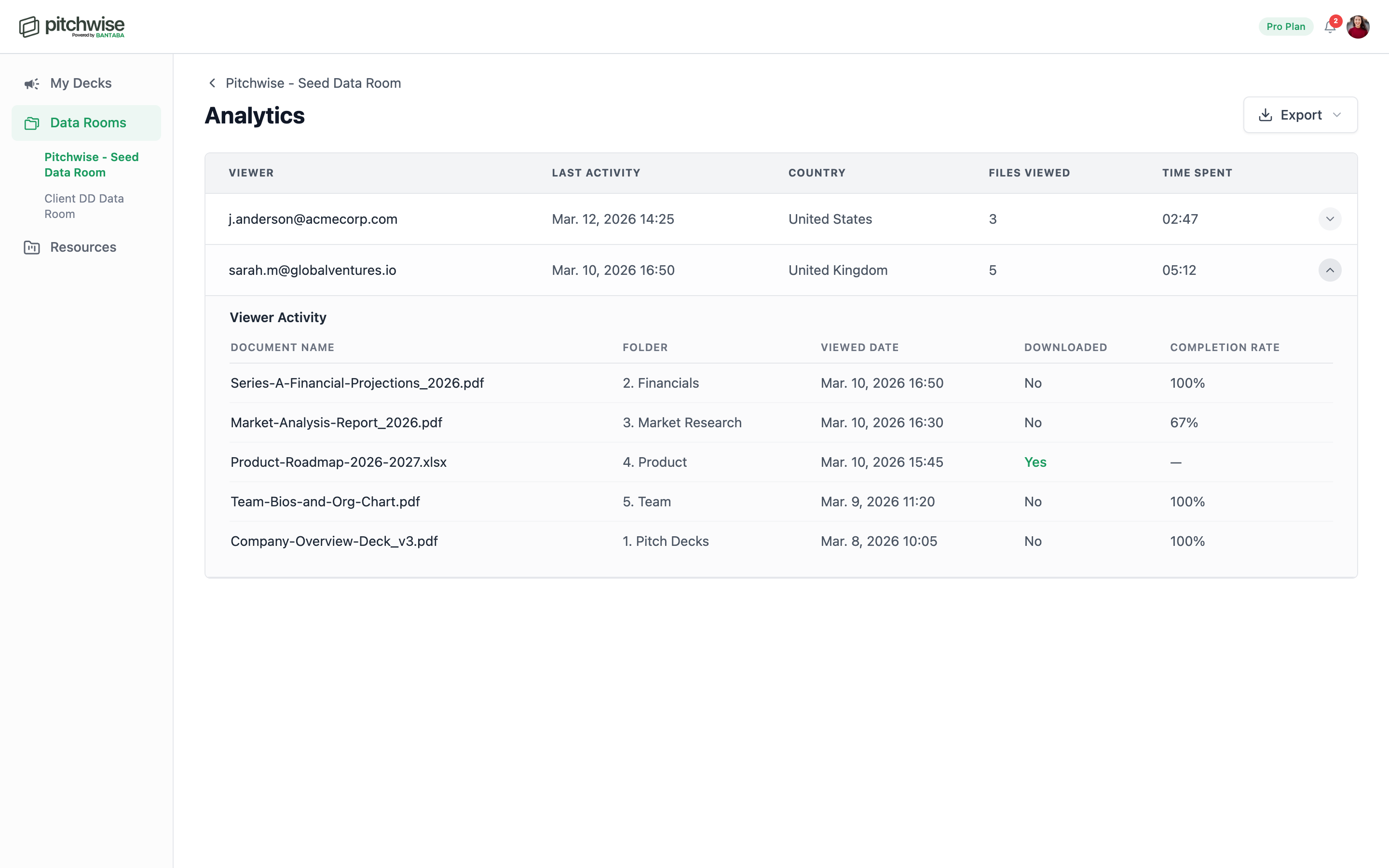
Data Room analytics for due diligence and bulk document sharing on Pitchwise
5. Data Room Access Requests
The transition from pitch deck to data room is one of the most significant threshold events in a fundraising process. According to research cited by data-rooms.org, of the 101 opportunities the average VC firm evaluates, only 4.8% proceed to due diligence, and it is at due diligence that data room access is typically granted.
When an investor requests data room access, they have cleared an internal bar. The deck worked. They are now committing time to the formal evaluation process. Data room analytics – which documents were accessed and how long the investor spent on your financial model versus your legal docs – give you a second layer of engagement data at the highest-conviction stage of the funnel.
Reading the Analytics: A Signal Interpretation Guide
Reading the Analytics: A Signal Interpretation Guide
How to Structure Your Follow-Up Around Analytics Data
The data tells you who to contact and roughly when. What it does not write for you is the follow-up message itself. The most common mistake founders make is referencing the analytics too directly: saying something like, 'I saw you spent twelve minutes on our financials slide' reads as surveillance, not attentiveness. The goal is to use the data to make your follow-up feel timely and relevant without revealing exactly what you tracked.
For high-engagement investors (5+ minutes, return visits)
Follow up within 24 to 48 hours. Keep the message short and forward-moving. Offer specific value in the email – an updated metric, a relevant customer win, or a concrete answer to a question you expect they may have formed based on the slides you know they dwelt on. Propose a specific meeting time rather than asking, "Would you like to chat?"
Example framing: "Following up on the deck I sent last week – we just closed our third enterprise pilot and updated the traction metrics. Happy to walk you through the numbers on a quick call. Does [specific date and time] work?"
For moderate-engagement investors (single visit, 3-5 minutes)
Wait three to five days, then send a brief update with one meaningful piece of new information. This is not a chase; it is a value-add touch that gives the investor a reason to re-engage. If the analytics show they spent time on a particular section, address it in your follow-up without being explicit about what you tracked.
For internal-forwarding signals (new domain from the same fund)
This warrants the most immediate response. Reach out to your original contact and casually note that you understand there may be additional interest at the firm, and offer to facilitate a group call or send supplementary materials. Timing matters: the internal conversation is happening right now, and you want to be helpful to that process, not absent from it.
How Pitchwise Uses Engagement Analytics to Close the Loop
Tracking who has responded to your mail across thirty or fifty investor conversations manually is unsustainable. You need somewhere to log this and tally which investors are accelerating through the funnel versus cooling off.
This is the gap Pitchwise is designed to close. Pitchwise provides document engagement intelligence so that when your deck analytics show a return visit from a Silicon Valley-based fund or a new viewer from a UK-based VC, founders gain visibility, which provides context during negotiations and prioritisation.
For founders running a round across multiple funds simultaneously, the compounding value is significant. Rather than managing twenty separate email threads, the Pitchwise dashboard shows at a glance where momentum is building, where it is stalling, and which investors have been silent long enough that it is time to requalify them or move on.
Setting Up Your Analytics Stack: What You Actually Need
You do not need an expensive enterprise platform to start tracking deck engagement. Here is the minimum viable setup:
Page-level analytics – total time on deck is useful; time per slide is essential. Ensure your platform provides slide-level data, not just aggregate session time.
Email-gating for forwarded views – enable the "require email to view" option so that forwarded versions capture the new viewer's identity.
Notification alerts – set up real-time alerts when your deck is opened so you can follow up while the investor is still actively engaged with your materials.
According to an analysis of fundraising data rooms, startups that use professional data room platforms with analytics close 30% faster than those relying on consumer file-sharing tools. The operational advantage of knowing who is serious – and being able to act on it in real time – compounds across a full fundraising round.
What Analytics Cannot Tell You
Engagement data is powerful, but it has limits worth naming explicitly. High engagement does not guarantee investment. An investor can spend fifteen minutes on your deck, ask several good questions in a follow-up meeting, and ultimately pass because of portfolio conflicts, fund timing, or a thesis mismatch that has nothing to do with your company quality.
Conversely, low engagement does not always mean disinterest. Some investors read decks on mobile, in transit, in fragmented sessions that analytics captures poorly. Others print decks and read offline. A single low-engagement data point is not a reliable signal on its own.
The right mental model is to treat analytics as a triage layer – it tells you where to focus your energy first, not who will invest. Combined with the behavioural and meeting signals covered in our investor engagement signals guide, analytics data becomes genuinely predictive. Used alone, it is useful but incomplete.
Frequently Asked Questions
How do you know if an investor opened your pitch deck?
If you share your deck as a PDF attachment, you have no visibility at all. Using a tracking-enabled platform like Pitchwise generates a unique link and every time an investor opens it, you see exactly when, for how long, and which slides they spent time on.
What is the best way to track pitch deck engagement?
The most reliable method is sharing your deck through a document analytics platform rather than email attachments. Look for platforms like Pitchwise that offer slide-level time tracking, repeat visit alerts, and forwarding detection. These three signals together give you the clearest picture of genuine investor interest.
How can I tell if an investor looked at my pitch deck?
Only if you share your deck through a tracking-enabled platform that generates an instrumented link. Email attachments provide no visibility at all. Tracking platforms show you exactly when the link was opened, by whom (if email-gating is enabled), and how long each page held the viewer's attention.
What analytics does a pitch deck tracking platform provide?
Core analytics typically include total session duration, time spent per slide, number of sessions (return visits), device and location data, forwarding detection, and real-time notification alerts on opening. More advanced platforms layer in data room analytics – tracking which diligence documents were accessed and for how long – providing a second tier of engagement intelligence at the due diligence stage.
How long should an investor spend on a pitch deck?
According to DocSend's weekly pitch deck metrics, the average investor review session runs around two to two and a half minutes. Sessions of five minutes or more suggest genuine evaluation. Ten minutes or more is uncommon enough to be a meaningful positive signal. Session time is most useful as a comparative metric across your investor pipeline rather than as an absolute threshold.
When should I follow up after sending a pitch deck?
Analytics gives you a more precise answer than "one week later". If the deck was never opened, follow up with a resend or alternative outreach after five to seven days. If it was opened with moderate engagement, follow up within three to four days with a value-add update. If analytics show high engagement or return visits, follow up within 24 to 48 hours while the investor's attention is still warm.
Can investors see that I am tracking their engagement?
Investors see that the deck is hosted on a sharing platform rather than sent as an email attachment – this is standard practice and does not create friction. They do not receive notifications that tracking is active and are not informed of the specific analytics you collect. Referencing tracking data explicitly in follow-ups is considered poor form and should be avoided; use the data to inform your outreach without citing it directly.
Conclusion: Make Your Follow-Up Smarter, Not More Frequent
The founders who close rounds most efficiently are not those who send the most follow-up emails. They are the ones who follow up at the right moment, with the right framing, to the right investors. Pitch deck analytics gives you the data layer to make that possible.
The five signals in this guide – session time, slide-level engagement, return visits, internal forwarding, and data room access – each carry different levels of conviction.
If you want to put this into practice within a structured fundraising structure built for African founders, Pitchwise provides engagement analytics so that every data signal maps to a concrete action, not just a number on a dashboard.
Lorem ipsum dolor sit amet, consectetur adipiscing elit. Suspendisse varius enim in eros elementum tristique. Duis cursus, mi quis viverra ornare, eros dolor interdum nulla, ut commodo diam libero vitae erat. Aenean faucibus nibh et justo cursus id rutrum lorem imperdiet. Nunc ut sem vitae risus tristique posuere.
Lorem ipsum dolor sit amet, consectetur adipiscing elit. Suspendisse varius enim in eros elementum tristique. Duis cursus, mi quis viverra ornare, eros dolor interdum nulla, ut commodo diam libero vitae erat. Aenean faucibus nibh et justo cursus id rutrum lorem imperdiet. Nunc ut sem vitae risus tristique posuere.



.png)


.png)
.png)