By clicking “Accept All Cookies”, you agree to the storing of cookies on your device to enhance site navigation, analyze site usage, and assist in our marketing efforts. View our Privacy Policy for more information.
Enterprise data room software has no list prices. You request a demo, get handed to a sales team, and receive a quote based on deal size, user count, and page volume. The invoice that arrives looks nothing like what you expected. For teams managing large M&A transactions, that trade-off is often worth it. For a team sharing documents with a handful of clients or investors, it is not.
This article covers what enterprise VDRs actually charge, why they cost that much, and which alternatives make sense depending on what you actually need a data room to do.
What enterprise VDRs actually cost
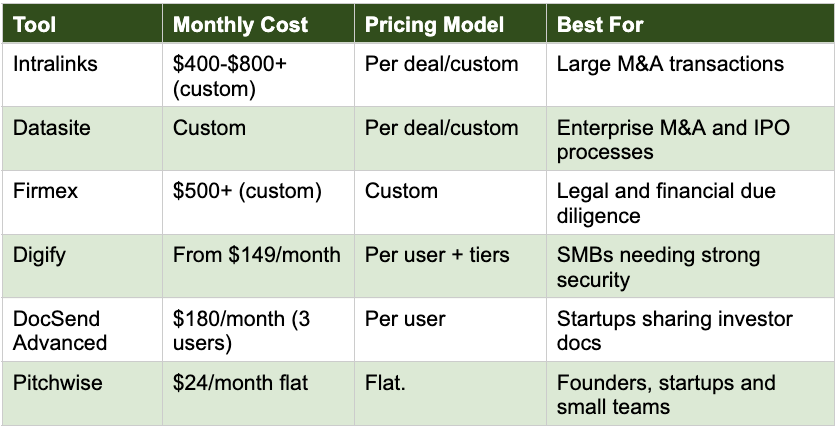
The market leaders in enterprise virtual data rooms, Intralinks, Datasite, and Firmex, publish no pricing. All three work on custom quotes. Based on publicly reported user data and analyst estimates, basic access to Intralinks typically runs between $400 and $800 per month for a straightforward transaction. Larger deals involving multiple parties, high document volumes, or extended timelines push that significantly higher.
Some enterprise tools still use per-page pricing, a model inherited from physical data rooms where firms charged per page copied. Uploading a large set of documents to a per-page platform can generate costs that are difficult to forecast before you start.
Lorem ipsum dolor sit amet, consectetur adipiscing elit. Suspendisse varius enim in eros elementum tristique. Duis cursus, mi quis viverra ornare, eros dolor interdum nulla, ut commodo diam libero vitae erat. Aenean faucibus nibh et justo cursus id rutrum lorem imperdiet. Nunc ut sem vitae risus tristique posuere.
Digify sits in the middle tier and is more transparent. Their Basic plan starts at $149 per month, Standard at $299, and Enterprise is custom. DocSend's Advanced Data Rooms plan costs $180 per month for three users. These are meaningfully cheaper than the enterprise leaders and cover most of what smaller teams need.
Why enterprise tools charge that much
The price on enterprise VDRs reflects the use case they were built for: large-scale M&A transactions, legal due diligence on complex deals, and regulated financial processes where document access history may be reviewed by auditors or in litigation.
Compliance and certification
Enterprise VDRs typically hold ISO 27001 certification, SOC 2 Type II compliance, and in some cases sector-specific certifications for financial services and healthcare. Acquiring and maintaining those certifications costs money and requires ongoing audits. The cost is passed to customers.
Audit trail depth
On enterprise tools, every document view, download attempt, print action, and access change is logged with a timestamp, user ID, and IP address. For a law firm managing a transaction where access history may be scrutinised after the fact; that level of detail matters. For a founder sharing a financial model with three investors, it is more record-keeping than the situation requires.
Dedicated support
Enterprise VDR contracts typically include a dedicated project manager who helps configure the room, train the team, and troubleshoot issues during a live transaction. That service model has a cost built into every subscription, whether you use it or not.
What most teams actually need
The requirements for most document sharing situations are considerably simpler than what enterprise tools are built for. You need to share a set of documents with a defined group of recipients, control who can see which files, track who opened what, and update documents without breaking existing access links.
None of that requires per-page billing or implementation support. The tools in the $24 to $180 per month range cover all of it and, in some cases, give you more granular engagement analytics than the enterprise options with similar certifications.
Pricing comparison
Pricing comparison
Which tool fits which situation
Large M&A or regulated transactions
If you are running a formal acquisition process, preparing for an IPO, or operating in a regulated industry where document access history may be legally reviewed, an enterprise VDR is the right choice. The audit trail depth and compliance certifications exist for a reason, and the cost is proportionate to the stakes involved.
Seed or Series A due diligence
Investors at this stage are not running enterprise-grade due diligence processes. They want organised, current documents that they can access without friction. DocSend Advanced Data Rooms at $180 per month or Pitchwise at $24 per month both cover this well. The main differentiator between the two is analytics depth: Pitchwise gives you slide-level engagement data; DocSend gives you page-level.
Client proposals or partner document sharing
For sharing proposals, contracts, case studies, or any set of materials with a client or business partner, the enterprise tier is more infrastructure than the situation warrants. Pitchwise at $24 a month gives you a data room with per-recipient access controls and engagement tracking at slide level. You know who opened which file, what they read, and whether they came back.
Early stage with a tight budget
Pitchwise at $24 a month with a data room still provides the best value for money even on a tight budget for teams. You also don’t get any trade-off in fewer analytics compared to other tools.
Frequently Asked Questions
Do I need an enterprise VDR for a Series A?
No. Series A investors are used to reviewing documents in purpose-built startup tools. What matters is that documents are organised, current, and access-controlled. A well-structured Pitchwise or DocSend data room covers all of that. An enterprise VDR does not signal anything about the quality of the business.
Why do some data rooms still use per-page pricing?
Per-page pricing came from physical data rooms where firms charged per page photocopied during in-person due diligence. The model survived the transition to digital because enterprise vendors found it profitable, not because it reflects actual infrastructure costs. Most tools outside the enterprise tier have moved to flat monthly billing, which makes costs predictable.
Can I use Google Drive as a data room?
Google Drive handles basic document sharing but does not give you tracking, per-link access controls, or document engagement data. You can see who has been granted access to a folder, not who actually opened a specific file or which pages they read. For early conversations, a shared folder is fine. Once you are sharing sensitive documents with multiple recipients and need to understand who is engaging with what, a dedicated tool is worth the cost.
What is the difference between a data room and a document tracking tool?
A data room organises multiple documents under a single access-controlled link. A document tracking tool tells you how recipients engage with individual files. The most useful tools for smaller teams combine both. Pitchwise and DocSend both let you organise multiple files in a shared room and track how each recipient engages with each document.
Set up a data room that tells you who is actually reading your documents
Pitchwise gives you a data room with slide-level engagement analytics at $24 a month. No per-page pricing, no implementation fees, no per-user charges. You know which recipients opened which documents and how long they spent on each one. Setup takes under ten minutes. Get started: app.pitchwise.se
Lorem ipsum dolor sit amet, consectetur adipiscing elit. Suspendisse varius enim in eros elementum tristique. Duis cursus, mi quis viverra ornare, eros dolor interdum nulla, ut commodo diam libero vitae erat. Aenean faucibus nibh et justo cursus id rutrum lorem imperdiet. Nunc ut sem vitae risus tristique posuere.
Lorem ipsum dolor sit amet, consectetur adipiscing elit. Suspendisse varius enim in eros elementum tristique. Duis cursus, mi quis viverra ornare, eros dolor interdum nulla, ut commodo diam libero vitae erat. Aenean faucibus nibh et justo cursus id rutrum lorem imperdiet. Nunc ut sem vitae risus tristique posuere.