By clicking “Accept All Cookies”, you agree to the storing of cookies on your device to enhance site navigation, analyze site usage, and assist in our marketing efforts. View our Privacy Policy for more information.
Best Startup Accelerators for Deeptech & AI Founders (2026)
by
Oluwadamilare Akinpelu
Deeptech and AI founders tend to get lumped together in accelerator lists, but they have different needs from a programme. An AI startup building a software product can go from idea to first paying customer in weeks. A hard tech startup developing new materials, lab-grown proteins, or industrial robotics hardware cannot. The accelerators that work well for one are often wrong for the other.
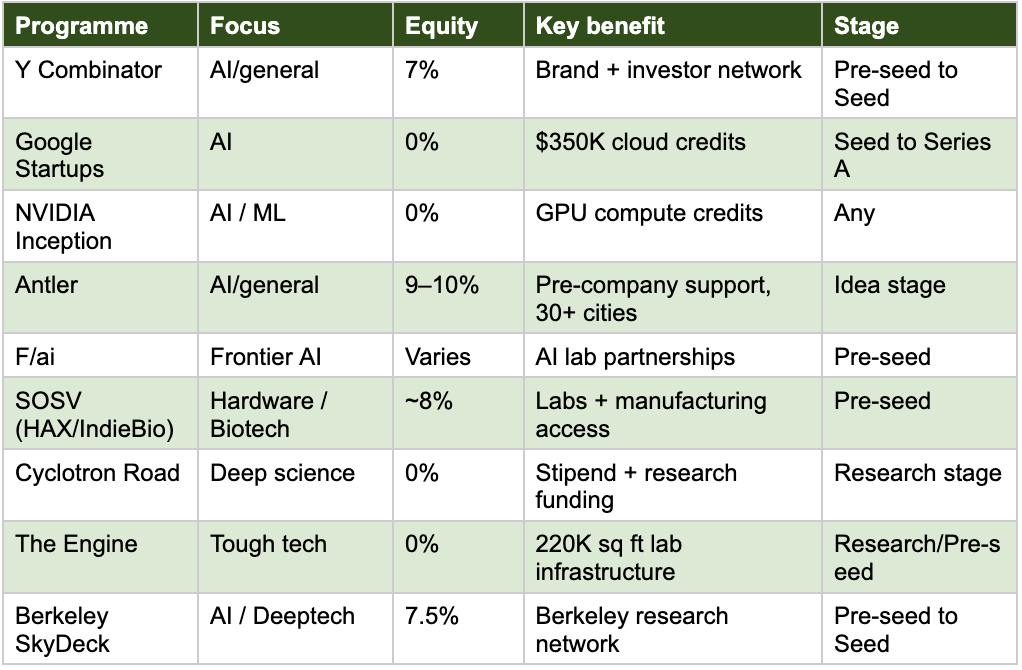
This guide separates them. Programs designed for AI software founders come first. Programs built for the longer timelines of hard tech, biotech, climate, and deep science follow. At the end, a comparison table covers equity terms and key benefits across all nine programmes.
Best accelerators for AI founders
Y Combinator
Y Combinator remains the highest-signal option for AI software founders. Around 60% of the 2026 batches are AI companies, so the cohort itself is a useful peer group. The programme invests $500K per company: $125K post-money SAFE at 7% equity, plus a $375K uncapped SAFE with MFN rights. The three-month programme runs from YC's San Francisco campus.
The brand effect is real. YC on your cap table opens doors with Series A and B investors that are otherwise harder to open. The trade-off is a competitive acceptance rate of roughly 1.5–2% across more than 30,000 applications per batch.
Notable alumni include OpenAI (W15), Stripe, and Scale AI. The 2026 batches are running close to 60% AI companies.
Best for: AI software founders who want the highest-credibility programme stamp and access to one of the strongest investor networks in tech.
Investment: $500K for 7% equity.
Google for Startups AI Accelerator
The Google for Startups AI Accelerator takes zero equity and runs for 10 weeks. Accepted startups get up to $350K in Google Cloud credits, direct access to Google AI engineers and researchers, and introductions to Google's investor and partner network. The programme runs regional tracks across North America, the UK, India, MENA, and Brazil, so geography is less of a constraint than with most cohort programmes.
Google for Startups alumni have collectively raised $31.2 billion across 87 countries since 2016, according to Google's own data. Recent AI cohort examples include BrainLogic AI, which doubled its user base to 2 million during the programme, and CAMB.AI, which builds multilingual AI dubbing infrastructure.
Best for: AI founders building on cloud infrastructure who want non-dilutive support and technical access to Google's AI models and research teams.
Investment: $0 cash. Up to $350K in Google Cloud credits. 0% equity.
Lorem ipsum dolor sit amet, consectetur adipiscing elit. Suspendisse varius enim in eros elementum tristique. Duis cursus, mi quis viverra ornare, eros dolor interdum nulla, ut commodo diam libero vitae erat. Aenean faucibus nibh et justo cursus id rutrum lorem imperdiet. Nunc ut sem vitae risus tristique posuere.
NVIDIA Inception is a non-dilutive membership programme for AI and data science startups. There is no cohort and no fixed timeline. Founders apply on a rolling basis and can run it alongside any other programme. Members get GPU credits, co-marketing opportunities, and introductions to NVIDIA's investor network. For compute-heavy AI workloads, it is one of the most practical non-dilutive options available.
Best for: AI founders with GPU-intensive products who want access to compute without giving up equity.
Investment: Non-dilutive. GPU credits and compute support (amount varies by stage). 0% equity.
Antler
Antler invests earlier than most programmes, sometimes before a company formally exists. Founders enter individually or in pairs and spend the initial weeks validating ideas and building teams, and those selected receive investment at 9–10% equity. Antler operates in over 30 cities globally, which makes it one of the more accessible options for founders outside major tech hubs.
Antler has two unicorns in its portfolio to date: Airalo, an eSIM startup for travellers that raised $220M at over $1B valuation, and Lovable, a Swedish AI coding tool that reached unicorn status within eight months of launch.
Best for: Technical AI founders who are pre-company or pre-cofounder and want a structured environment to build from scratch.
Investment: Approximately $500K at 9–10% equity (varies by region and cohort).
F/ai (Plug and Play)
F/ai, launched in early 2026 as a new Plug and Play programme, brings together OpenAI, Anthropic, Google, Meta, Microsoft, and Mistral as partners. The first cohort of 20 startups collectively raised €34M and presented at a Deal Day in April 2026. It is one of the few programmes where accepted founders get direct working relationships with teams at the major AI labs.
Best for: AI founders building products that sit closely alongside frontier model infrastructure and who want relationships inside the major AI labs.
Investment: Terms vary. Check the current cohort details directly with Plug and Play.
Best accelerators for deeptech and hard tech founders
SOSV — HAX and IndieBio
SOSV runs two of the most respected deeptech programmes globally. HAX focuses on hardware, robotics, industrial automation, climate tech, and advanced materials. IndieBio focuses on biotech, health, and life sciences. Both provide hands-on support that goes well beyond typical accelerator programming: lab space, manufacturing access, and mentors with scientific and engineering backgrounds.
SOSV portfolio companies raised $7.5 billion in follow-on funding between 2021 and 2025, according to publicly available programme data. HAX provides up to $550K at approximately 8% equity. IndieBio provides up to $525K at a similar equity structure.
HAX alumni include Opentrons, which builds open-source lab automation robots and has raised over $200M in follow-on funding. IndieBio alumni include NotCo, a Chilean startup using AI to develop plant-based foods that raised $350M+ and reached a $1.5B valuation.
Best for: Hardware, biotech, climate tech, and industrial founders who need physical infrastructure alongside capital.
Investment: HAX: up to $550K at ~8% equity. IndieBio: up to $525K at ~8% equity.
Cyclotron Road (Activate Fellowship)
Cyclotron Road, hosted at Lawrence Berkeley National Laboratory, is a two-year fellowship for scientists and engineers commercialising deep science. Fellows receive an $80K–$115K annual living stipend, health insurance, and $100K–$150K in research funding at Berkeley Lab. The programme takes no equity, and fellows retain full IP ownership.
It is designed for founders whose work begins in a research environment: new energy systems, advanced materials, biotechnology, or climate solutions. These founders typically need years rather than months to reach commercial viability. Cyclotron Road companies have generated over $3 billion in follow-on funding across 92 startups to date.
Notable alumni include Twelve, which converts CO₂ into chemicals and fuels and has supply partnerships with Mercedes-Benz and Procter & Gamble; and Antora Energy, which is building thermal battery storage for industrial decarbonisation.
Best for: Scientist-founders commercialising research breakthroughs who need a multi-year runway without equity dilution.
Investment: $80K–$115K annual stipend + $100K–$150K in research support. 0% equity.
The Engine (MIT)
The Engine, created by MIT in 2016, supports Tough Tech startups working on breakthroughs in materials science, climate technology, biology, and advanced engineering. The path from lab to product takes years in each of these fields. Resident companies get access to 220,000 square feet of lab and engineering space, plus a curated investor network that understands long development timelines. The Engine converted to a non-profit in 2025 and does not take equity.
The most prominent alumni company is Commonwealth Fusion Systems, which is developing compact fusion reactors and has raised over $1.8B in funding, including from Google, Breakthrough Energy Ventures, and Eni. Biobot Analytics, another Engine company, built the wastewater monitoring infrastructure used across the US during the COVID-19 pandemic.
Best for: Science-based founders affiliated with MIT or in the Boston area, building in climate, materials, biotech, or advanced engineering.
Investment: No equity. Lab and engineering infrastructure access.
Berkeley SkyDeck
Berkeley SkyDeck invests $200K for 7.5% equity and runs two cohorts per year from UC Berkeley's campus. The programme covers a broad range of technology sectors but has strong representation in AI, hardware, biotech, and climate tech, given Berkeley's research depth. Demo Days attract over 600 investors.
SkyDeck alumni include Xendit, an Indonesian payments infrastructure company that became a unicorn, and SuperAnnotate, an AI training data platform. Portfolio companies have collectively raised over $2.7B.
Best for: Founders connected to UC Berkeley or building in sectors where Berkeley's research strengths translate into a genuine advantage.
Investment: $200K for 7.5% equity.
How they compare
How they compare
How to choose
The clearest dividing line is the timeline. If your product can reach paying customers within 12 months, programmes like YC and Antler are well-suited to your pace. If your startup is built on a scientific breakthrough that needs years of development before commercial viability, fellowship and infrastructure programmes like Cyclotron Road or The Engine are better designed for that reality.
For AI founders, the non-dilutive programmes are worth stacking. Running NVIDIA Inception and Google for Startups simultaneously while applying to YC or Antler is a common pattern. You pick up compute credits and technical support without giving up equity, and it does not interfere with a primary cohort relationship.
For deeptech founders outside the US, SOSV has a strong track record internationally and operates physical labs. Antler runs programmes across Europe, Asia, and the Middle East if a US-based programme is not practical.
What is the difference between an AI accelerator and a deeptech accelerator?
AI accelerators are generally built for software-first startups where the main input is compute and development speed. Deeptech accelerators are designed for startups where the core work happens in a lab: hardware, biotech, advanced materials, or energy systems. The timelines differ significantly. AI products can launch in months, while deeptech products often take years to reach the market. The right programme depends on which category your startup falls into.
Can I apply to multiple accelerator programmes at the same time?
Yes, and for non-dilutive programmes like NVIDIA Inception and Google for Startups, applying to several simultaneously is standard practice. These programmes are designed to run alongside other commitments. Equity-taking programmes like YC or Antler are more exclusive about participation during the cohort, but there is no restriction on applying to both before you receive offers.
Which accelerator is best for a pre-revenue deeptech startup?
For pre-revenue deeptech startups, SOSV and Cyclotron Road are the strongest options. SOSV's HAX and IndieBio programmes specifically target founders before revenue and provide the lab infrastructure to move toward it. Cyclotron Road is better suited to founders who are still at the research stage and need time and resources before a company can formally exist. The Engine is worth considering for founders in or near the Boston area.
Do I need to be based in the US to apply?
Most major programmes accept international applicants. YC requires founders to be based in San Francisco for the duration of the three-month cohort. Google for Startups runs regional tracks that do not require US residency. Antler operates programmes in over 30 cities globally. SOSV runs HAX with a strong presence in Asia and Europe. Cyclotron Road requires fellows to work at the Berkeley Lab facility in California for the two-year programme.
Share your pitch deck with tracking when you apply
When you apply to accelerators, you will send your pitch deck to multiple partners and programme managers. Pitchwise lets you share it as a tracked link so you know exactly who opened it, how long they spent, and which slides they came back to. That information makes your follow-up more specific. Instead of a generic check-in, you know whether a partner spent ten minutes on your deck or opened it for thirty seconds. Track every share for $13 a month.
Lorem ipsum dolor sit amet, consectetur adipiscing elit. Suspendisse varius enim in eros elementum tristique. Duis cursus, mi quis viverra ornare, eros dolor interdum nulla, ut commodo diam libero vitae erat. Aenean faucibus nibh et justo cursus id rutrum lorem imperdiet. Nunc ut sem vitae risus tristique posuere.
Lorem ipsum dolor sit amet, consectetur adipiscing elit. Suspendisse varius enim in eros elementum tristique. Duis cursus, mi quis viverra ornare, eros dolor interdum nulla, ut commodo diam libero vitae erat. Aenean faucibus nibh et justo cursus id rutrum lorem imperdiet. Nunc ut sem vitae risus tristique posuere.