By clicking “Accept All Cookies”, you agree to the storing of cookies on your device to enhance site navigation, analyze site usage, and assist in our marketing efforts. View our Privacy Policy for more information.
How to Share Important Documents During a Partnership Evaluation
by
Oluwadamilare Akinpelu
Evaluating a new business partnership almost always requires sharing information you would not normally make public. Financial data, product roadmaps, customer lists, and integration specs. The challenge is that partnerships fail for reasons that have nothing to do with fit. A deal that falls apart halfway through due diligence means your sensitive materials are now sitting in someone else's inbox, with no clear controls over what happens next.
This guide covers how to share the right documents at the right stage, with the controls that hold up when a deal goes sideways.
Why document sharing in partnerships carries real risk
Most partnership evaluations involve more sensitive information than either party initially expects. What starts as a high-level conversation about integration or co-selling quickly becomes a request for financials, technical architecture, and named customer references.
The risk is not just that the deal falls through. Verizon's 2025 Data Breach Investigations Report found that third-party involvement in data breaches doubled year-on-year, now accounting for 30% of all confirmed breaches. Supply chain and partner relationships are the most common vectors. Sharing a sensitive document over email with a counterpart who has weaker security practices than you do is a concrete, measurable exposure.
Separately, the Barracuda Email Security Breach Report 2025 found that email was compromised in 61% of data breaches. Attaching a confidential deck to an email and sending it off is not a neutral act. Once it lands in someone's inbox, you have no visibility into who forwards it or how long it stays accessible.
None of this means you should refuse to share anything until a deal is signed. Partnership evaluations require genuine information exchange. The goal is to share deliberately, with controls that match the sensitivity of what you're disclosing.
Lorem ipsum dolor sit amet, consectetur adipiscing elit. Suspendisse varius enim in eros elementum tristique. Duis cursus, mi quis viverra ornare, eros dolor interdum nulla, ut commodo diam libero vitae erat. Aenean faucibus nibh et justo cursus id rutrum lorem imperdiet. Nunc ut sem vitae risus tristique posuere.
Get the NDA signed before sharing anything sensitive
The NDA is not a formality. It is the legal instrument that defines what the counterpart can and cannot do with the information you share and what recourse you have if they misuse it. No sensitive document should leave your hands without one in place.
A standard mutual NDA for a partnership evaluation should cover the definition of confidential information (broader than you think you need), how long the confidentiality obligation lasts after the deal concludes, what happens to documents if discussions end, and which employees or contractors of the receiving party are permitted to access the materials.
One practical note: the NDA signing moment is a useful signal. A counterpart who pushes back on the terms or suggests skipping it entirely is telling you something about how they will handle the rest of the process.
Use a tiered disclosure approach
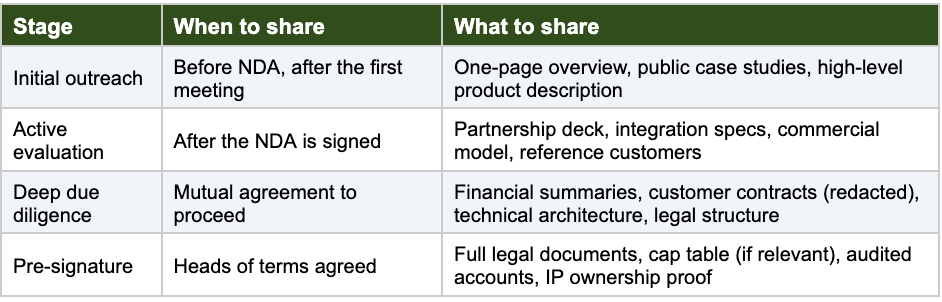
Not every document needs to go across on day one. A tiered approach protects you at each stage while still giving the counterpart what they need to evaluate the opportunity seriously. The table below maps the typical stages of a partnership evaluation to the documents appropriate for each.
Use a tiered disclosure approach
The logic behind tiering is simple: share what is needed to reach the next decision point, not everything needed to close the deal. If the evaluation stalls at the active evaluation stage, you have not exposed your full financial picture or customer contracts to a counterpart who may walk away and compete with you tomorrow.
How to share documents in practice
The specific methods below each solve a different part of the problem, from preventing unauthorised forwarding to maintaining an audit trail if a deal later becomes a dispute.
Send a link, not a file
Sending a PDF attached to an email means losing control of the document the moment you press send. The recipient can forward it, download it, screenshot it, or share it with colleagues outside the scope of your NDA, and you have no record of any of it.
Sharing via a tracked link changes this. You can see when the document was opened, how long the recipient spent on it, which sections they focused on, and whether it was forwarded. That visibility matters in two ways: it protects you by creating an audit trail, and it gives you context for your next conversation. Knowing that a counterpart has read your financial summary three times but spent no time on the integration spec tells you something useful before you get on the next call.
Tools like Pitchwise give you page-level analytics and real-time open notifications on every document you share, so you know exactly where the counterpart is in the review process without having to ask.
Set access controls that match the sensitivity
For any document shared during active evaluation or deeper stages, access controls should be set before the link goes out. At minimum, this means password protection or email-gated access so the link cannot be forwarded to anyone outside the evaluation. For the most sensitive materials, consider time-limited access that expires after a defined review window.
If you are sharing a data room rather than individual documents, role-based permissions let you give different counterparts access to different sections. A technical evaluator does not need to see financials. A procurement lead does not need to see architecture diagrams. Scoping access to what each person actually needs is both a security practice and a process discipline.
Keep a log of what you have shared and when
It sounds obvious, but most partnership evaluations end without a clear record of which documents went to which person at which stage. If a deal falls through and a question arises about what the counterpart saw, that log is the difference between a clear answer and a guessing game.
A simple shared document or project management note that records the document name, the date it was shared, the recipient, and the access level in place at the time is enough. The point is to have it, not to make it complicated.
What to do when a partnership evaluation ends without a deal
Most partnership evaluations do not result in a signed agreement. That is normal. What matters is having a clear process for what happens to the documents you shared when discussions end.
Your NDA should specify a return or destruction obligation, requiring the counterpart to confirm in writing that all materials have been deleted or returned within a defined period after discussions conclude. In practice, compliance varies, but having the obligation in the agreement is important because it establishes the legal expectation.
On your end, revoke access to any shared links or data rooms as soon as it is clear the evaluation is ending. This is a one-click action if you used a trackable link or a data room tool, and a significantly harder problem to solve if you sent email attachments.
If any sensitive information was shared that you consider particularly high risk, it is worth sending a brief written note to the counterpart confirming the end of discussions and reminding them of their confidentiality obligations. This creates a documented record and, in most cases, is enough to make the point without escalating.
Documents you should not share during a partnership evaluation
There are categories of information that rarely need to move during an evaluation and carry disproportionate risk if they do.
Full unredacted customer lists. A summary of the customer profile and segment is almost always sufficient. Named customers with contact details are not required until a deal is close to being signed.
Source code or proprietary algorithms. Architecture overviews and technical summaries serve the same purpose during evaluation without exposing your core IP.
Personal data about employees or users. In most jurisdictions, sharing this without a data processing agreement in place creates a compliance problem separate from the partnership itself.
Cap table and investor details. Unless the partnership involves equity or acquisition, this information is not relevant to the evaluation and creates unnecessary exposure.
Frequently Asked Questions
Do I need an NDA before sharing a company overview or one-pager?
Not necessarily. A company overview that describes what you do at a high level, without revealing financials, customer names, or technical specifics, can typically be shared before an NDA is in place. As soon as you move to materials that contain information you would not want a competitor to have, the NDA should be signed first.
What is the difference between a data room and a shared folder?
A data room is a purpose-built environment for sharing documents in a controlled, audited way during due diligence or evaluations. It gives you role-based permissions, access logs, expiry controls, and NDA gating. A shared folder in Google Drive or Dropbox can replicate some of these features but lacks the audit trail and access management depth that matters when the stakes are high. For early-stage sharing, a shared folder may be sufficient. For anything involving financials, customer contracts, or IP, a data room or a dedicated document-sharing tool is worth using.
Can I share documents with multiple people at the counterpart company?
Yes, but each person should be named in the NDA or in a schedule of authorised recipients attached to it. Blanket sharing with an entire company without knowing who has access is the most common way that confidential information ends up in the wrong hands. Use role-based access controls to scope what each person sees, and review the access list if personnel change on their side during the evaluation.
How long should I keep records of what I shared in a partnership evaluation?
A minimum of three years is a reasonable baseline for most business partnerships, matching standard contract limitation periods in most jurisdictions. If the evaluation involved materials relevant to a pending legal matter or regulatory enquiry, retain records for as long as that matter remains open. Your legal counsel can give jurisdiction-specific guidance.
What should I do if I discover a document was forwarded outside the scope of the NDA?
Document the discovery first, including when you found out and what evidence you have. Then contact the counterpart directly and in writing, referencing the specific NDA clause that covers unauthorised disclosure. In most cases, this is enough to resolve the situation. If the disclosure was material, involve legal counsel before taking further steps.
When you share documents during a partnership evaluation, use a trackable link so you know who opens them, when, and which sections they focus on. Pitchwise gives you page-level analytics and real-time open notifications. Start free at app.pitchwise.se.
Lorem ipsum dolor sit amet, consectetur adipiscing elit. Suspendisse varius enim in eros elementum tristique. Duis cursus, mi quis viverra ornare, eros dolor interdum nulla, ut commodo diam libero vitae erat. Aenean faucibus nibh et justo cursus id rutrum lorem imperdiet. Nunc ut sem vitae risus tristique posuere.
Lorem ipsum dolor sit amet, consectetur adipiscing elit. Suspendisse varius enim in eros elementum tristique. Duis cursus, mi quis viverra ornare, eros dolor interdum nulla, ut commodo diam libero vitae erat. Aenean faucibus nibh et justo cursus id rutrum lorem imperdiet. Nunc ut sem vitae risus tristique posuere.





.png)
.png)