
Sending a pitch deck as an email attachment tells you almost nothing. You know you sent it. You do not know whether the investor opened it, whether they got through the financial slides or whether they forwarded it to a partner who spent twenty minutes on the market slides. That information exists. You just need the right tool to capture it.
Pitch deck tracking software replaces the email attachment with a tracked link. When an investor opens the link, you get a notification. You can see which slides they viewed, how long they spent on each, and whether the link was opened a second time from a different location (which usually means they forwarded it). That data changes how you prepare for the follow-up call.
This guide covers the six tools founders are using for pitch deck tracking in 2026, what each one actually measures, and how to decide which fits your situation.
What to look for in pitch deck tracking software
The baseline feature is open notification: you know when someone opens your link. Every tool on this list does that. The meaningful differences are at the next level down.
Slide-level analytics show how long a viewer spent on each slide, which ones they returned to, and which they skipped entirely. That detail matters more than a total time-on-document figure. A viewer who spent four minutes on your market size slide and skipped the team slide is a different conversation than one who did the opposite.
Viewer identification matters when a link gets forwarded. If you send a deck to one partner and it gets opened three times from two different cities, knowing whether those opens are the same person or a second partner reviewing independently tells you whether the firm is moving as a group. The better tracking tools surface this clearly.
Link control covers the ability to disable a link, set an expiry date, or require an email before access. It gives you authority over who can see your deck after you have shared it, which matters when a conversation goes cold and you want to stop the link rather than hope the investor does not reshare it.
The best pitch deck tracking tools in 2026
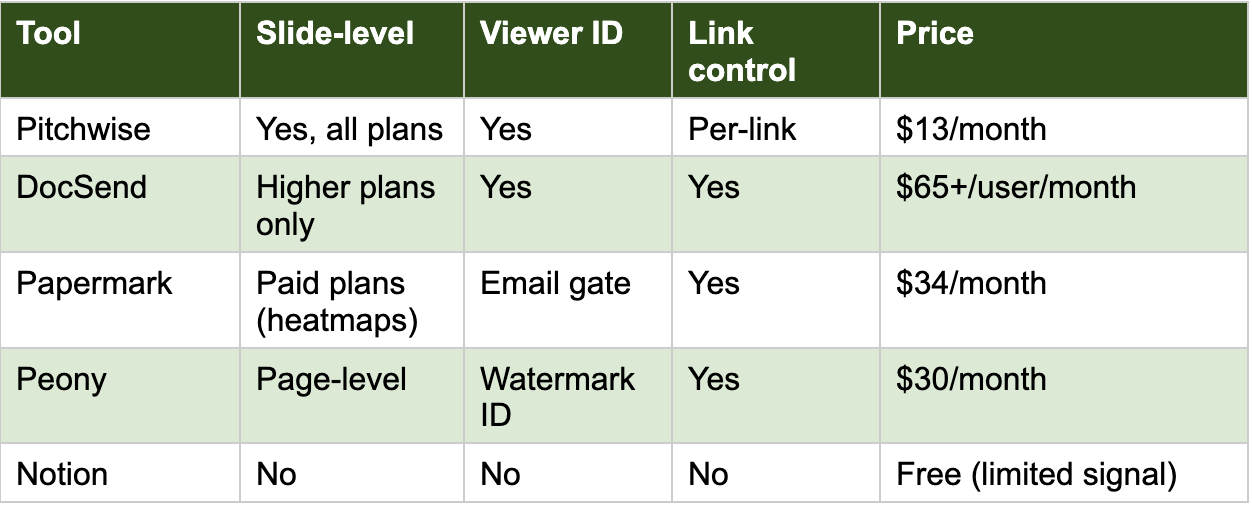
Here is how five commonly used tools stack up on price, tracking depth, and setup time for founders mid-raise.
1. Pitchwise - Price starts at $13/month
Pitchwise is built for exactly this use case. You upload your deck, generate a tracked link, and share it as you would any other URL. When the investor opens it, you see the notification in real time. The slide-level analytics show time spent per slide across every viewing session, so if the deck gets opened five times, you can see whether the attention pattern changes between sessions.
You can also update a link with a newer version of your document, and investors would be able to see the current and latest version without a need to resend the link.You can disable any link without affecting the others. The data room feature extends the same tracking to a full folder of documents, which is useful once you move into due diligence.
At $13 a month with no per-user pricing, it is also the most cost-effective dedicated tracking tool on this list. It also has a data room plan at just $24 per month.
Best for: Founders who want slide-level analytics and per-link controls at a flat monthly rate.
2. DocSend - Price starts at $15/month
DocSend is the most established name in this category. The tracking is page-level rather than slide-level on most plans, meaning you see total time per page but not necessarily whether the viewer scrolled through a page or stayed fixed on one section. On higher plans, the analytics become more detailed. DocSend also shows geographic data on where the link was opened, which can help you identify if a forwarded link was opened in a different country than your primary contact.
The main limitation is pricing. The Standard plan that includes detailed tracking starts at $65 per user per month. For a solo founder, that is $780 a year; with a co-founder, it doubles. The Personal plan at $15 a month covers basic tracking but limits your document count and does not include data room functionality.
Best for: Founders who want the most recognised brand in this space and whose investors are already familiar with DocSend links.
Price: Starts at $15/user/month, depending on plan.
3. Papermark - Price starts at $34/month
Papermark started as an open-source DocSend alternative. You can share a pitch deck via link, see open notifications, and get basic time-on-page data without paying anything. The paid plans, which start at around $34 a month, add heatmaps that show where on each slide a viewer's attention was concentrated, custom domains, and advanced access controls.
For a pre-seed founder that fancies open-source options, Papermark is the obvious starting point.
Best for: Founders who want to start tracking with an open-source option.
Price: Paid plans from approximately $34/month.