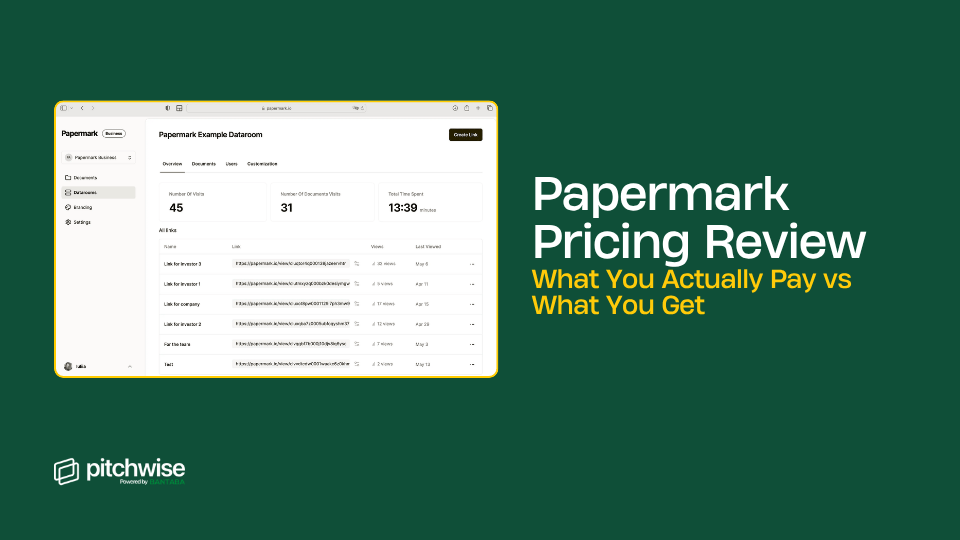
Papermark is one of the most-searched DocSend alternatives. But its pricing structure has a few details worth understanding before you commit. Here is the full breakdown, including how it compares to Pitchwise.
What Papermark offers
Papermark is an open-source document sharing and virtual data room platform. Its core value proposition is that the codebase is publicly available on GitHub, which allows self-hosting for organisations that need to keep documents on their own infrastructure. The hosted version is what most users sign up for directly.
The platform covers the core use cases: sharing documents via trackable links, page-by-page analytics, access controls, and virtual data rooms for fundraising or due diligence. For most early-stage founders and small teams, the feature set is solid.
Papermark pricing plans in 2026
Papermark's pricing has shifted significantly since 2024, and the tier that made sense for most founders a year ago no longer maps cleanly to the current feature set. Papermark's hosted plans are structured around storage and team size:
- Free plan: Available but limited. You can create links and share documents, but full analytics and advanced access controls are gated behind paid plans. Useful for testing the interface — not practical for active sharing with investors or clients.
- Starter — $34/month: Includes more file support, document sharing with full analytics, password protection, and basic access controls. No data rooms at this tier. Suitable for individual founders sharing a pitch deck with a small group of investors.
- Business — $92/month: Unlocks NDA signing, custom domains, and team seats. For most fundraising, this is the minimum viable plan.
- Data Rooms — starts at $173/month: This is where Papermark becomes a full VDR product rather than just a link-sharing tool. Their lease plan with a dedicated data room tier with unlimited storage, advanced permissions, and priority support. Aimed at teams running active transactions where multiple data rooms need to operate simultaneously.
What the pricing structure means in practice
The core issue with Papermark's pricing is the step from free or Starter to Business. The features most users actually need for professional document sharing, NDA gating, and custom domains only become available at the $92/month Business tier and data rooms at the $173 data room tier. That is a meaningful jump for an early-stage founder or a small team.
The open-source angle also adds complexity for non-technical users. Self-hosting requires a server, configuration, and ongoing maintenance. For most teams, the hosted version is what they use, which means the open-source differentiator is less relevant in practice.
How Papermark compares to Pitchwise
Pitchwise is purpose-built and fully hosted — there is no self-hosting option, which means no configuration overhead and no infrastructure to maintain. The key differences in pricing and features:
- Pitchwise starts at $13/month for the Starter plan — data rooms are available from $24/month on the Pro plan, compared to Papermark's $173/month Data Room tier
- Pitchwise includes slide-level analytics on all paid plans. Papermark's analytics are comparable, but the entry point is higher
- Pitchwise is not open source — for most users, this is irrelevant, but for teams with data sovereignty requirements, it is worth noting
- Pitchwise includes an investor network feature — founders who are fundraising can optionally share their deck with active investors on the platform, which Papermark does not offer
- Both platforms include email verification, access controls, and audit logs on their respective paid plans
Pitchwise Pro starts at $13/month. Data rooms from $24/month. No self-hosting, no setup overhead. Start free at app.pitchwise.se
Who Papermark is best for
Papermark is well-suited for technical teams that want to self-host for data sovereignty reasons, teams with existing infrastructure that want to run their own instance, and organisations in regulated industries where keeping data on-premise is a compliance requirement.
Its hosted version is a capable DocSend alternative, but the pricing step to access data rooms makes it less competitive for most founders and sales teams.
Who should consider Pitchwise instead
Pitchwise is better suited for teams who need a fully managed, immediately usable platform without technical setup, users who want data rooms available at a lower price point, teams who want Pitchwise's investor network feature as part of their fundraising workflow, and anyone who wants direct founder support rather than community-based open-source help.
The bottom line
Papermark is a credible DocSend alternative, particularly for technically confident teams who value the open-source architecture. For most founders, sales teams, and deal professionals who want to get set up quickly and share documents professionally, Pitchwise offers the same core capabilities at a lower entry price with a simpler setup.
The right choice depends on your team's technical setup, your budget, and whether data sovereignty or self-hosting is a genuine requirement for your organisation.
You can get started on Pitchwise for free at app.pitchwise.se