By clicking “Accept All Cookies”, you agree to the storing of cookies on your device to enhance site navigation, analyze site usage, and assist in our marketing efforts. View our Privacy Policy for more information.
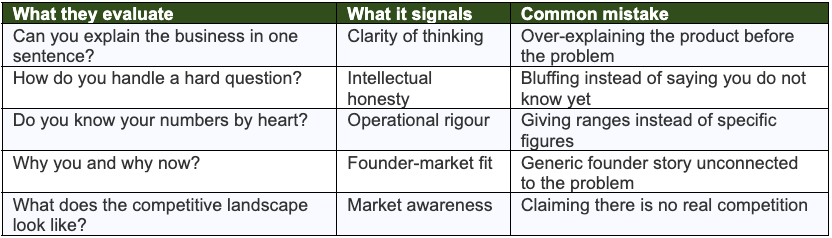
A first VC meeting is an evaluation of founder quality, market conviction, and business clarity. Partners are deciding whether to spend more time with you, not whether to invest. They are looking for a clear answer on what the company does, evidence of real market understanding, and signs that you can build and lead.
It is not a pitch. It is a screening.
Most founders walk into a first VC meeting trying to close. That is the wrong frame. The partner across from you is deciding one thing: is this worth another meeting? They are not making an investment decision. They are screening for a signal.
Understanding this changes how you prepare. You do not need to answer every possible question in 45 minutes. You need to leave them with one or two things they want to dig into further. That is what earns a second meeting.
Lorem ipsum dolor sit amet, consectetur adipiscing elit. Suspendisse varius enim in eros elementum tristique. Duis cursus, mi quis viverra ornare, eros dolor interdum nulla, ut commodo diam libero vitae erat. Aenean faucibus nibh et justo cursus id rutrum lorem imperdiet. Nunc ut sem vitae risus tristique posuere.
Partners review your materials before the meeting. The quality of your deck, the clarity of your one-pager, and how you have framed your ask all shape the lens through which they listen. A disorganised or confusing pre-meeting send creates a credibility gap you spend the whole meeting closing.
Pitchwise's one-pager builder lets you create a clean, trackable teaser document before the meeting. When the partner opens it, you see exactly when they looked and which sections they spent time on, giving you real intelligence about what they are most curious about before you walk in.
What VCs actually measure in the room
What VCs actually measure in the room
Team and founder quality
At an early stage, a VC is largely betting on you. The market can shift. The product will change. The team is what stays constant. Partners watch how you listen, how you respond to being challenged, and whether you seem like someone who can hire, sell, and persist through hard periods.
The founders who make the strongest impressions in first meetings are not the most polished presenters. They are the ones with genuine depth: they have done the work, they know what they do not know, and they are not selling past the evidence.
Strong market answers come from primary research: conversations with customers, distribution data, and analysis of adjacent categories. Show where you got your conviction, not just the conclusion you reached.
How to prepare for a first VC meeting
Tip: Research the specific partner, not just the fund. Look at their last three or four investments, find a piece they have written or a talk they have given, and use that to frame at least one of your answers. Generic preparation is easy to spot.
Before the meeting, use Pitchwise's investor database to filter by stage, sector, and check size, then look at the partner's actual portfolio. Understanding what they have already backed tells you their pattern recognition and what they are likely to push on.
What kills a first meeting
Overselling kills meetings. If you are not confident in a number, say so. If a market assumption is early, call it out. Partners have seen enough founders to recognise when someone is inflating metrics or burying uncertainty. Intellectual honesty is more compelling than a polished pitch that does not quite hold together.
The other meeting-killer is a vague ask. Know exactly how much you are raising, at roughly what terms, and what milestones that capital gets you to. Vagueness on the raise signals you have not thought the round through.
Frequently Asked Questions
How long does a first VC meeting usually last?
Most first meetings run 30 to 60 minutes. Some funds use a shorter initial call as a screen before a longer in-person meeting. Leave room for genuine back-and-forth. A conversation is more valuable than a monologue that runs out the clock.
Should I bring a deck to the first meeting?
Have it ready but do not default to presenting it slide by slide. A dialogue is more valuable than a presentation. If the partner asks to see the deck, walk through it. Otherwise, use it as a leave-behind and let the conversation lead.
What questions should I ask the VC?
Ask about their current focus within the fund, how they support portfolio companies beyond capital, and what would make them excited to continue the conversation. Asking a specific question about one of their portfolio companies signals you have done your homework.
How many first meetings do I need before getting a term sheet?
It varies widely. Some founders receive a term sheet after a handful of meetings with one fund. Others take 50 to 80 first meetings over several months. A first meeting is an early data point, not a direct line to a close.
Lorem ipsum dolor sit amet, consectetur adipiscing elit. Suspendisse varius enim in eros elementum tristique. Duis cursus, mi quis viverra ornare, eros dolor interdum nulla, ut commodo diam libero vitae erat. Aenean faucibus nibh et justo cursus id rutrum lorem imperdiet. Nunc ut sem vitae risus tristique posuere.
Lorem ipsum dolor sit amet, consectetur adipiscing elit. Suspendisse varius enim in eros elementum tristique. Duis cursus, mi quis viverra ornare, eros dolor interdum nulla, ut commodo diam libero vitae erat. Aenean faucibus nibh et justo cursus id rutrum lorem imperdiet. Nunc ut sem vitae risus tristique posuere.