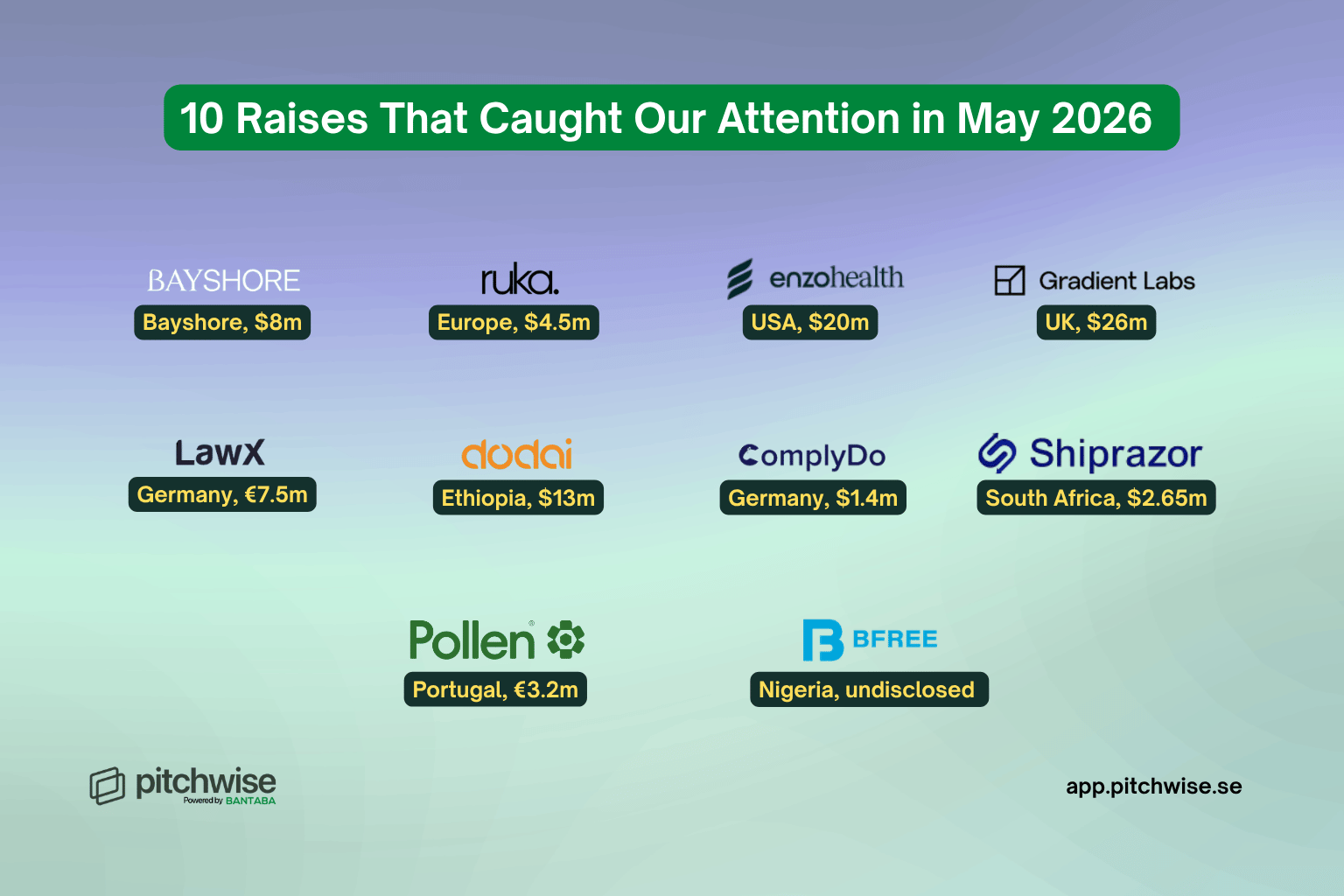
Every month, founders and investors close rounds that signal where capital is moving. May 2026 had a wide spread: a Japanese entrepreneur betting on Ethiopia's government-mandated EV transition, three ex-Monzo engineers building AI agents for bank compliance, and a Berlin lawyer who noticed that half of what law firms do every day has nothing to do with lawyering. Here are the ten that stood out for us at Pitchwise.
These are not necessarily the largest rounds of the month. They are the ones with an interesting market angle, an unusual investor thesis, or a structural innovation worth paying attention to.
1. Dodai — $13 million
Country/Region: Ethiopia (Addis Ababa; expanding to Abidjan, Kinshasa, Accra)
Sector: Electric mobility
Round: Series A ($8M equity + $5M debt)
Founder: Yuma Sasaki (CEO)
Investors: British International Investment, Value Chain Innovation Fund, UTokyo Innovation Platform, Nagase & Co., Persistent ACV Fund, For Seasons, CBC, Inclusion Japan
Why it caught our attention
In January 2024, Ethiopia became the first country to ban the import of petrol-powered vehicles – driven not by climate ambition but by economic necessity. The country spends over $4.5 billion annually on fuel imports. The structural tailwind for electric mobility is stronger here than in almost any other market on the planet.
Yuma Sasaki made the bet before the policy was widely understood. "Nigeria and Kenya are attractive but crowded. Ethiopia and the DRC are large but difficult, with fewer competitors. That means more impact if we succeed," he said. Dodai assembles electric motorbikes locally in Addis Ababa and runs a battery-swapping network that lets riders replace a depleted battery in minutes rather than waiting through a charge cycle, which is a model targeting delivery drivers and motorcycle taxi operators who need maximum uptime to earn a living. Riders switching from petrol reduce fuel and maintenance costs by 80 to 90 per cent.
The company has deployed over 2,000 electric motorbikes and built a team of 100 employees, 97% of them Ethiopian. The three-year target: 30,000 active users and 1,000 swap stations in Addis Ababa before expanding to Abidjan, Kinshasa, and Accra.
2. Shiprazor — $2.65 million
Country/Region: South Africa (Cape Town)
Sector: E-commerce logistics
Round: Seed (total funding $3.3M)
Founder: Sahil Affriya (CEO), former venture capitalist
Lead investor: Norrsken22
Also participated: AAIC, E4E, Tremis Capital, angel investors including senior Google executives
Why it caught our attention
Transport costs in Africa run approximately 75% higher than the global average. For online merchants, the result is a fragmented stack of courier relationships, inconsistent coverage, and fulfilment failures that stall growth long before demand runs out.
Founded in 2023 by former VC Sahil Affriya, Shiprazor connects merchants to a network of more than 20 courier partners through a single Shopify or WooCommerce integration. The system routes each shipment based on cost, speed, and historical carrier performance. Since launching, the company has processed over 1.5 million deliveries across South Africa.
Affriya's VC background typically produces a specific kind of founder, one who understands exactly what investors need to see and how to close the gap between a compelling problem and a fundable business. The $2.65 million suggests he did.
3. Enzo Health — $20 million
Country/Region: United States (Lehi, Utah)
Sector: Healthcare AI
Round: Series A (total funding $26M)
Founders: Zach Newman (CEO), Dan (co-founder)
Lead investor: N47
Also participated: Gradient, Tandem Ventures, Rigby Watts, Lionel Partners, Soma
Why it caught our attention
More than 10,000 Americans turn 65 every day. Home health agencies are supposed to absorb much of that demand but still run on legacy software not designed for modern care delivery. Zach Newman and his co-founder built an AI-native platform from scratch, connecting front office, clinical operations, and back office in one system, from referral intake to reimbursement.
In 24 months since launch, Enzo has grown revenue more than 40X. The agencies on its platform collectively support over 500,000 patients annually. The $20 million Series A, led by N47 funds expanded into skilled nursing and hospice-adjacent markets with the same workflow problems and comparable regulatory complexity.
4. Gradient Labs — $26 million
Country/Region: United Kingdom (London)
Sector: AI agents for financial services
Round: Series A (doubled to $26M)
Founders: Dimitri Masin (CEO), Neal Lathia (CTO), Danai Antoniou — all former Monzo
Lead investors: Octopus Ventures, CommerzVentures
Also participated: Redpoint Ventures, Exceptional Capital
Customers: Wise, Monzo, Zego, Stash, Rho, Current, Pockit
Why it caught our attention
Dimitri Masin, Neal Lathia, and Danai Antoniou met at Monzo as early employees, watching first-hand how all-consuming it is to operate a bank at scale. At Monzo, they built the machine learning systems for customer operations and financial crime. When GPT-4 arrived, weekends spent building with new LLMs showed them that most of the manual, repetitive work in financial services could now be automated safely.
Gradient Labs builds vertical AI agents for financial services: automating customer support, lending workflows, dispute resolution, and KYC verification, all within regulatory guardrails. Revenue grew 900% in the past year. Customers include Wise, Monzo, and Zego in Europe and Stash and Rho in the US. When the companies that built modern banking trust your compliance infrastructure, that is the product endorsement that matters.
5. LawX — €7.5 million
Country/Region: Germany (Berlin)
Sector: Legal AI / Law firm operations
Round: Seed (total funding €10.9M)
Founders: Dr Norman Koschmieder (CEO) — former GC at Flink and Enpal; Dr Sara Brinkmann — co-founder at both; Torben Rabe — formerly at Qonto
Lead investor: Motive Partners
Also participated: WENVEST Capital, xdeck, SIVentures, angel investors including Flink founder Christoph Cordes and former Deutsche Bank board member Ralph Müller
Why it caught our attention
Most well-funded legal AI targets what lawyers do: research, drafting, and contract review. Harvey raised $200 million at an $11 billion valuation in this category. LawX is targeting the other half of a law firm's day: opening case files, managing calendars, processing documents, and producing the bill at the end. About 50% of law firm activities are administrative. Most still run on software from the 1990s.
Koschmieder was general counsel at Flink and then Enpal. Brinkmann worked with him at both. Rabe came from a transformation role at Qonto. That combination of legal pedigree and tech operator experience is the founding team configuration that builds software practitioners who actually adopt. The €7.5 million funds expansion from Germany's notary market into the wider European law firm segment.
6. Bayshore — $8 million
Country/Region: Germany (Berlin)
Sector: Compliance legaltech
Round: Seed
Investors: Y Combinator, Reaktor.Berlin
Why it caught our attention
Two YC-backed compliance plays in the same month, Bayshore and ComplyDo, are signals worth noting. Y Combinator has historically been an early indicator of which software categories are approaching mainstream venture viability, and compliance tooling in regulated European industries appears to be entering that window.
Bayshore's specific focus is turning compliance rules into executable code: taking regulatory requirements and translating them into software logic that businesses can audit, update, and run automatically. For regulated industries like financial services, healthcare, and manufacturing, that interpretation layer is expensive and error-prone to manage manually.
7. ComplyDo — $1.3 million
Country/Region: Germany (Berlin)
Sector: Compliance management SaaS
Round: Seed
Investors: Y Combinator, Reaktor.Berlin
Why it caught our attention
The round is small. The signal is the combination of Y Combinator backing and a Berlin base at this stage. YC's German selections tend to identify founders in markets where compliance complexity is high, and software penetration is low. That profile fits ComplyDo precisely, a platform that consolidates regulatory obligations in one place, replacing spreadsheets and disconnected legacy tools that most compliance teams currently use.
Two YC-backed compliance companies in Berlin in one month tell you something about where the European software opportunity is concentrating.
8. Ruka — $4.5 million
Country/Region: Europe
Sector: Biotech beauty
Round: Seed
Lead investors: Freedom Trail Capital, Henkel Ventures
Why it caught our attention
Henkel is one of the largest consumer goods companies in the world, with beauty and home care products distributed through retail relationships that most startups spend a decade trying to build. Henkel Ventures co-leading a seed round is, therefore, also a distribution signal.
Ruka builds at the intersection of biotechnology and consumer beauty, using scientific formulation and biotech-derived ingredients that sit closer to pharmaceutical precision than mass-market cosmetics. The funding expands production, grows its retail footprint, and sets up a US launch in 2026. Consumer biotech is having a moment, and Ruka's lead investor suggests the product is ready to scale through channels the company could not reach alone.
9. Pollen — €3.2 million
Country/Region: Portugal
Sector: Clean mobility / Battery-swapping infrastructure
Round: Seed
Why it caught our attention
Two battery-swapping plays in one month, Dodai in Addis Ababa and Pollen in Lisbon, is a structural coincidence worth noting. Both bet on the same infrastructure thesis for electric two-wheelers: the charging friction problem is solvable not through faster charging but through network density and swappable battery standardisation.
Pollen builds a universal battery-swapping network for mopeds and motorcycles, designed to work across compatible vehicles rather than locking to a single brand. Portugal's high two-wheel vehicle usage, urban density, and EU pressure on combustion engines make it a favourable first market. The model is highly portable across Southern Europe if the density thesis plays out.
10. BFREE — Undisclosed growth round
Country/Region: Nigeria
Sector: Distressed credit infrastructure
Round: Growth equity
Founders: Julian Flosbach (CEO), Chukwudi Enyi (COO), Moses Nmor (VP Product) — founded 2020
Lead investor: AfricInvest (Financial Inclusion Vehicle)
Also participated: Algebra Ventures (first Nigeria-headquartered investment), Capria Ventures, VestedWorld, Axian CVC, Angaza Capital, 4Di Capital, DotExe Ventures
Why it caught our attention
BFREE operates in a space most fintechs avoid: distressed credit. The company buys non-performing loan portfolios from banks and fintechs, then uses AI to manage collections ethically and without the intimidation tactics that characterise traditional recovery. Better recovery rates are the business case for doing it properly.
The structural argument is simple. Billions of dollars in African retail and SME credit go unresolved every year because the institutional infrastructure to clear them does not exist. BFREE is building that infrastructure. AfricInvest leads through its Financial Inclusion Vehicle, while Algebra Ventures joins as its first investment in a Nigeria-headquartered company. For African fintech, the model is unsexy, structurally important, and increasingly fundable.
Also Read: 10 Raises That Caught Our Attention in April 2026
In Conclusion
For founders currently fundraising, the bar for investor materials has risen across all of these categories. Institutional investors, development finance institutions, and strategic corporate backers each bring their own diligence requirements. Managing that process without a controlled, structured document environment is how rounds slow down.
Pitchwise gives you a secure data room for your fundraising materials with real-time visibility into who is engaging with what. Start free at app.pitchwise.se We've also put together a directory of the most prominent global investors actively backing rounds like these, broken down by sector, stage, and geography. You can find it here.




.png)
.png)