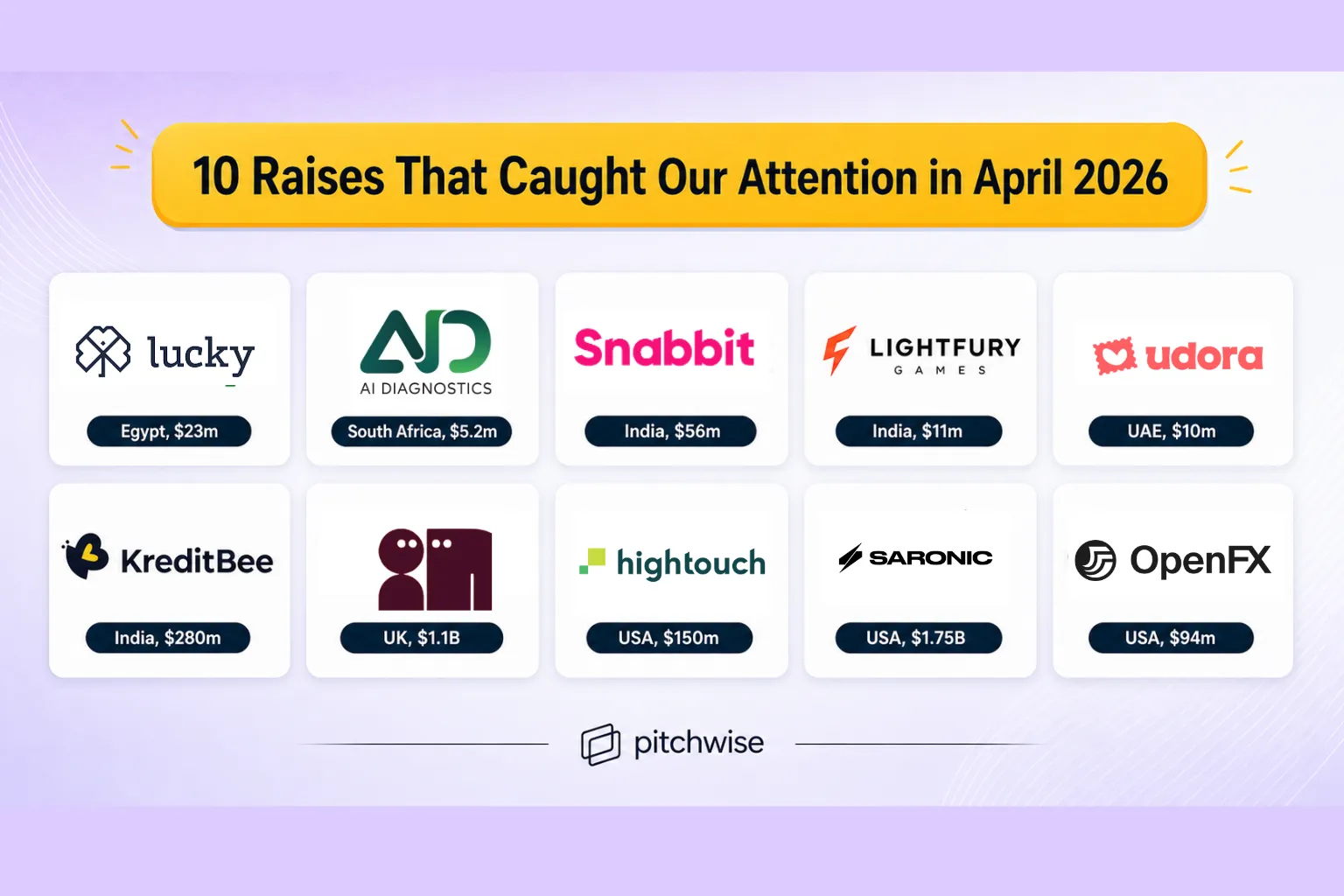
Every month, founders and investors close rounds that signal where capital is moving. April 2026 had a wide spread: a former Navy SEAL building autonomous warships, a two-year-old payments startup processing $45 billion a year, and a gaming studio backed by MS Dhoni. Here are the ten that stood out.
These are not necessarily the largest rounds of the month. They are the ones with an interesting market angle, an unusual investor thesis, or a structural innovation worth paying attention to.
1. Lucky — $23 million
Country/Region: Egypt (expanding across North Africa)
Sector: Consumer credit / Neobanking
Round: Series B (equity + debt)
Founders: Ayman Essawy (CEO), Momtaz Moussa, Marwan Kenawy
Lead investors: Disruptech Ventures, DPI Venture Capital via Nclude fund, Suez Canal Bank, OneStop
Why it caught our attention
Most African fintech Series B stories are about growth. Lucky's is about discipline. Founded in Cairo in 2019, the company started as a cashback platform before evolving into a consumer credit network. By the end of 2025, it had tripled annual growth and reached profitability — a combination that is genuinely rare in African fintech at this stage.
The timing matters. Egypt's Central Bank has been opening digital onboarding frameworks and a Payment Service Provider licensing pathway. Lucky is applying for that PSP licence now, and the $23 million is partly a bet on being first through that window. Mohamed Farouk joined as Chairman, signalling the governance shift that comes with moving toward institutional readiness.
Lucky has not named its North Africa target markets, but the regional thesis is in place. For founders preparing to cross a border, the sequencing here is worth studying.
2. AI Diagnostics — $5.2 million
Country/Region: South Africa
Sector: Medtech / AI diagnostics
Round: Seed
Why it caught our attention
Tuberculosis is responsible for more than a million deaths annually, and South Africa carries one of the highest burden rates in the world. AI Diagnostics built an AI-powered screening platform that identifies TB from standard pathology images, removing the specialist equipment and radiologist availability that slow diagnosis in under-resourced settings.
The $5.2 million raise is modest by the standards of this list. That is the point. South African medtech is still undercovered relative to fintech in the African funding conversation, and this is the kind of healthcare bet that development finance institutions have historically anchored. The open question is whether the company can build a commercial pathway alongside the institutional funding that has sustained it so far.
3. Snabbit — $56 million
Country/Region: India (Bengaluru; Delhi NCR, Mumbai, Hyderabad, Pune)
Sector: On-demand home services
Round: Series D
Founder: Aayush Agarwal (CEO), formerly at Zepto
Lead investors: Susquehanna Venture Capital, Mirae Asset Venture (Unicorn Growth Fund), Bertelsmann India Investments; Nexus, Lightspeed, FJ Labs also participated
Why it caught our attention
One number sits at the centre of Snabbit's Series D: 247 metres. That is the median distance between two consecutive jobs on its network. Agarwal calls it the single number that explains the round. It encodes the operating thesis: density over footprint, depth over reach.
Founded in 2024, Snabbit went from 400 to 40,000 daily jobs in a single financial year, crossing one million monthly jobs in March 2026 across just five cities. When density compounds, per-job economics improve and repeat usage builds retention. Some mature micro-markets are now running over 1,000 jobs a day independently.
The next category is home cooks, who are already in the pilot. All 15,000+ service professionals on the platform are women, with a dedicated safety system called Snabbit Kavach built into the product. That workforce structure is also the supply-side retention mechanism in a category that has historically struggled with consistency.
4. LightFury Games — $11 million
Country/Region: India (Bengaluru)
Sector: Gaming / AAA mobile
Round: Pre-Series A
Founders: Karan Shroff, Anurag Banerjee, Tina Balachandran
Investors: Blume Ventures, V3 Ventures, MIXI, Times Internet; MS Dhoni, Jasprit Bumrah, Hardik Pandya, Shreyas Iyer, Ravindra Jadeja, Tilak Varma, Sai Sudharsan
Why it caught our attention
Seven active Indian cricketers are on the cap table of this $11 million pre-Series A for a mobile cricket game called eCricket. The athlete-as-investor structure has precedents. What makes this one different is the direct alignment: these players are stakeholders in a game built around their own sport, at a moment when Indian cricket fandom is the largest single entertainment audience on the planet.
The founding team at LightFury has over 40 AAA titles between them, and the game targets mobile AAA quality, a segment that has underperformed in India, given the size of the opportunity. Institutional co-investors include Blume and Japanese gaming firm MIXI. The round gets the company to launch. What happens post-launch is where the model gets tested.
5. Udora — $10 million
Country/Region: Dubai, UAE (50+ markets, 1,500+ cities)
Sector: Gifting marketplace
Round: Private round
Founder: Slava Bogdan (CEO)
Why it caught our attention
Udora was Flowwow until recently. The rebrand and the $10 million round arrived together, and together they tell a structural story. Udora has formally separated its international operations from its Russian business, creating a clean entity in Dubai with no entanglement in the legal complexity of the Russian market. That is a substantive decision, not a cosmetic one.
Every order on the platform is fulfilled by a local SME. Udora provides the payments, marketing, and customer access that those businesses could not build on their own. In the UAE, the seller network grew 66.5% in 2025. 61.3% of orders came from returning customers. Average satisfaction held at 92.4%.
Saudi Arabia launches in Q3 2026. Gifting in the GCC is occasion-driven and deeply culturally specific. Bogdan's stated approach is to map local search behaviour, payment expectations, and cultural norms before entering each market. Applied consistently across 50 markets, that deliberateness is the differentiation.
6. KreditBee — $280 million
Country/Region: India
Sector: Consumer lending
Round: Series E
Key milestone: Became India's newest unicorn in April 2026
Notable backer: MUFG
Why it caught our attention
The global BNPL story of the last four years is largely about overextension. KreditBee built something with different economics: personal loans to India's underserved borrower segment, with over ₹50,000 crore disbursed and a $1 billion valuation that came from credit discipline rather than user acquisition.
Most of its borrowers are thin-file customers, people with limited or no formal credit history who are invisible to traditional banks. KreditBee uses alternative data in its underwriting to serve this segment at scale, in a market where the formal credit gap remains large.
The $280 million Series E is significant. The more durable signal is MUFG. A Japanese institutional bank with deep consumer lending expertise choosing to build a long position in Indian consumer credit is a vote of confidence in the quality of the book, not just the trajectory.
7. Ineffable Intelligence — $1.1 billion
Country/Region: London, United Kingdom
Sector: Frontier AI / Reinforcement learning
Round: Seed — Europe's largest on record
Founder: David Silver, former head of reinforcement learning at Google DeepMind; co-creator of AlphaGo and AlphaZero
Lead investors: Sequoia Capital, Lightspeed Venture Partners
Also participated: Nvidia, Google, DST Global, Index Ventures, EQT, UK Sovereign AI Fund, British Business Bank
Why it caught our attention
No product. No revenue. No roadmap. $1.1 billion at seed, at a $5.1 billion valuation, before a single line of product code has been released. Ineffable Intelligence is Europe's largest seed round on record.
Silver's thesis diverges from most frontier AI work. Rather than scaling language models on human-generated data, Ineffable is pursuing a "superlearner" that discovers knowledge through its own experience using reinforcement learning. This is the same intellectual lineage behind AlphaGo's defeat of Lee Sedol in 2016 and AlphaZero's mastery of chess without human examples. The bet is that reward-driven experience, at sufficient scale, outperforms curated pre-training.
For a Pitchwise audience, the technology is secondary. The relevant question is what this round says about how conviction is priced. When Sequoia and Lightspeed co-lead $1.1 billion into a company with no product, the founder's track record is the entire thesis. Silver's two decades at DeepMind have been capitalised at $5.1 billion. What does it take to be genuinely irreplaceable in a domain? That is the question Ineffable puts on the table.
8. Hightouch — $150 million
Country/Region: San Francisco, USA
Sector: AI marketing infrastructure
Round: Series D
Founders: Kashish Gupta (co-CEO), Tejas Manohar (co-CEO)
Lead investors: Goldman Sachs Alternatives (Growth Equity), Bain Capital Ventures
Also participated: Iconiq Capital, Sapphire Ventures, Amplify Partners, Y Combinator, TD7 (The Trade Desk venture arm)
Valuation: $2.75 billion
Why it caught our attention
Most AI marketing tools produce content. Hightouch runs agents on top of a company's own data to research audiences, generate creative, and execute campaigns across channels. The data stays where it lives. That distinction matters for enterprise customers, where data governance requirements rule out most AI-native vendors.
Customers, including Domino's, PetSmart, and DraftKings, use the platform for this reason. Growth has been over 100% annually for two consecutive years. The Trade Desk's venture arm joining the Series D is worth noting: one of the world's most sophisticated programmatic advertising platforms is betting on Hightouch's data layer becoming the infrastructure it connects to upstream.
9. Saronic — $1.75 billion
Country/Region: Austin, Texas, USA
Sector: Defence tech / Autonomous maritime vessels
Round: Series D
Founders: Dino Mavrookas (CEO), Vibhav Altekar (CTO), Doug Lambert (COO), Rob Lehman (CCO)
Lead investor: Kleiner Perkins
Also participated: Advent International, Bessemer Venture Partners and others
Valuation: $9.25 billion
Why it caught our attention
Dino Mavrookas spent 11 years as a US Navy SEAL, completed eight combat deployments, then spent several years in private equity before co-founding Saronic in 2022. The decision came from a specific observation: the United States, which produced 18,000 ships in a single year during World War II, had allowed its shipbuilding capacity to erode to a fraction of that figure while China built the world's largest naval fleet. Saronic's response was to design autonomous surface vessels from first principles, with software built before hardware, manufactured at commercial speed. Its 24-foot Corsair costs under $1 million. A guided-missile destroyer costs $2 billion and takes up to nine years.
The $1.75 billion Series D funds expansion of the Louisiana shipyard to 20 vessels per year and development of Port Alpha, a purpose-built autonomous shipbuilding facility, Mavrookas says will run at ten times current capacity. The US Navy has already awarded a $392 million production contract.
The reason Saronic belongs here is the business model architecture. Build software first, own the manufacturing, move faster than incumbents, and price the product at a fraction of legacy alternatives. That is a venture playbook applied to physical defence infrastructure. The sector is new to it. The approach is not.
10. OpenFX — $94 million
Country/Region: New York, USA (also operating in UK, UAE, India)
Sector: Cross-border payments / FX infrastructure
Round: Series A
Founder: Prabhakar Reddy, formerly co-founder and COO of FalconX
Lead investors: Accel, Lightspeed Faction, M13, Northzone, Pantera Capital
Valuation: ~$500 million
Why it caught our attention
Prabhakar Reddy got the idea for OpenFX while watching workers queue outside a Western Union branch in Dubai. Small transfers had improved. But businesses trying to move $1 million to $10 million hit thin order books, spreads of 2 to 5%, and settlement windows of two to five business days. The $200 trillion annual FX market was running on infrastructure from the 1970s.
OpenFX uses stablecoins as an intermediary settlement rail, routing institutional FX conversions faster and cheaper than legacy systems. Over 98% of transactions settle in under 60 minutes. The platform has gone from $4 billion to $45 billion in annualised volume in a year. Clients include MoneyGram, Yellow Card, and a range of neobanks and payroll platforms.
The $94 million Series A, raised at a ~$500 million valuation two years after founding, funds expansion into Southeast Asia and Latin America. Reddy's view on where this goes: "I believe AI agents will be the largest category of FX users on the planet within ten years." If software systems conducting economic activity need to move value across borders, the infrastructure for that has to exist first. OpenFX is building it.
For founders currently fundraising, the bar for investor materials has risen across all of these categories. Institutional investors, development finance institutions, and sovereign wealth funds each bring their own diligence requirements. Managing that process without a controlled, structured document environment is how rounds slow down.
Pitchwise gives you a secure data room for your fundraising materials – organised by stage, gated by NDA, with real-time visibility into who is engaging with what. Start free at app.pitchwise.se