By clicking “Accept All Cookies”, you agree to the storing of cookies on your device to enhance site navigation, analyze site usage, and assist in our marketing efforts. View our Privacy Policy for more information.
Why Your Pitch Deck Headers Might Matter More Than You Think
by
Oluwadamilare Akinpelu
Every week, thousands of founders hit "send" on cold pitch deck submissions. Most never hear back. Not because their startups aren't viable, but because their decks never get read.
If you have ever stared at an “Opened” notification and still gotten silence, this is probably why. Investors are not sitting down with your deck as if it were a report. They are actively filtering, and on a first pass, the time window is short. Think seconds. If you’re lucky, one or two minutes.
The bottleneck isn't capital. It's attention.
Now, the question is: what separates the decks that survive from those that get closed in minutes?
Esteban Abid, a founder and researcher at the University of St. Gallen, designed an experiment using Pitchwise to find out. He took his own early-stage pitch deck and created two identical versions—same slides, same data, same design. Only one element changed: how the subtitles were phrased. Twenty-one active early-stage investors reviewed the decks under real cold-screening conditions.
What he discovered was a roadmap for every founder fighting to get noticed in an overcrowded inbox.
The Cold Deck Problem: Where 80% of Opportunities Die
Here's the uncomfortable truth about early-stage fundraising: most of it happens without context.
According to research from the University of St. Gallen, analysing over 14,000 deals, approximately 80% of pitch decks that reach investors are "cold" submissions with no warm intro, no referral, just a founder and a deck in an inbox. These cold decks get screened with whatever attention remains after investors have reviewed their referred opportunities.
The numbers are brutal:
Investors spend an average of 2 minutes and 15 seconds per deck
Only about 10% of all submissions pass initial screening
Cold decks account for just 40% of advancing opportunities, despite representing 80% of submissions and being of comparable quality to referred decks
At this stage, investors aren't making investment decisions. They're making triage decisions: "Is this worth ten more minutes of my time, or should I close it now?"
And when you only have a couple of minutes, you do what any overloaded person does. You skim the easiest parts first.
In a pitch deck, that usually means slide titles and subtitles. If those lines are concrete and they hang together, investors tend to slow down and read deeper.
That is why Esteban decided to test subtitle phrasing. At this stage, which he calls “the cemetery of opportunities”, those few words can be the difference between “skim and close” and “keep reading”.
Lorem ipsum dolor sit amet, consectetur adipiscing elit. Suspendisse varius enim in eros elementum tristique. Duis cursus, mi quis viverra ornare, eros dolor interdum nulla, ut commodo diam libero vitae erat. Aenean faucibus nibh et justo cursus id rutrum lorem imperdiet. Nunc ut sem vitae risus tristique posuere.
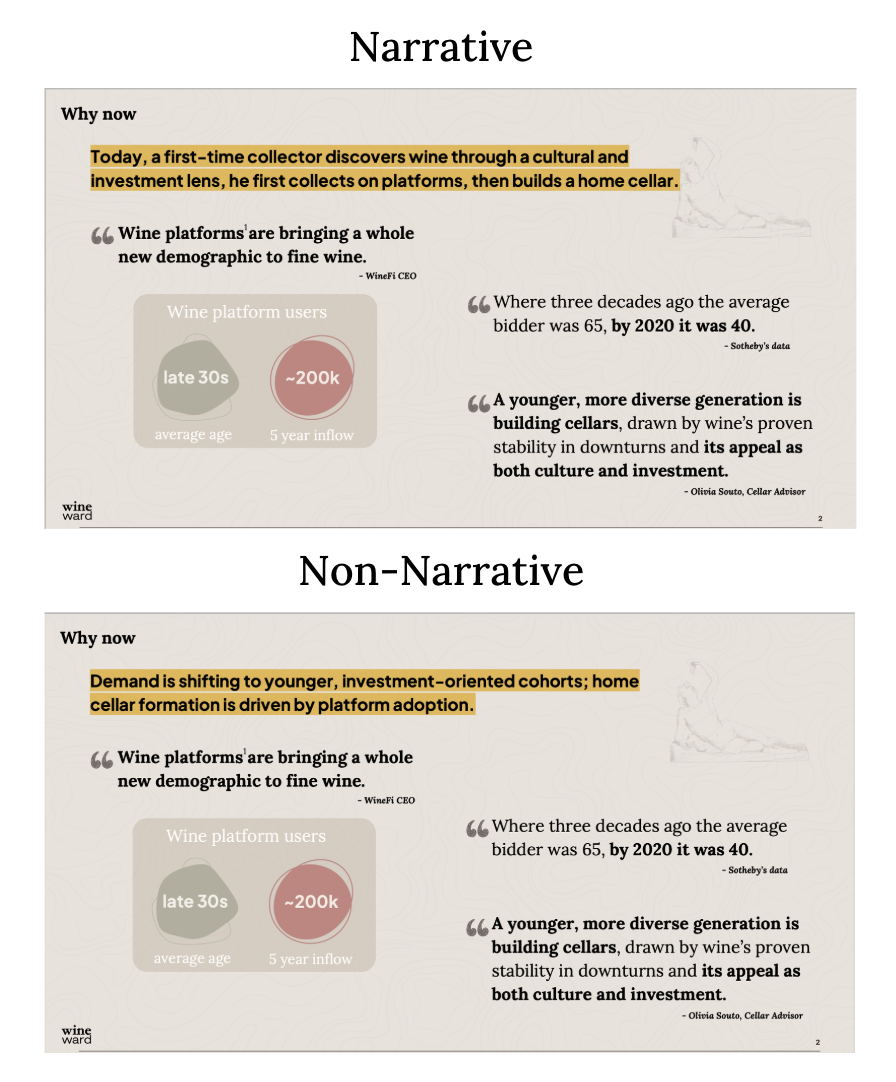
Esteban designed a simple and actionable test. He took his own pre-seed pitch deck for WineWard—a deck crafted using industry best practices from Sequoia Capital's framework, structured according to documented investor preferences, and refined for visual clarity—and created two versions.
Everything stayed identical: the same 11 slides, same facts, same charts, same design. Only one element changed: how the subtitles were phrased.
One version used analytical subtitles. Clean, abstract, a little like the headings you see in consulting decks.
Example: “Market dynamics and regulatory framework.”
The other version used narrative subtitles. Still serious, but more concrete. More specific. You can see the actor, the action, and what is at stake.
Esteban's startup pitch deck with Narrative and Non-Narrative Subtitle Phrasing
Twenty-one active early-stage investors—a mix of business angels and venture capital professionals—were randomly assigned to review one version through Pitchwise's platform, replicating real cold-screening conditions. They didn't know they were seeing different linguistic framings. With Pitchwise’s deck analytics and a 20-item survey, Esteban then measured their engagement, comprehension, attitudes toward the founder and venture, and behavioural intentions.
The setup was designed to isolate one question: At the cold-screening gate, does how you phrase your subtitles matter?
The Findings: Attention Is Everything (And It Doesn't Cost You Credibility)
Narrative subtitles increased engagement by 43%.
This wasn't a marginal difference. Investors who saw narrative subtitles rated the deck as significantly more engaging. They were more likely to read it through to the end. When Esteban analysed slide-by-slide dwell times, he found that several lower-priority slides received just enough viewing time to read the title and subtitle. This confirmed that investors were literally navigating by these elements before deciding whether to engage deeper.
Narrative vs Non-Narrative Deck Engagements slide-by-slide on Pitchwise
The effect was strongest at the attention stage, which makes theoretical sense: subtitles are the first contact point. If they don't earn those next few seconds, nothing else matters.
What Didn't Hurt (The Surprising Part)
For years, founders have been told there's a trade-off: Narrative equals engaging but less serious, and Analytical equals credible but boring.
Esteban's data challenges this assumption. More investors completed the narrative version of the deck (55% vs. 40%), suggesting that narrative framing helped decks survive the skim long enough to be read through
Narrative subtitles showed no detectable penalty on:
Perceived founder competence
Clarity of the market need
Perceived realism of the opportunity
The narrative deck did not come across as fluff. It just held attention better.
The Honest Limitation
Did narrative framing lead to more funding intent or next-step requests? The results were directionally positive but inconclusive in this pilot study. Esteban is transparent about this: framing helps you win attention, but it can't compensate for weak fundamentals.
However, there's an important caveat. The investors in this study had opted into an academic research project, meaning they were more motivated than a typical busy investor skimming 200 decks a quarter. In real cold screening—where the default is close and move on—the engagement gap is likely even larger.
You can't advance to evaluation if your deck is never read. And you can't get read if your subtitles don't earn the next ten seconds.
The Playbook: How to Write Subtitles That Survive the Skim
Esteban's research translates into a clear, actionable framework for founders:
1. Treat Subtitles as Your "Skim Layer"
Assume many investors will only read your slide titles and subtitles before deciding whether to engage with the content. This isn't laziness but a rational triage under time scarcity. Design for that reality.
2. Encode Three Elements in Every Subtitle
Effective narrative subtitles contain:
An agent (who is involved)
An action (what is happening)
Stakes (why it matters or what's at risk)
This structure creates a micro-story that helps investors build a mental model of your venture quickly.
3. Examples: The Before and After
Problem Slide:
❌ Analytical: "Market gap and customer pain points"
✅ Narrative: "Collectors spend $12,000 on insurance that doesn't protect their most valuable asset: authenticity."
Solution Slide:
❌ Analytical: "Proprietary technology platform and verification methodology"
❌ Analytical: "Market timing and regulatory landscape analysis"
✅ Narrative: "EU regulations now require digital product passports—making our solution compliance-ready and scalable."
The analytical versions are accurate, yet they are also easy to skip. The narrative versions are easier to picture and easier to remember.
4. Use the Hybrid Approach
You don't need to narrativise everything. The most effective structure is:
Subtitles = narrative hooks (who, what, why it matters)
Slide body = analytical proof (data, charts, metrics)
Let the subtitle earn attention. Let the content earn conviction.
5. You Won't Look "Less Serious"
Esteban's data directly contradicts the widespread belief that narrative phrasing makes you seem less competent or rigorous. In his study, perceived competence and market clarity were statistically indistinguishable between conditions.
Translation: You can write engaging subtitles without sacrificing credibility. The trade-off the founders fear doesn't materialise in practice.
Why This Matters: The Real Bottleneck Isn't Capital, It's Attention
The venture funding model creates a structural disadvantage for non-referred founders. With limited screening capacity, investors apply a heuristic: they prioritise decks that come through trusted channels and give residual attention to cold submissions.
This isn't bias in the traditional sense; it's a rational response to information overload. But it means that cold-deck founders face a higher bar before they even start.
Esteban's research suggests a lever founders can actually control: the linguistic framing of their decks. In the cold outreach environment, investors navigate by titles and subtitles. If those lines stay abstract, your deck feels like effort. If they are concrete, they give the reader a path.
Esteban's research systematises what happens in investors’ heads during that brief cold-deck skim. Narrative subtitles create mental imagery that persists. They make decks memorable enough to pass the first gate. At this gate, your competition isn't just other startups. It's the close button. Every word you choose is competing for survival.
So the next time you review your pitch deck, ask yourself: if an investor only reads my slide titles and subtitles, would they understand the story? Would they remember it two months later?
If not, it might be time to rewrite the subtitles.
About Esteban Abid
Esteban Abid is a two-time founder currently pursuing his Master’s degree in Accounting and Corporate Finance at the University of St. Gallen. His interests are in entrepreneurship and entrepreneurial finance. In the context of his studies, he has worked on fundraising and early-stage venture evaluations, with a particular focus on how pitch-deck crafting and framing affect investor decisions. This article is based on his study “Framing Effects in Early Venture Evaluations: Randomized evidence from angel & pre-seed VC screening,” developed under the supervision of Sebastian Frankenberger, PhD (specialized in M&A and strategic acquisitions, and successful entrepreneur) and Fabienne Bünzli, PhD (researcher in strategic communication and persuasion at the University of St. Gallen). Connect with him on LinkedIn.
Want to test your deck's narrative framing? Upload your pitch deck to Pitchwise and see how investors engage with it—backed by the same infrastructure that powered this research. Get started here.
Lorem ipsum dolor sit amet, consectetur adipiscing elit. Suspendisse varius enim in eros elementum tristique. Duis cursus, mi quis viverra ornare, eros dolor interdum nulla, ut commodo diam libero vitae erat. Aenean faucibus nibh et justo cursus id rutrum lorem imperdiet. Nunc ut sem vitae risus tristique posuere.
Lorem ipsum dolor sit amet, consectetur adipiscing elit. Suspendisse varius enim in eros elementum tristique. Duis cursus, mi quis viverra ornare, eros dolor interdum nulla, ut commodo diam libero vitae erat. Aenean faucibus nibh et justo cursus id rutrum lorem imperdiet. Nunc ut sem vitae risus tristique posuere.