By clicking “Accept All Cookies”, you agree to the storing of cookies on your device to enhance site navigation, analyze site usage, and assist in our marketing efforts. View our Privacy Policy for more information.
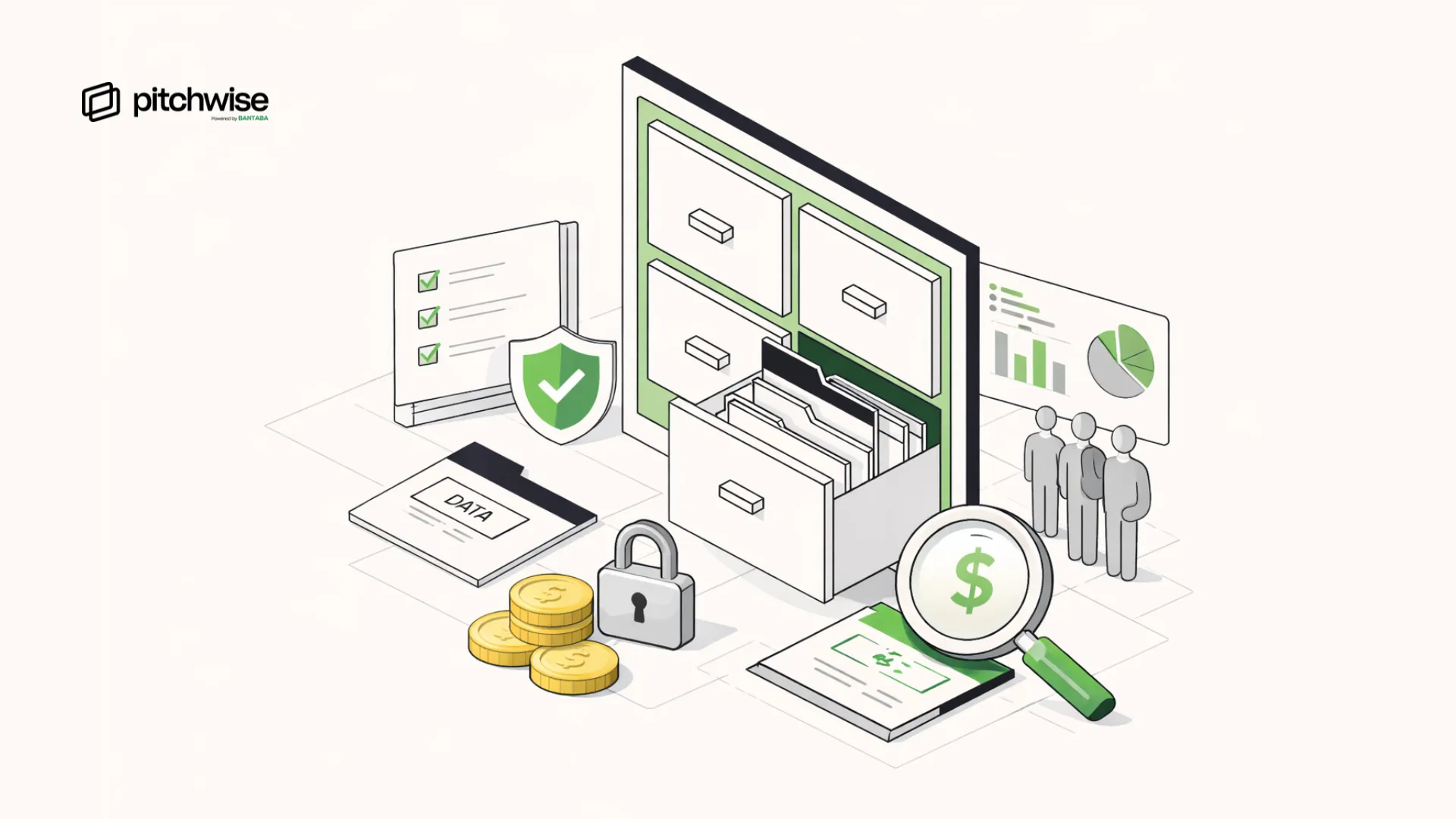
A well-organised data room is one of the most underrated advantages a founder can bring to a fundraising. It is not just a folder of files; it is a strategic asset that shapes how investors perceive your business, your team, and your readiness to scale.
According to PitchBook Q1 2025 fundraising data, startups with professional data rooms close rounds up to 30% faster than those relying on consumer file-sharing tools. Meanwhile, research from CB Insights shows that roughly 38% of venture capitalists cite poor organisation of materials as a reason for passing on otherwise promising deals.
So, whether you are preparing for a seed round or gearing up for Series B due diligence, this guide will walk you through exactly how to build a data room that accelerates investor decisions, with a special focus on the revenue projections investors scrutinise most.
Why Your Data Room Is Your Silent Pitch
Your pitch deck opens the door. Your data room is what happens after investors walk through it. As Andreessen Horowitz explains, once a first meeting goes well, it typically ends with a request to see your data room. That data room then becomes the foundation for an investor’s internal memo and, ultimately, their investment committee decision.
Investors reviewing your data room are not just checking documents off a list. They are evaluating how well you manage information, anticipate their needs, and present complex business details clearly. A disorganised data room signals operational weaknesses that can derail promising conversations before they even begin.
A well-prepared data room can speed up the process of fundraising. When investors can self-serve the information they need, the back-and-forth shrinks, due diligence compresses, and term sheets arrive sooner.
What Investors Actually Look for in a Data Room
Every investor has a slightly different checklist, but the core evaluation framework is remarkably consistent. Investors are trying to answer a handful of fundamental questions: Is this a real business? Can the team execute? What are the risks? And will I get a return on my capital?
Your data room needs to address these questions across four dimensions:
Financial health and trajectory — historical performance, current burn rate, and forward-looking revenue projections that investors can model against.
Legal and corporate governance — incorporation documents, shareholder agreements, IP ownership, and compliance records that confirm your business is on solid legal ground.
Operational proof points — customer contracts, key metrics, product roadmaps, and competitive analysis that demonstrate traction and strategic clarity.
Team credibility — management bios, organisational charts, advisory board details, and equity incentive plans that show investors who is behind the numbers.
According to research from Abacum, startups that invest over 40 hours in due diligence preparation achieve significantly better outcomes — up to 7.1x returns — compared to those that spend fewer than 20 hours on it. Preparation is not busywork; it directly correlates with fundraising success.
Lorem ipsum dolor sit amet, consectetur adipiscing elit. Suspendisse varius enim in eros elementum tristique. Duis cursus, mi quis viverra ornare, eros dolor interdum nulla, ut commodo diam libero vitae erat. Aenean faucibus nibh et justo cursus id rutrum lorem imperdiet. Nunc ut sem vitae risus tristique posuere.
Revenue Projections: The Document Investors Scrutinise Most
Of everything in your data room, your revenue projections will likely receive the most scrutiny. Investors use your financial model to evaluate the risk-return profile of your venture, and well-crafted projections demonstrate that you understand both your business fundamentals and your market.
Here is what makes revenue projections credible in an investor’s eyes:
Build from the bottom up. Top-down projections that start with the total addressable market and assume a capture percentage are a red flag. Instead, ground your model in specific, defensible assumptions like customer acquisition rates, average deal sizes, conversion rates, and pricing. As SVB’s startup guidance notes, investors care about whether your projections are based on data-driven assumptions, not aspirational thinking.
Show your work. Document every assumption behind your projections in a separate tab or file. Explain how you derived growth rates, churn figures, and expansion revenue. This transparency is what separates a credible model from a spreadsheet full of wishful thinking.
Include scenario analysis. Present at least three scenarios: conservative, base case, and optimistic. Effective scenario planning identifies key variables that could significantly impact performance and helps investors understand the range of possible outcomes.
Make the path to profitability visible. Investors want to understand when your business will break even and how capital-efficient your growth trajectory is. Include gross margins, net income projections, and clear milestones tied to each funding stage.
Avoid hockey-stick curves without drivers. Projecting explosive revenue growth without explaining exactly what will cause it is one of the most common mistakes founders make. Every inflexion point in your model should be tied to a specific initiative, a product launch, market expansion, or sales team scaling.
A critical but often overlooked detail: make sure your data room numbers are internally consistent. Andreessen Horowitz flags this as a common red flag: if your pitch deck says $2M in ARR but your model shows $1.5M, that inconsistency will erode trust faster than almost anything else. Build one comprehensive model and link across tabs so that a change in one place propagates everywhere.
Essential Documents Every Investor Data Room Needs
While the specific documents vary by stage and investor type, there is a core set that nearly every VC will expect to find. Based on guidance from multiple investor conversations, here is what to prioritise:
1. Pitch deck. Your narrative backbone: company thesis, product vision, competitive landscape, traction, team, and use of funds.
2. Cap table. A clear record of current ownership, previous investment rounds, convertible notes, SAFEs, and potential dilution.
3. Historical P&L and monthly burn. Show the path from gross revenue through net income monthly. Investors want to see trends, not just snapshots.
4. Revenue projections and financial model. Three-to-five-year forecasts with documented assumptions, scenario analysis, and clear separation between actuals and projections.
5. Key metrics dashboard. MRR/ARR, churn, LTV, CAC, gross margin, and any industry-specific KPIs relevant to your business model.
6. Legal documents. Articles of incorporation, shareholder agreements, IP assignments, employee agreements, and any material contracts.
7. Customer evidence. Contracts, letters of intent, testimonials, or case studies that prove market validation and product-market fit.
8. Team information. Bios of key team members, organisational chart, advisory board details, and ESOP details.
How to Structure Your Data Room for Fast Due Diligence
Structure is where many founders lose the advantage. Even with all the right documents, a poorly organised data room creates friction that slows investors down. The goal is to mirror how investors think about evaluating a startup — progressive disclosure from high-level overview to granular detail.
Use numbered folders to create a reading order.A structure like 01_Executive_Summary, 02_Financials, 03_Legal, 04_Product, 05_Team, and 06_Metrics guides investors through information logically. This progressive approach helps investors build understanding step by step.
Create a master index document. A single document that lists every file in the data room with brief descriptions serves as a roadmap and demonstrates comprehensiveness. Update it whenever you add new materials.
Use consistent file naming. Formats like Financial_Statements_2025_Q3_v2.pdf prevent confusion when investors reference specific documents in discussions. Avoid special characters and keep names under 50 characters.
Implement a layered access approach. Structure your data room in layers, granting deeper access as investor interest progresses. Share your pitch deck and overview broadly, but reserve detailed financials and contracts for investors who have signed NDAs or progressed past initial meetings.
Include an FAQ document. Anticipate common investor questions based on your business model and have pre-written answers ready. This saves time for both sides and signals that you understand the investor evaluation process.
Choosing the Right Data Room Platform
The platform you choose sends a signal to investors before they even open a document. Consumer-grade tools like basic Google Drive folders work for very early pre-seed conversations, but as industry data shows, professional virtual data rooms accelerate due diligence by centralising content and eliminating redundant back-and-forth, often cutting deal cycles by weeks.
Here is how the most popular options compare:
Docsend vs Papermark vs Visible vs Pitchwise vs Google Drive
The key features to prioritise are document analytics (which investors viewed what, and for how long), granular access controls, and ease of setup. DocSend is the most recognised name in the space, but it comes at a steep $250 per month for its data room plan, and it caps the number of documents you can upload. Papermark offers an open-source alternative with document tracking at €79 per month, though it lacks visitor data export and broader fundraising resources. Visible is strong for ongoing investor updates but is not optimised for the due diligence phase of active fundraising.
Pitchwise stands out by combining data rooms, pitch deck tracking, investor lists, templates, and practical fundraising guides into one platform, starting at $24 per month for the Pro plan with full data room access. You get unlimited documents, unlimited granular analytics, and robust access controls at a fraction of what DocSend, Visible, or Papermark charges. For founders who need more than just file sharing, it is the most complete and affordable option on the market.
One of the most powerful advantages of a virtual data room is the ability to see exactly how investors interact with your materials. This intelligence helps you prioritise follow-ups, tailor conversations, and create momentum.
Monitor document-level engagement. If an investor reopens your financial model three times in a week, that is a strong buy signal. If they have not looked at your deck after five days, it may be time to re-engage or move on.
Identify frequently requested documents. When multiple investors ask for something that is not in your data room, that is a gap. Monitor these patterns and proactively add materials that strengthen investor confidence.
Time your follow-ups strategically. Investors who spend significant time reviewing revenue projections may be ready for a detailed financial discussion. Those focusing on team information might want to meet key personnel. Let the data guide your outreach cadence.
Create informed urgency. When you can see that three investors are actively deep in due diligence simultaneously, you can honestly communicate competitive interest, which is one of the most effective ways to compress decision timelines.
Common Data Room Mistakes That Kill Deals
Even well-intentioned founders sabotage their fundraising with avoidable data room errors. According to Deloitte’s M&A research, incomplete or disorganised data rooms can delay deals by four to eight weeks and reduce valuations by 10–15%. Here are the most common mistakes to avoid:
Inconsistent numbers across documents. If your deck, model, and metrics dashboard tell different stories, investors will question everything. Build from a single source of truth.
Outdated materials. Stale financials or an old org chart suggest the company is not well-managed. Update your data room at least quarterly, and always before active fundraising begins.
Information overload. More documents are not always better. Sharing irrelevant internal memos or duplicate materials dilutes the narrative. Every file should earn its place.
Sharing editable files. Sending investors live spreadsheets invites unintended changes or misinterpretations. Use read-only formats unless specifically requested.
Broad access permissions. Giving every investor full access to every document from day one removes your ability to control the narrative and protect sensitive information.
No separation between actuals and projections. Investors need to clearly see where historical data ends and forward-looking estimates begin. Use colour coding, labels (A for actuals, P for projected), or separate tabs.
Frequently Asked Questions
What should be in a data room for investors?
At minimum, include your pitch deck, cap table, historical P&L, revenue projections, key metrics, legal documents, customer evidence, and team bios. The exact documents vary by stage: early-stage investors focus on team and vision, while later-stage investors demand detailed financial and operational metrics. Organise everything into clearly labelled folders with a master index.
How long does due diligence take?
Timelines vary by round size and complexity. Seed-stage due diligence typically takes two to four weeks, while Series A and beyond often requires eight weeks or more. Having a well-prepared data room can compress this timeline significantly by reducing the back-and-forth between founders and investors.
When should I set up my data room?
Start building your data room before you begin active fundraising, ideally two to three months in advance. This gives you time to ensure documents are current, consistent, and well-organised. However, share access strategically; do not send your data room link until an investor has expressed genuine interest in moving forward.
Do I need a paid data room platform?
For very early pre-seed rounds, Google Drive can work. But once you are engaging institutional investors at the seed stage and beyond, a platform with analytics, access controls, and professional presentation is strongly recommended. The investment of $24 on Pitchwise pays for itself in faster close times and better investor impressions.
How do I present revenue projections investors will trust?
Use bottom-up modelling grounded in specific assumptions like customer acquisition rates, average deal sizes, and churn. Include scenario analysis (conservative, base, optimistic), document your assumptions transparently, and show a clear path to profitability. Most importantly, ensure your projections are consistent with every other number in your data room and pitch deck.
Lorem ipsum dolor sit amet, consectetur adipiscing elit. Suspendisse varius enim in eros elementum tristique. Duis cursus, mi quis viverra ornare, eros dolor interdum nulla, ut commodo diam libero vitae erat. Aenean faucibus nibh et justo cursus id rutrum lorem imperdiet. Nunc ut sem vitae risus tristique posuere.
Lorem ipsum dolor sit amet, consectetur adipiscing elit. Suspendisse varius enim in eros elementum tristique. Duis cursus, mi quis viverra ornare, eros dolor interdum nulla, ut commodo diam libero vitae erat. Aenean faucibus nibh et justo cursus id rutrum lorem imperdiet. Nunc ut sem vitae risus tristique posuere.