By clicking “Accept All Cookies”, you agree to the storing of cookies on your device to enhance site navigation, analyze site usage, and assist in our marketing efforts. View our Privacy Policy for more information.
A practical comparison of M&A data room software in 2026 — from accessible tools (DocSend, Papermark, Pitchwise) to enterprise-grade platforms (iDeals, Datasite) for context—with pricing, feature breakdowns, and guidance on which fits which deal size.
The global virtual data room market was valued at $3.4 billion in 2025, and it is not growing because M&A deals are getting more complex. It is growing because the tools are finally becoming accessible. A founder preparing for a $5 million asset sale and a private equity firm running a $500 million auction both need a secure, trackable place to share sensitive documents; they just need very different platforms to do it.
For years, the market offered two options: use a consumer tool (Google Drive, Dropbox) and accept the security gaps, or pay for an enterprise VDR and accept the opaque pricing and week-long onboarding. That gap has closed. The accessible tier — DocSend, Papermark, Pitchwise — now covers most of what founder-led and mid-market deal teams actually need.
This guide compares both tiers honestly, with real pricing and true caveats.
Granular access controls — who can view, download, print, or share each document; folder-level and file-level permissions are essential once you have multiple buyer groups or advisors
Engagement analytics — page-level data showing which documents received attention, how long each section was reviewed, and whether new stakeholders entered the room
Access revocation — the ability to turn off a link or remove a viewer instantly, including for documents already downloaded
Audit logs—a full record of every view, download, and permission change for compliance and negotiation leverage
Setup speed — a deal that is moving quickly cannot wait for a sales cycle and onboarding call; most modern platforms should be live in under 10 minutes
Pricing clarity — Research found actual VDR costs regularly exceed initial quotes by 2–10x; per-page and storage-overage models are the main culprits.
Lorem ipsum dolor sit amet, consectetur adipiscing elit. Suspendisse varius enim in eros elementum tristique. Duis cursus, mi quis viverra ornare, eros dolor interdum nulla, ut commodo diam libero vitae erat. Aenean faucibus nibh et justo cursus id rutrum lorem imperdiet. Nunc ut sem vitae risus tristique posuere.
These four platforms cover the needs of the majority of M&A data room users: founders, operators, advisors on smaller transactions, and anyone for whom enterprise VDR pricing is disproportionate to deal size.
1. DocSend — familiar but expensive for data rooms
DocSend is the most recognised name in this tier, as it is widely used for pitch deck sharing and document tracking and is deeply embedded in the startup ecosystem through its Dropbox integration and investor familiarity. For basic document sharing with analytics, it works well. The problem is with the pricing of data rooms.
Data rooms are only available on DocSend's Advanced plan, which starts at $250/month for larger teams. The features that most buyers use to justify the cost—custom branding, watermarking, NDAs—are also gated behind Advanced. For teams that only need a data room for a single transaction, that is significant overhead.
Best for: Teams already using DocSend for document sharing who want to extend into a data room without switching platforms
Pricing: $15/month (Personal, no data room) · $65/month (Standard, no data room) · $250/month (Advanced, data room included)
Key strengths: Brand recognition; investors and buyers are already familiar with the DocSend link experience
Limitation: Data room access is locked behind the most expensive plan; there is no meaningful upgrade path between Standard and Advanced
2. Pitchwise — best data room value in the accessible tier
The data room is included in the Pro plan at $24/month. That single tier gives you a secure virtual data room, page-level engagement analytics showing who reviewed which document and for how long, real-time open notifications, email verification for viewer identity, domain-level access controls (block or allow specific company domains, not just individuals), link expiration, download prevention, and full audit logs.
The pricing contrast: DocSend's data room requires its Advanced plan at $250/month. Papermark's data room tier starts at $172/month. Pitchwise Pro includes a data room at $24/month ($49/month for the Team plan with multiple rooms). For a founder or advisor running one or two active deals, the difference is significant.
Best for: Founder-led M&A preparation, seed-to-Series B fundraising with due diligence components, boutique advisory firms, and sales teams managing complex multi-document deals
Pricing: Starter $13/month annual · Pro $24/month (includes data room) · Team $49/month annual (multiple rooms)
Key strengths: Lowest entry point for a complete data room in this tier; domain-level access controls; real-time engagement alerts; no sales process — set up in minutes
Limitation: No dedicated Q&A module at enterprise scale; no AI document classification.
Start free at pitchwise.se — no credit card required.
3. Papermark — open-source with a competitive data room tier
Papermark is an open-source document-sharing platform that has built a credible data-room offering. It is genuinely transparent on pricing, and the data room features (dynamic watermarking, NDA gating, page-level analytics, and granular permissions) are solid for the price.
The data room tier starts at $172/month, with a more complete Data Rooms Plus plan at $404/month. For teams with multiple active deals or larger document volumes, it is one of the better-priced options in this bracket. The open-source foundation also means privacy-conscious teams can self-host, though that requires technical setup.
Best for: Founders and advisors who want transparent pricing, no sales process, and solid analytics; technical teams who value the self-hosting option
Pricing: Free (basic sharing) · $45/month Pro · $68/month Business · $172/month Data Rooms · $404/month Data Rooms Plus (all billed annually)
Key strengths: Transparent pricing, open-source, strong page-level analytics, unlimited storage on all plans
Limitation: No Q&A module for managing buyer questions at scale; no view-only Excel support (must convert to PDF); basic customer support on lower tiers
Enterprise tier — when the deal size justifies it
For transactions above $25–50 million, or when regulatory compliance, multi-bidder isolation, and dedicated project management become requirements, the accessible tier reaches its limits. Two platforms consistently come up at this level.
4. iDeals — the mid-market enterprise standard
iDeals has been one of the most widely used enterprise VDR providers since 2008 and earned a 4.7/5.0 rating on G2 in 2026. Eight levels of granular user permissions, Q&A workflows, 24/7 support, and a structured process for managing multiple bidder groups make it the right choice for formal sell-side processes where document control and audit compliance are non-negotiable.
Best for: Mid-market M&A ($25M–$500M), private equity sell-side processes, transactions with 20+ external reviewers
Pricing: Quote-based; typically $500–$1,000/month for small rooms, scaling to $5,000–$10,000+/month for active processes
Key strength: Established compliance certifications; strong Q&A module; transparent prorated overage model vs legacy per-page pricing
Limitation: Pricing feels elevated for smaller deployments; reviewers note the inability to jump directly from audit logs to specific viewed files
5. Datasite — for large-cap and cross-border transactions
Datasite (formerly Merrill DataSite) is the default platform for investment banks and large law firms managing high-value deals. In 2026, it invested heavily in AI — automated redaction across 100+ PII categories, AI-powered document classification, and generative AI tools for summarisation. It was the first VDR provider to earn ISO/IEC 42001 certification for AI governance.
Best for: Large-cap M&A ($100M+), investment banks, regulated industries where compliance infrastructure is the primary requirement
Pricing: Custom quote only; estimated $25,000–$100,000+ per transaction for large deal rooms
Key strength: Deepest AI and compliance feature set in the market; established trust with institutional buyers and advisors
Limitation: Opaque per-page pricing model that can produce significant cost overruns; overkill for anything below $25M
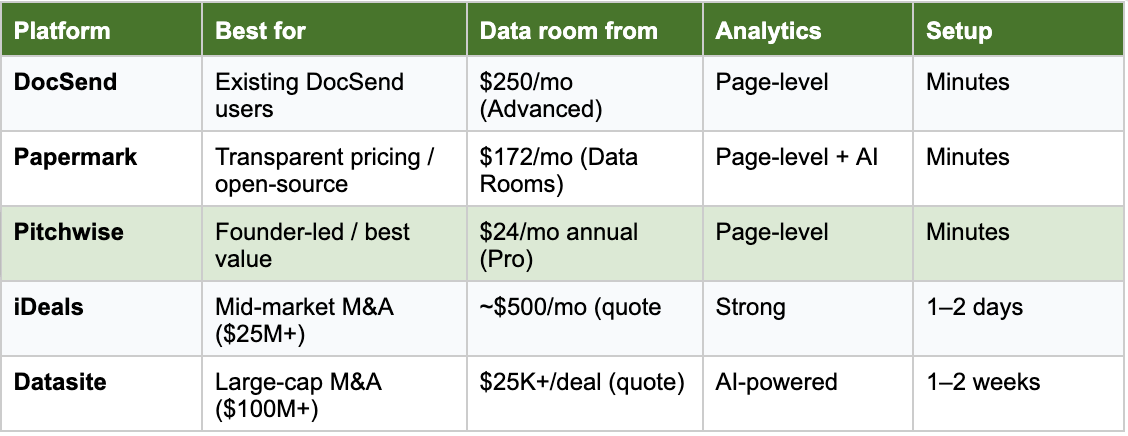
Quick comparison: M&A data room platforms at a glance
Quick comparison: M&A data room platforms at a glance
Which platform is right for your deal?
The right choice depends on deal size, the number of parties reviewing documents, and how much of the process requires formal audit trails or bidder isolation.
Pre-LOI / early exploration: You need to share a teaser or CIM with a small group securely. Pitchwise — set up in minutes, full engagement visibility, no unnecessary cost.
Formal due diligence with one buyer: A structured data room with audit logs and access controls. Pitchwise Pro ($24/month) handles this well for most founder-led transactions.
Sell-side process with multiple bidder groups: You need bidder isolation and a Q&A workflow. iDeals is the right step up.
Large-cap or cross-border transaction ($100M+): Datasite. Budget for it accordingly.
Frequently asked questions
How much does an M&A data room cost?
It depends entirely on which tier you need. Pitchwise Pro includes a data room from $24/month. Papermark's data room tier starts at $172/month. DocSend requires the Advanced plan at $250/month for data room access. Mid-market enterprise platforms like iDeals typically start at $500–$1,000/month. Datasite and Intralinks use deal-level custom pricing that commonly runs $25,000–$100,000+ per transaction. SRS Acquiom's research on 3,800+ M&A deals found that final invoices regularly exceed initial quotes by 2–10x on legacy platforms, so pricing transparency matters before you commit.
What should I look for in an M&A data room?
The six features that matter most in practice are granular access permissions at the file and folder level, page-level engagement analytics, the ability to revoke access after documents have been shared, a full audit log for compliance, clear pricing with no surprise overages, and fast setup. For smaller deals, Q&A module depth and enterprise compliance certifications are less critical — but become essential once the deal involves multiple bidder groups or regulatory review.
Can I use Google Drive for M&A due diligence?
For very early informal sharing, Google Drive works. But it lacks three things that matter once a process becomes formal: you cannot prevent a recipient from forwarding a link to a competitor, there is no page-level engagement data showing which documents received serious review, and there is no audit trail with legal standing. Once the process has moved to formal due diligence—with NDAs signed and financial documents being shared—a purpose-built data room is the appropriate tool.
How long does it take to set up an M&A data room?
Modern accessible-tier platforms (Pitchwise, Papermark) are live in minutes — upload your documents, configure permissions, and share the link. No sales call, no onboarding meeting. Mid-market enterprise platforms like iDeals typically require 1–2 days to configure properly. Datasite and Intralinks can take 1–2 weeks, including onboarding and dedicated project manager setup. For deals moving quickly, setup speed is a genuine differentiator.
What is the difference between a VDR and a data room?
The terms are used interchangeably. A virtual data room (VDR) is the digital equivalent of the physical room where buyers once reviewed confidential deal documents under supervision. The 'virtual' prefix has become redundant — both terms refer to the same category of secure, permissioned document-sharing platform used for M&A, fundraising, legal transactions, and due diligence.
Lorem ipsum dolor sit amet, consectetur adipiscing elit. Suspendisse varius enim in eros elementum tristique. Duis cursus, mi quis viverra ornare, eros dolor interdum nulla, ut commodo diam libero vitae erat. Aenean faucibus nibh et justo cursus id rutrum lorem imperdiet. Nunc ut sem vitae risus tristique posuere.
Lorem ipsum dolor sit amet, consectetur adipiscing elit. Suspendisse varius enim in eros elementum tristique. Duis cursus, mi quis viverra ornare, eros dolor interdum nulla, ut commodo diam libero vitae erat. Aenean faucibus nibh et justo cursus id rutrum lorem imperdiet. Nunc ut sem vitae risus tristique posuere.