By clicking “Accept All Cookies”, you agree to the storing of cookies on your device to enhance site navigation, analyze site usage, and assist in our marketing efforts. View our Privacy Policy for more information.
Most articles about European accelerators rank them by reputation or portfolio valuation. That is a different question from which ones actually produce founders who go on to raise Series A. The two lists are not identical.
Series A in Europe has become harder to reach. The seed-to-Series-A conversion rate dropped to around 38% in 2025, down from roughly 50% a few years earlier, and the average time between seed and Series A has stretched to 616 days. Picking the right programme matters more now than it did when capital was cheap.
This article focuses on six European programmes with verified track records at the Series A stage, what each one does well, and how to decide which fits your situation.
What actually determines Series A outcomes from an accelerator
The most useful thing an accelerator can give a founder heading toward Series A is direct relationships with the investors who write Series A cheques in Europe. Index Ventures, Accel, Balderton, Northzone, and Atomico are the names that matter at that stage. Programmes whose partners can make a credible warm introduction to those funds give their founders an advantage that is genuinely difficult to replicate independently.
The second factor is follow-on capital. Some programmes invest again at Series A, either through the same fund or a connected vehicle. That follow-on signal matters to outside investors. A lead partner who already knows your business and writes a cheque alongside a new investor sends a different message than one who quietly exits at seed.
Alumni network quality compounds over time. The strongest European programmes have alumni who are now founding partners at funds, operators at growth-stage companies, and angels writing cheques at the exact stage where Series A conversations start.
Lorem ipsum dolor sit amet, consectetur adipiscing elit. Suspendisse varius enim in eros elementum tristique. Duis cursus, mi quis viverra ornare, eros dolor interdum nulla, ut commodo diam libero vitae erat. Aenean faucibus nibh et justo cursus id rutrum lorem imperdiet. Nunc ut sem vitae risus tristique posuere.
The European accelerators with the strongest Series A track records
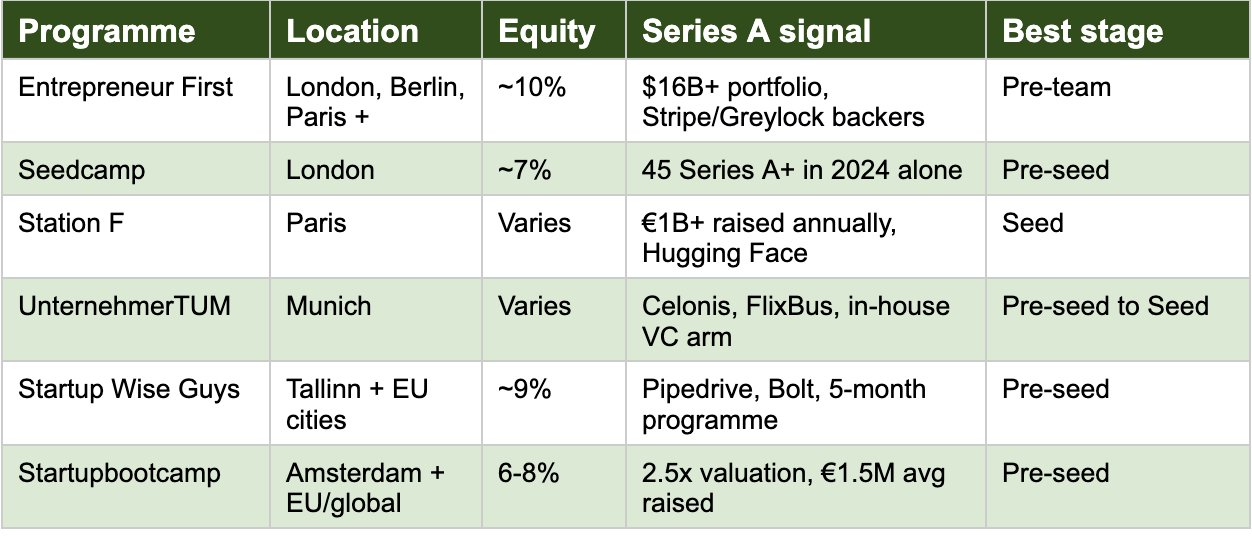
Six programmes have a verifiable track record of producing Series A companies in Europe. Each is different in structure, geography, and what it asks of founders. Here is how they compare.
Entrepreneur First
Entrepreneur First is a talent-first programme. Founders join as individuals, spend the first weeks building a team and validating an idea, and those who form strong founding pairs receive investment. EF runs programmes in London, Berlin, Paris, Bangalore, and Singapore, so it is one of the few European-originated programmes with genuine global reach.
The programme's investor base is unusually strong for a pre-seed accelerator. EF raised $158M in 2022 from backers including Patrick and John Collison of Stripe, Reid Hoffman, and Greylock Partners. Those relationships translate into introductions that most European accelerators cannot offer. The collective portfolio is valued at over $16B.
Notable alumni include Tractable, a computer vision company for insurance backed by Insight Partners; Cleo, an AI financial management platform backed by Sofina; and Sonantic, a voice AI company acquired by Spotify.
Best for: Technical founders without a co-founder or idea who want to build from scratch inside a high-quality peer group.
Equity taken: Approximately 10%, with initial investment at the team formation stage.
Seedcamp
Seedcamp operates as a pre-seed fund rather than a traditional cohort accelerator. It invests early, typically at the idea or prototype stage, and follows the company over multiple rounds. Fund VI closed at €166M in 2023, the largest European early-stage fund of its kind at the time.
The Series A track record is concrete. In 2024 alone, 45 Seedcamp portfolio companies raised Series A or later rounds. Revolut, now valued at over $33B, is among the portfolio companies. Wise is listed on the London Stock Exchange with a market cap above £8B. UiPath went public on the NYSE. Twenty portfolio companies have been acquired by buyers, including Stripe, Facebook, and Airbnb.
Seedcamp's approach works because it stays involved long after the initial investment. Founders get access to the Seedcamp Nation community and introductions to later-stage investors built up over 17 years. Operators across the portfolio are also available as advisors.
Best for: Pre-seed founders in Europe who want a long-term fund relationship rather than a programme cohort.
Equity taken: Approximately 7% at pre-seed entry.
Station F
Station F, located in Paris, is the largest startup campus in Europe. Over 1,000 startups work from the campus at any given time, running across 30+ programmes from corporate and VC partners. Google, Meta, and LVMH are among the names running resident programmes. The density of companies, investors, and corporates on a single campus creates a different kind of network than a traditional accelerator cohort.
Portfolio companies have raised over €1 billion annually since 2021. The most prominent alumni company is Hugging Face, the open-source AI platform that became Station F's first unicorn and has since raised over $395M. In 2026, Station F launched F/ai, a programme backed by OpenAI, Anthropic, Google, Meta, Microsoft, and Mistral. The first cohort of 20 startups collectively raised €34M.
Best for: Founders who want Paris as a base and benefit from the density of corporate and investor relationships the campus provides.
Equity taken: Varies by programme. Some programmes on campus are equity-free.
UnternehmerTUM
UnternehmerTUM, based in Munich and connected to the Technical University of Munich, was ranked the number one EU startup hub in 2026 by the Financial Times and Sifted. It has been running since 2002 and focuses on deep tech, climate tech, industrial technology, and AI.
The alumni base reflects the technical strength of the Munich research environment. Celonis, the process mining company, raised over $1B in funding before its Series D. FlixMobility, which operates FlixBus, is one of Europe's largest mobility companies. Isar Aerospace is building European launch vehicles and has raised over €300M.
UnternehmerTUM differs from most accelerators in that it operates its own venture capital arm, UVC Partners, which invests between €1M and €10M per round. Founders who go through the programme can access follow-on capital from a fund that already knows their business.
Best for: Technical and deeptech founders in Germany or Central Europe who want a programme with a strong research base and in-house follow-on capital.
Equity taken: Varies by programme and investment stage.
Startup Wise Guys
Startup Wise Guys is the most active accelerator in the Baltics and one of the most active in Central and Eastern Europe, running programmes across Tallinn, Riga, Vilnius, Copenhagen, Milan, and other cities. It invests approximately €50K for around 9% equity and runs a five-month programme, which is longer than most.
The extended programme length is a deliberate choice. Five months gives founders more time to reach the commercial milestones that Series A investors actually care about. The programme has accelerated over 350 startups across more than nine cohorts per year.
Notable alumni include Pipedrive, the CRM company that raised $65M in growth funding before being acquired, and Bolt, the Estonian mobility platform that has raised over €628M. Both came out of the Baltic startup scene that Startup Wise Guys helped build.
Best for: Early-stage B2B founders in Central or Eastern Europe who want a longer programme with hands-on commercial support.
Equity taken: Approximately 9%, with around €50K investment.
Startupbootcamp
Startupbootcamp, headquartered in Amsterdam, runs sector-focused cohorts across Europe and into the Middle East and Asia. It has supported over 1,600 startups since 2010 and runs more than 150 programmes across 20 countries. Each cohort focuses on a specific sector: fintech, deeptech, retail, health, and others.
The sector focus is the main differentiator. A fintech cohort gives founders direct access to the banks and specialist investors active in that space, relationships that are unlikely to surface through a generalist programme.
Best for: Founders in a defined sector who want warm introductions to corporate partners and specialist investors in that space.
Equity taken: 6-8%, with €25K investment and over €100K in partner perks.
How they compare
How the different accelerators compare
How to choose the right programme
The clearest filter is the stage. If you do not yet have a co-founder or a validated idea, Entrepreneur First is the only programme on this list designed for that situation. If you have a founding team and an early product, Seedcamp, Startup Wise Guys, and Startupbootcamp are all viable, depending on geography and sector.
If you are in Germany or have a deeptech product, UnternehmerTUM is worth prioritising over generalist programmes. The research infrastructure and the in-house VC arm create a combination that generalist accelerators cannot match for technical founders.
For founders who want Paris as a base and whose product has AI at its core, Station F's F/ai programme gives access to the major AI labs directly. That relationship is difficult to replicate through other programmes.
Geography matters more in Europe than it does in the US, because Series A investors in Europe still tend to be relationship-driven and city-specific. A London-based fund is more likely to lead a Series A for a company they met through Seedcamp or EF than for one they have never encountered. Choosing a programme in the city where you plan to live helps.
Frequently Asked Questions
Which European accelerator has the strongest track record for Series A?
Seedcamp has the most concrete published data, with 45 portfolio companies raising Series A or later rounds in 2024 alone. Entrepreneur First has the strongest investor network relative to programme stage, given its backers include the Collison brothers and Greylock. The right answer depends on your stage: Seedcamp is better if you have a product, while EF is better if you are still finding your co-founder.
How do European accelerators compare to Y Combinator for Series A outcomes?
Y Combinator produces more unicorns in absolute numbers, but the comparison is not straightforward. YC requires founders to be in San Francisco for the cohort, which is a significant barrier for European founders who plan to build and raise in Europe. The investors who lead European Series A rounds are typically European-based firms, and a Seedcamp or EF relationship gets you closer to those firms than a YC batch would. For founders who plan to raise a US-led Series A, YC remains the stronger option.
How long does it take to go from seed to Series A in Europe?
Based on 2025 funding data, the average time between seed and Series A is approximately 616 days, or around 20 months. That gap has been widening as Series A investors raise their requirements. European Series A rounds typically range from €5M to €20M on a post-money valuation of €30M to €60M, and investors expect meaningful revenue or very strong user growth before committing at that level.
Do I need to be based in Europe to apply to these programmes?
Most of these programmes accept international founders, but relocation is often required for the duration of the programme. Entrepreneur First runs cohorts in multiple cities globally, including outside Europe, so geography is less of a constraint there. Seedcamp invests across Europe without a campus residency requirement. Startupbootcamp and Startup Wise Guys have cohorts in multiple cities, so there is usually a location that works for European founders regardless of where they start.
Track who opens your accelerator application deck
When you apply to these programmes, your pitch deck goes to partners and scouts whose engagement you cannot see. Pitchwise lets you share your deck as a tracked link so you know who opened it and where their attention went. That tells you whether to follow up, when, and with what context. It takes minutes to set up and costs $24 a month.
Lorem ipsum dolor sit amet, consectetur adipiscing elit. Suspendisse varius enim in eros elementum tristique. Duis cursus, mi quis viverra ornare, eros dolor interdum nulla, ut commodo diam libero vitae erat. Aenean faucibus nibh et justo cursus id rutrum lorem imperdiet. Nunc ut sem vitae risus tristique posuere.
Lorem ipsum dolor sit amet, consectetur adipiscing elit. Suspendisse varius enim in eros elementum tristique. Duis cursus, mi quis viverra ornare, eros dolor interdum nulla, ut commodo diam libero vitae erat. Aenean faucibus nibh et justo cursus id rutrum lorem imperdiet. Nunc ut sem vitae risus tristique posuere.