By clicking “Accept All Cookies”, you agree to the storing of cookies on your device to enhance site navigation, analyze site usage, and assist in our marketing efforts. View our Privacy Policy for more information.
The Investor Data Room Checklist: Seed vs Series A (2026)
by
Oluwadamilare Akinpelu
A data room is not the same thing at seed as it is at Series A. The documents are different, the level of detail investors expect is different, and the questions your data room is answering are different. Showing up to a Series A conversation with a seed-stage data room, or overbuilding an elaborate room before your first investor meetings, wastes time on both sides.
This checklist covers what belongs in your data room at each stage, why each document is there, and what gets added as you move from seed to Series A. It is organised so you can use it directly, not just read it.
What a data room is actually for at each stage
At seed, an investor is asking a narrow set of questions. Who are these founders? Is the market real? Does the product exist in some form? Is there early evidence that people want it? At this stage, your data room supports a conviction already forming from the pitch. It does not need to be exhaustive. It needs to be credible.
At Series A, the investor is running a proper diligence process. They have likely seen your pitch, had several calls, and are now checking whether the story holds when they look at the numbers in detail. Series A due diligence can involve a legal team, a financial analyst, and reference calls with your customers. Your data room needs to hold up to that level of scrutiny across every document in it.
The wrong move at either stage is to dump every document you have ever created into a folder. A data room with fifty unlabelled files signals disorganisation. A data room with twelve well-organised, current files signals a founder who understands what investors need.
Lorem ipsum dolor sit amet, consectetur adipiscing elit. Suspendisse varius enim in eros elementum tristique. Duis cursus, mi quis viverra ornare, eros dolor interdum nulla, ut commodo diam libero vitae erat. Aenean faucibus nibh et justo cursus id rutrum lorem imperdiet. Nunc ut sem vitae risus tristique posuere.
These are the documents that belong in a seed data room. Each one answers a specific question that an investor will have. If a document does not answer a real question, it probably does not belong.
1. Pitch deck
The same deck you are sharing in meetings, in its most current version. Some founders maintain a shorter "teaser" deck for cold outreach and a longer deck for serious conversations. Both can live in the data room, clearly labelled, so the investor knows which to send to their partners.
2. Executive summary or one-pager
A single-page summary of the business: what you do, who you serve, your traction, the ask, and the team. This is what investors forward to colleagues when they want to get a second opinion quickly. If you do not provide one, they will use your deck for this purpose, which is less efficient.
3. Financial model (12 to 18 months)
A spreadsheet showing your revenue assumptions, cost structure, and cash position over the next twelve to eighteen months. Seed investors do not expect three-year models with high precision. They want to see that you understand your unit economics and have thought through how the capital will be deployed. Keep the assumptions visible and the logic clean.
4. Cap table
The current ownership breakdown, including all founders, any existing investors, and the option pool. Use a tool like Carta or a clean spreadsheet rather than a Word document. Investors will look at this to understand dilution and flag any issues before proceeding.
5. Incorporation documents
Certificate of incorporation and any shareholder agreements currently in place. Investors want to confirm the legal entity is properly set up, and there are no surprises in the governance structure. Keep this section brief. One or two documents are sufficient. A folder of every filing you have ever made adds noise without adding clarity.
6. Team information
Concise bios for each founder covering relevant background, past companies, and why this team is the right one to build this specific product. LinkedIn profiles work here if they are current and professional. Some founders include an org chart if the team has grown beyond the founding group.
7. Key metrics
A one-page dashboard showing your most important numbers: active users or revenue, growth rate over the last three to six months, churn if applicable, and any other metric central to your business model. If you have strong cohort data, include it. If you do not have much traction yet, show leading indicators rather than hiding the slide.
8. Product overview
Screenshots, a short demo video, or a product walkthrough document. Investors who do not get a live demo during the pitch will want to understand what the product actually does. A two-minute recorded demo is more useful than a deck full of feature descriptions.
9. Customer evidence (if available)
Letters of intent, signed contracts, case studies, or direct quotes from customers. Even informal evidence matters at seed. A screenshot of a Slack message from a customer saying your product solved a real problem is worth including. Investors are looking for a signal that the pain is real and that people are paying or committing to pay.
That is the seed data room. Nine categories. Everything beyond this adds clutter without adding conviction at the seed stage.
What gets added at Series A
Series A due diligence is materially deeper than seed. The investor is now running a process that may involve their portfolio operations team, a legal review, and customer reference calls. Your data room needs to support all of that without requiring back-and-forth on every document.
Full financial model with historical data
A three-year forward model plus actual historical financials: profit and loss, balance sheet, and cash flow statement. The historical data covers at least the past twelve months and ideally longer. Series A investors will rebuild your model in their own spreadsheet and check your assumptions against your actuals. Gaps between what you projected and what happened will come up in the conversation. Address them directly in the data room rather than waiting for an investor to surface them during diligence.
Revenue breakdown
A detailed view of revenue by customer, by cohort, or by product line, depending on your business model. Investors want to see concentration risk: what percentage of revenue comes from your top one or two customers, whether any single customer departure would materially change the numbers, and how new customer cohorts are performing compared to older ones.
Key customer contracts
The two or three most significant customer agreements were redacted where necessary for confidentiality. Investors at Series A are checking contract terms, renewal rates, and whether your commercial relationships are as strong as the pitch describes. You do not need every customer contract in the data room. The ones that represent meaningful revenue or that demonstrate the quality of your commercial relationships are sufficient.
Legal documentation
IP assignment agreements confirming that intellectual property created by founders and employees belongs to the company. Employment agreements for key team members, including vesting schedules. Any outstanding litigation, disputes, or encumbrances on the business. Investors are checking whether any legal issues would complicate the investment or a future exit.
Corporate governance documents
Board minutes from the past twelve months, any written consents, and current shareholder agreements. Series A investors joining a board want to understand how decisions have been made and whether governance has been handled properly. This is also where investors look for any existing investor rights that might complicate a new round.
Product roadmap
A twelve-month product plan covering what you are building and why. Investors will check this against your financial model to see whether your planned hires and spending align with the product priorities. Keep it honest. A roadmap that promises everything by Q2 will raise questions about resource allocation.
Technical and security overview
A brief document covering your technology stack, data handling practices, and any security certifications or audits you have completed. This matters more for B2B companies where enterprise customers require security reviews before signing. If you are handling sensitive customer data, investors will want to understand how it is protected.
Reference materials
Market research, competitive landscape analysis, or third-party reports that support the size of the opportunity. You do not need to commission custom research. Published reports from analysts, or a well-constructed competitive matrix you have built yourself, work well here.
Full checklist comparison
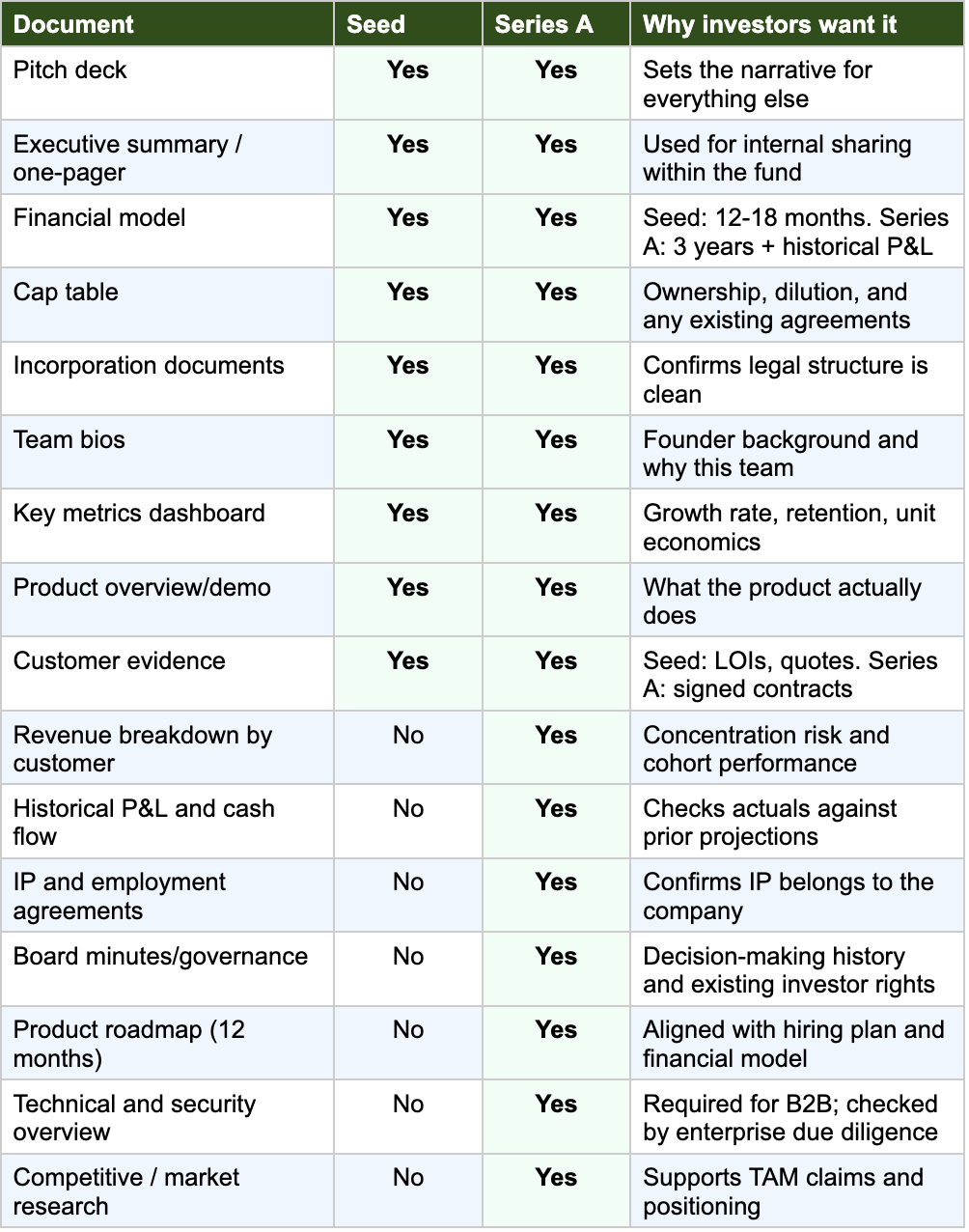
The table below maps every document to its stage. A downloadable and full version of this checklist is also available here if you want a version you can fill in as you build your room or to share it with a co-founder.
Full checklist comparison for Seed and Series A data rooms
What to leave out
The most common mistake is including documents that show activity rather than progress. Old board decks, internal strategy memos, and early product specifications add volume without adding conviction. If a document does not directly answer a question an investor would ask, it belongs somewhere else.
Do not include documents that are unfinished or outdated. A financial model with placeholder numbers or a pitch deck from six months ago does more damage than having no document at all. Every file in the data room should be current and complete before you share the link.
Avoid including sensitive information that is not yet relevant to the stage of conversation. Full customer contracts belong at Series A, not in a seed data room shared at the first meeting. Personal financial information about founders has no place in a fundraising data room at any stage.
How to organise the folder structure
A clear folder structure makes the difference between a data room that investors navigate confidently and one they have to message you to understand. Label folders by category rather than by date or document type.
A working structure for seed: a top-level folder with five subfolders: Pitch, Financials, Legal, Team, and Product. Each subfolder contains only what belongs in that category. Series A adds two additional folders: Customers and Governance.
Name documents with the date and a clear description. "Financial Model May 2026" is more useful than "Model v4 final FINAL." Investors may download documents and refer to them outside the data room weeks later; the filename should make clear what the document is without opening it.
Frequently Asked Questions
Do I need a data room for a seed round?
You do not need one from your first investor conversation. The point at which a data room becomes necessary is when a seed investor says they want to "do a bit of diligence" before committing. At that point, having a clean, organised set of documents to share is significantly better than sending individual files over email. Setting one up before you need it takes an afternoon and saves you from scrambling at the wrong moment.
How long should it take to build a seed data room?
If you have your documents in order, setting up a seed data room should take under two hours. The time goes into gathering current versions of each document, not into the tool itself. Most founders find that the process of building the data room surfaces gaps in their materials before an investor does, which is the better time to discover them.
Should I require an NDA before sharing my data room?
At seed, requiring an NDA before sharing a pitch deck typically slows conversations more than it protects you. Most seed investors will not sign an NDA at the early stages of a conversation. A better approach is to keep the earliest version of your data room to less sensitive materials like the deck and your metrics dashboard, then gate the financial model and customer contracts behind a separate link that you only share once a conversation is more advanced.
Can investors see who else has viewed the data room?
Only if you choose to tell them. A well-configured data room gives you visibility on investor engagement, not the other way around. You can see which investors have opened specific documents, how long they spent on each, and whether they have returned to the room. That information helps you prioritise follow-ups and know who is genuinely engaged without revealing your full investor list to anyone.
What is the difference between a data room and just sharing a Google Drive folder?
The functional difference is tracking and access control. A data room tells you who opened which document and when. It lets you disable access to a specific investor's link without affecting anyone else's. It also gives you version control, so when you update the financial model, investors are always seeing the current version rather than a download they took three weeks ago. Google Drive does none of this by default.
Share your data room and know who is actually reading it
Pitchwise gives you a data room where you can see exactly which documents each investor has opened and how long they spent on each one. When an investor says they are "still reviewing", you know whether that is true. When a partner at a fund opens your financial model for the first time, you know to follow up. Setup takes under ten minutes and costs $24 a month.
Lorem ipsum dolor sit amet, consectetur adipiscing elit. Suspendisse varius enim in eros elementum tristique. Duis cursus, mi quis viverra ornare, eros dolor interdum nulla, ut commodo diam libero vitae erat. Aenean faucibus nibh et justo cursus id rutrum lorem imperdiet. Nunc ut sem vitae risus tristique posuere.
Lorem ipsum dolor sit amet, consectetur adipiscing elit. Suspendisse varius enim in eros elementum tristique. Duis cursus, mi quis viverra ornare, eros dolor interdum nulla, ut commodo diam libero vitae erat. Aenean faucibus nibh et justo cursus id rutrum lorem imperdiet. Nunc ut sem vitae risus tristique posuere.