By clicking “Accept All Cookies”, you agree to the storing of cookies on your device to enhance site navigation, analyze site usage, and assist in our marketing efforts. View our Privacy Policy for more information.
Angel investors are individuals who invest their own money, typically at the earliest stage, sometimes before there is a product or revenue. Seed funds are institutional vehicles that invest from a managed fund, usually at a slightly later stage with more formal requirements. The main differences are check size, stage of entry, process formality, and what each type of investor looks for in a company.
Founders often use "angel" and "seed" interchangeably. They are not the same thing, and the distinction matters when you are deciding who to approach, when, and with what story.
Getting this wrong in practice means approaching the wrong type of investor at the wrong stage, pitching a seed fund when you only have an idea, or chasing angels when you need a $2M lead with board support. Understanding the difference saves time and relationship capital.
What is an angel investor?
An angel investor is an individual who invests their own personal capital into early-stage companies, typically in exchange for equity or a convertible instrument like a SAFE. Angels are usually successful founders, executives, or operators who have accumulated capital and want to invest it into startups, either for financial return, to stay close to the ecosystem, or to support founders in their industry.
Angel cheques typically run from $10,000 to $250,000, with most individual angels writing in the $25,000 to $100,000 range. "Super angels", experienced, high-volume angel investors, sometimes write $250,000 to $500,000 and may lead rounds or syndicate investments with other angels.
The defining characteristic of an angel is that they are investing their own money. This matters because their decision-making is typically faster, more personal, and less process-bound than institutional funds. They do not have investment committees, quarterly fund cycles, or LPs to report to. A good angel can commit in a week.
Lorem ipsum dolor sit amet, consectetur adipiscing elit. Suspendisse varius enim in eros elementum tristique. Duis cursus, mi quis viverra ornare, eros dolor interdum nulla, ut commodo diam libero vitae erat. Aenean faucibus nibh et justo cursus id rutrum lorem imperdiet. Nunc ut sem vitae risus tristique posuere.
A seed fund is an institutional venture capital fund that focuses specifically on seed-stage investments. Unlike angels, seed funds manage capital raised from limited partners (LPs), family offices, university endowments, fund-of-funds, and high-net-worth individuals and have a defined mandate, fund size, and expected return profile.
Seed funds write larger cheques, typically $500,000 to $3 million, and often take a more formal diligence process than angels. Many will request a data room, reference calls, and a partner-level meeting before committing. Some will take a board seat or observer role as a condition of investment.
Seed funds also have fund lifecycles to manage. They raise a fund, deploy it over three to four years, and then raise again. This creates real urgency within specific windows; a seed fund in the middle of deployment is a very different conversation partner than one that is just closing its new fund or has nearly fully deployed.
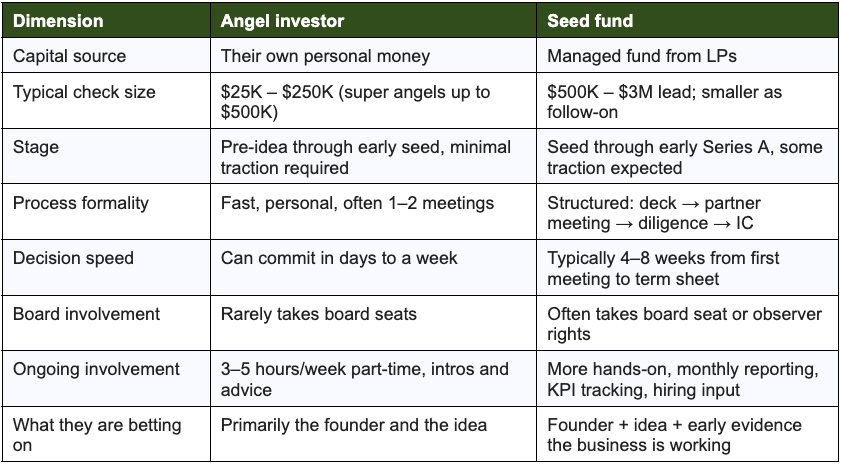
Key differences between angels and seed funds
Key differences between angels and seed funds
Who should you approach first, angels or seed funds?
The answer depends on where you are in the business. If you have an idea and a team but no product or revenue, angels are the right starting point. They are comfortable making a bet on a founder with conviction and a clear problem before there is much to show. Seed funds at this stage will often say, "come back when you have something to show."
Once you have a product in the market, early users or customers, and some traction signal, even if it is modest, seed funds become a viable conversation. They are looking for evidence that the idea is working, not just that it is interesting. The goal is to close a seed round with a lead seed fund anchoring the terms and angels filling in alongside.
✓ Tip: A common pattern: raise $250K–$500K from angels to reach your first traction milestone, then raise a $1.5M–$3M seed round led by a seed fund. The angel round builds credibility, extends runway, and gives you real evidence to show seed funds that the early thesis was right.
Pitchwise's investor database lets you filter by investor type (angel vs institutional), stage focus, sector, and check size, so you can build a targeted list of the right people to approach at the right time rather than blasting the same outreach to everyone. How to find the right investors for your startup covers how to use that filter to build a prioritised list.
What do angels and seed funds look for differently?
Angels primarily bet on founders. They are asking, 'Does this person have the conviction, the domain knowledge, and the drive to make something real?' They often invest in founders they know personally or who come through a warm introduction from someone in their network. A strong resume and a compelling personal story matter significantly.
Seed funds bet on founders plus evidence. By the time you are in conversation with a seed fund, they want to see that the product exists, that some people want it, and that there is a reasonable path to the business being worth something. The founder narrative matters, but it is the supporting evidence that unlocks the larger cheque.
When is the right time to start fundraising? maps the traction requirements at each stage in detail, including what angels vs. seed funds are typically looking for before they commit.
Frequently Asked Questions
What is the main difference between angel investors and seed funds?
Angels invest their own personal capital, usually at the earliest stage, with check sizes of $25K–$250K and fast, informal decision-making. Seed funds are institutional investors managing LP capital, writing $500K–$3M checks, requiring more formal diligence, and often taking board seats or observer rights.
Should you approach angels or seed funds first?
Angels first if you have an idea and a team but little or no traction. Seed funds once you have a product in the market and early evidence it is working. A common pattern is to raise $250K–$500K from angels to reach a traction milestone, then raise a larger seed round led by a seed fund.
How much do angel investors invest?
Most individual angels write checks of $25,000 to $100,000. Super angels, high-volume experienced angel investors, sometimes write $250,000 to $500,000 and may lead or syndicate rounds. The key characteristic is that they are investing their own money, which means faster and more personal decision-making.
What do seed funds look for in a startup?
Seed funds look for founders plus evidence: a product that exists, early traction (users, customers, revenue, or retention signal), a clear market, and a team that can execute. They typically require a more formal diligence process than angels, partner meetings, data room access, and reference calls before committing.
Lorem ipsum dolor sit amet, consectetur adipiscing elit. Suspendisse varius enim in eros elementum tristique. Duis cursus, mi quis viverra ornare, eros dolor interdum nulla, ut commodo diam libero vitae erat. Aenean faucibus nibh et justo cursus id rutrum lorem imperdiet. Nunc ut sem vitae risus tristique posuere.
Lorem ipsum dolor sit amet, consectetur adipiscing elit. Suspendisse varius enim in eros elementum tristique. Duis cursus, mi quis viverra ornare, eros dolor interdum nulla, ut commodo diam libero vitae erat. Aenean faucibus nibh et justo cursus id rutrum lorem imperdiet. Nunc ut sem vitae risus tristique posuere.