By clicking “Accept All Cookies”, you agree to the storing of cookies on your device to enhance site navigation, analyze site usage, and assist in our marketing efforts. View our Privacy Policy for more information.
The right time to start fundraising is when you have enough runway to run a proper process, something concrete to show that reduces investor risk, and a clear sense of what the money will do. Most founders start too early, which burns relationships and wastes the runway the raise was supposed to protect.
Fundraising feels urgent long before it is ready. Founders often start the process when they are anxious about runway rather than when the conditions are right. Those two starting points produce very different outcomes.
Starting too early, before you have anything concrete to show, before the story holds together, before you know what the money will actually do, does not accelerate the process. It burns relationships with investors who pass, and it uses up runway that the raise was supposed to replace.
Lorem ipsum dolor sit amet, consectetur adipiscing elit. Suspendisse varius enim in eros elementum tristique. Duis cursus, mi quis viverra ornare, eros dolor interdum nulla, ut commodo diam libero vitae erat. Aenean faucibus nibh et justo cursus id rutrum lorem imperdiet. Nunc ut sem vitae risus tristique posuere.
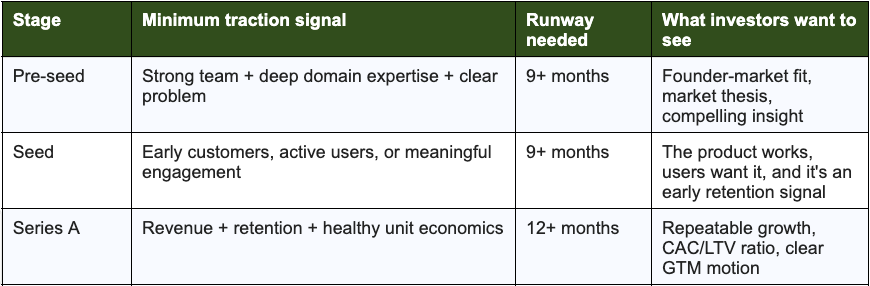
Three conditions together signal readiness: you have enough runway to run a full process without panic, you have something that reduces investor risk at your stage, and you can articulate clearly what the money will do. What "something concrete" looks like varies significantly by stage:
Should you raise before or after product-market fit?
It depends on the round. Pre-seed and seed rounds are often raised before product-market fit is achieved; the entire premise is that the investment will help you find it. Series A rounds are almost always raised after, because investors writing larger cheques want to see that the product is working before they fund the scaling.
The honest question to ask before starting a raise is, 'Will more capital solve the current problem, or is the current problem something that more capital cannot fix?' If the answer is the latter, the right move is to fix the problem before raising rather than raising in the hope that the money will fix it.
What should you have in place before your first investor meeting?
These are the non-negotiables. Missing any of them slows the process down or damages first impressions:
☐ A pitch deck that stands alone, generates a response when sent without you presenting it
☐ A data room with at least the core documents ready to share quickly
☐ Key metrics you can speak to from memory without confusion or hedging
☐ A researched list of 30-50 target investors matched to your stage, sector, and geography
☐ IP assignments in place and a clean, reconciled cap table
☐ Any outstanding equity commitments or informal agreements resolved
Yes, in practice. September through November and January through April are the most active fundraising windows. Investors are at their desks, funds are deploying, and decision-making timelines are shorter. December and August are the quietest months; partners are on holiday, investment committees are delayed, and processes that start then tend to drift.
If your business conditions are right and you start in September, you can realistically target a December or January close. The timing of the market is a secondary consideration; a startup hitting real milestones can be raised in August. But when everything else is equal, the seasonal window matters for timelines. How to build real urgency in your fundraise covers how to run a tight, time-bounded process once you have decided to start.
What happens if you start fundraising too early?
You use up relationship capital with investors who pass, and those passes are on record. Investors talk to each other, and a founder who came in too early with a weak deck or thin traction is remembered when they come back. The bar is higher on the second approach because the investor has already formed an impression.
⚠ Watch out: Every week spent in investor meetings before you are ready is a week not spent reaching the milestone that would have made the fundraise easier. Starting a round too early is not just ineffective; it is actively costly to the business.
How do you know when you are ready to start fundraising?
When you have at least six months of runway to run a proper process, something concrete that reduces investor risk at your stage, and a clear answer to what the money will do. If any of these three are missing, the process will be harder than it needs to be.
How much traction do you need before raising money?
It depends on the round. Pre-seed investors back teams and ideas with little or no traction. Seed investors want an early signal like customers, users, or meaningful engagement. Series A investors expect revenue, retention, and unit economics. Traction requirements step up significantly at each stage.
Should you raise before or after product-market fit?
Pre-seed and seed rounds are often raised before product-market fit. Series A is almost always raised after, because investors at that stage are funding scale, not discovery. Trying to raise a Series A before the product is working will almost always produce a pass.
What is the best time of year to start fundraising?
September through November and January through April are the most active windows. December and August are the quietest. If the business conditions are right, these seasonal patterns are secondary, but they affect process timelines significantly when everything else is equal.
Lorem ipsum dolor sit amet, consectetur adipiscing elit. Suspendisse varius enim in eros elementum tristique. Duis cursus, mi quis viverra ornare, eros dolor interdum nulla, ut commodo diam libero vitae erat. Aenean faucibus nibh et justo cursus id rutrum lorem imperdiet. Nunc ut sem vitae risus tristique posuere.
Lorem ipsum dolor sit amet, consectetur adipiscing elit. Suspendisse varius enim in eros elementum tristique. Duis cursus, mi quis viverra ornare, eros dolor interdum nulla, ut commodo diam libero vitae erat. Aenean faucibus nibh et justo cursus id rutrum lorem imperdiet. Nunc ut sem vitae risus tristique posuere.