By clicking “Accept All Cookies”, you agree to the storing of cookies on your device to enhance site navigation, analyze site usage, and assist in our marketing efforts. View our Privacy Policy for more information.
A bridge round is short-term funding, typically $500K to $2M via SAFE or convertible note, designed to extend runway to a specific milestone before your next major round. Used correctly, a bridge buys time and preserves optionality. Used incorrectly, it delays an inevitable difficult decision and signals distress to the investors you will need next. The difference usually comes down to whether the bridge has a clear target it is bridging to.
Bridge rounds have a bad reputation they do not entirely deserve. Most of the damage comes not from the bridge itself but from the circumstances that lead founders to raise one without thinking clearly about what it is supposed to achieve.
A bridge round is not a failed round. It is a deliberate decision to extend the runway for a specific reason. The question is whether that reason is strong enough to justify the dilution, the complexity it adds to the cap table, and the signal it sends to future investors.
What is a bridge round?
A bridge round is a short-term financing round raised between two larger rounds, typically between seed and Series A, or between Series A and Series B. It is usually structured as a SAFE or convertible note rather than a priced equity round, which means it is faster to close and avoids the complexity of setting a new valuation at a potentially awkward moment.
Bridge rounds are typically smaller than the round they are bridging to; $500,000 to $2 million is common. They are usually raised from existing investors who know the company well, though strategic or new investors sometimes participate. The explicit purpose is to extend runway to a defined milestone that will support a stronger position for the next major round.
When is the right time to start fundraising? covers how to time fundraising more broadly; the bridge round decision fits within the same framework of runway, milestones, and market conditions.
Lorem ipsum dolor sit amet, consectetur adipiscing elit. Suspendisse varius enim in eros elementum tristique. Duis cursus, mi quis viverra ornare, eros dolor interdum nulla, ut commodo diam libero vitae erat. Aenean faucibus nibh et justo cursus id rutrum lorem imperdiet. Nunc ut sem vitae risus tristique posuere.
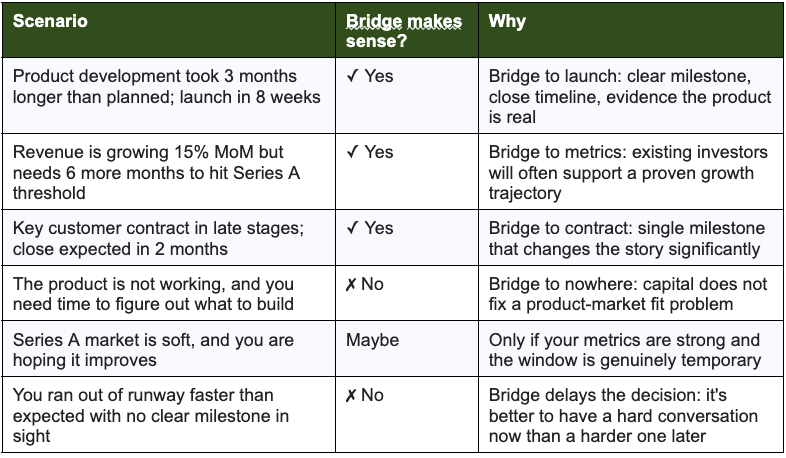
A bridge makes sense when there is a specific milestone you can credibly reach with the additional capital, and reaching that milestone will meaningfully change the quality of your next raise. The milestone has to be real, not a vague hope for better metrics, but a concrete marker: a specific revenue target, a product launch, a customer contract, or a regulatory clearance.
It also makes sense when market conditions are temporarily unfavourable and you have the evidence that you will be raising into a stronger position in six to twelve months. This is particularly relevant in periods when public market conditions suppress private market valuations. A bridge that avoids a down round can preserve meaningful value if the timing is genuinely working against you.
When does a bridge round make sense
When does a bridge round make things worse?
A bridge makes things worse when it is used to avoid a difficult decision rather than to enable a clear next step. If the fundamental problem is that the product has not found its market, more runway does not fix it; it just delays the point at which the money runs out. Every month you spend on a bridge in this situation is a month of dilution, cap table complexity, and investor patience expended without improving the underlying situation.
The signalling risk is also real. When a Series A investor looks at your cap table and sees a bridge note sitting between your seed and their proposed round, the first question is why you needed it. A good story, "we bridged to our revenue target and hit it," is fine. "We missed our milestones and needed more time" is a harder conversation, especially if the bridge has not yet produced the improvement it was supposed to.
⚠ Watch out: Stacking multiple SAFEs at low valuation caps is a common bridge mistake. Each SAFE converts into equity at a discount at your next priced round. Do the math on the combined dilution before you close; founders who do not run the numbers are often surprised at how much of the company they have given away by the time the Series A is priced.
How should you structure a bridge round?
The instrument choice, SAFE versus convertible note, matters less than the valuation cap. Too low a cap signals you are in a weak position; too high a cap gives investors less incentive to participate. A practical rule of thumb: the bridge cap should be 20 to 30 per cent above the previous round's valuation, offering the bridge investors a meaningful discount to the Series A without advertising distress.
Keep the bridge small relative to your runway need. If you need six months of runway, raise funds for six months plus a reasonable buffer. Raising a large bridge when you need a small one is cap table damage you will feel at Series A. Raising a small bridge that does not actually get you to the milestone means doing it again, which compounds the signalling problem.
Approach existing investors first. An existing investor who participates in a bridge is sending a positive signal; it tells new investors that the people who know the company best are still backing it. An existing investor who declines to participate in a bridge is a much more concerning signal, particularly if it becomes known during the Series A diligence process. How to build real urgency in your fundraise covers how to use investor dynamics constructively rather than letting them work against you.
When you send bridge materials to existing investors, use a tracked link via Pitchwise rather than an email attachment. You can see which investors open the deck update, how long they spend on the financials page, and whether they forward it to a partner before responding. That engagement tells you who is likely to say yes before you get on a call, so you can sequence conversations in the right order.
What do Series A investors think when they see a bridge on your cap table?
A bridge note on a cap table is not disqualifying. Most experienced Series A investors have seen many. What they are looking for is the story: why was the bridge raised, what milestone was it targeting, and did the company hit it? If the answers are crisp and the metrics show the bridge did its job, it is a non-issue.
What Series A investors do not want to see is a bridge that has been sitting on the cap table for 18 months without a clear outcome, or a bridge that was raised to avoid a down round and has simply delayed the pricing conversation without improving the underlying metrics. In those cases, the bridge becomes part of the diligence conversation in ways that are harder to navigate.
Pitchwise lets you track which Series A investors who previously passed re-engage with your deck after the bridge milestone is hit. An investor who opens your materials again after six months of silence is the right person to reach out to proactively. You know they are paying attention again before they have said a word.
Investor engagement signals that predict a term sheet covers what Series A investors are actually looking for when they engage deeply with a company; understanding their diligence lens helps you anticipate the bridge conversation before it happens.
Frequently Asked Questions
What is a bridge round in startup fundraising?
A bridge round is short-term financing, typically $500K to $2M via SAFE or convertible note, raised between two larger rounds to extend runway to a specific milestone. It is faster to close than a priced equity round and is usually raised from existing investors who know the company.
When should a startup raise a bridge round?
When there is a specific, credible milestone you can reach with the additional capital and that milestone will meaningfully improve your next raise, a revenue target, product launch, key customer contract, or regulatory clearance. A bridge without a clear milestone to bridge to is just delayed dilution.
Is a bridge round bad for a startup?
Not inherently. A bridge that enables a clear next step and reaches its target milestone is a sensible tool. A bridge that delays an inevitable difficult decision – product not working, no clear path to metrics – makes things worse by adding dilution and cap table complexity without solving the underlying problem.
How should you structure a bridge round?
Use a SAFE or convertible note. Set the valuation cap at 20–30% above your previous round's valuation, a meaningful discount for bridge investors without signalling distress. Keep the size matched to your actual runway need. Approach existing investors first; their participation sends a positive signal to future investors.
Lorem ipsum dolor sit amet, consectetur adipiscing elit. Suspendisse varius enim in eros elementum tristique. Duis cursus, mi quis viverra ornare, eros dolor interdum nulla, ut commodo diam libero vitae erat. Aenean faucibus nibh et justo cursus id rutrum lorem imperdiet. Nunc ut sem vitae risus tristique posuere.
Lorem ipsum dolor sit amet, consectetur adipiscing elit. Suspendisse varius enim in eros elementum tristique. Duis cursus, mi quis viverra ornare, eros dolor interdum nulla, ut commodo diam libero vitae erat. Aenean faucibus nibh et justo cursus id rutrum lorem imperdiet. Nunc ut sem vitae risus tristique posuere.