A one-pager is not a short pitch deck. It is a different document with a different job: getting someone who has never heard of you to agree to a first conversation. That distinction changes everything it should include.
Most founders write their one-pager as a summary of their pitch deck, which makes it too long, too detailed, and too focused on answering questions the investor has not asked yet. This guide covers what actually belongs on a one-pager and what to cut.
What is an investor one-pager?
A one-pager is a single-page document that gives an investor enough information to decide whether to take a meeting. It is typically sent as the first touch in a cold outreach sequence, as a leave-behind after a conference introduction, or alongside an introductory email.
It is not the document that closes the round. That is the pitch deck. The one-pager exists only to earn the next step. If you think about what to send an investor before your pitch deck, the one-pager is often the right answer.
| Situation | Use a one-pager | Use a pitch deck |
|---|
| Cold outreach via email | Yes -- keeps the ask small | Too much to send cold |
| Conference follow-up | Yes -- lightweight leave-behind | Only if they asked for the deck |
| Investor already knows you | No | Send the deck directly |
| Formal fundraise process | No | Deck is expected |
| LP or family office intro | Depends on formality | Usually expected at first meeting |
What to include on a startup one-pager
The headline
One sentence. What the company does, who it does it for, and the specific outcome it delivers. This is not a tagline or a vision statement. It is a plain description that lets the investor immediately understand what they are looking at.
Bad: "We are revolutionising the way founders connect with capital." Good: "Pitchwise helps startup founders track who opens their pitch deck and data room, so they know which investors are actually interested."
Problem and solution
Two to four sentences each. The problem section should describe a real friction the target customer experiences, ideally with a number attached if one is credible. The solution section should state clearly what the product does to remove that friction. Avoid describing the product's features here; describe the outcome.
Market size
A single number with a credible source, or a brief calculation showing how you arrived at it. Total addressable market figures from analyst reports are common but often dismissed. A bottom-up calculation showing how many buyers exist multiplied by what they spend on the problem is more convincing.
Traction
The most important section for early-stage investors. Include your most compelling metric: ARR, MRR, number of paying customers, growth rate over the last three months, or a notable enterprise customer. If you are pre-revenue, include usage metrics, waitlist size, or pilot commitments. Do not leave this section out because the numbers feel early; some number is always better than none.
Team
Two to three lines. Relevant prior experience only. If a founder built and sold a company in this space before, that belongs here. If a founder has a PhD relevant to the core technology, that belongs here. Generic credentials do not.
The ask
State the amount you are raising, the instrument (SAFE, priced round, convertible note), and how far along the round is. Investors will not reach out to find out how much you are raising. If the amount is not on the document, it will not be on their calendar either.
What to leave out
- A full product roadmap
- More than two or three competitor names
- Financial projections for years three through five
- Legal disclaimers or confidentiality notices
- More than one page
The last point is the most common failure. Founders add one more section and then one more after that until the document is three pages long. At that point it is a short pitch deck, not a one-pager, and the investor's calculus changes from "do I want to take a meeting" to "is this worth reading."
Format and length
One page. PDF format. The layout should be readable at a glance, with clear section labels and enough whitespace that it does not look crowded. Use a single font at two sizes maximum. Black text on a white background unless your brand has a strong visual identity that is worth carrying into fundraise documents.
Do not use a deck template with one slide per idea. The one-pager is a document, not a slide. It should read top to bottom in sixty seconds.
How to send it
Send the one-pager as a link rather than an attached PDF. Attachments are less likely to be opened and you lose all visibility once the file leaves your outbox. When you send a tracked link you can see whether the investor opened it, how long they spent reading it, and whether they came back. That information changes how and when you follow up.
You have two options on Pitchwise. You can upload your one-pager as a PDF and share a tracked link -- the investor clicks through and reads the document, and you see the open event in real time. Or you can create a teaser: a short preview that surfaces your headline, problem, and ask before the investor decides to open the full document. The teaser works well for cold outreach because it gives the investor enough to be curious without requiring them to open an attachment or click to a new page immediately.
Either way, share the link with controls set: no download, no forwarding, an expiry date if you want one. If an investor forwards it to a partner at their fund, you will see that too.
FAQ
Should a one-pager include a deck link?
Not in the first message. The one-pager is the ask for a meeting. If you also attach the deck, you are asking them to do more work before they have agreed to anything. Send the one-pager, wait for a response, and share the deck when they ask or when you have the meeting confirmed.
Is a one-pager the same as an executive summary?
They are similar but not identical. An executive summary is typically a longer document, one to three pages, written for a reader who has already agreed to evaluate the opportunity. A one-pager is for a reader who has not yet decided whether to look. The executive summary can include more context, more financials, and more detail on the team. The one-pager cannot.
Do I need a different one-pager for angels vs VCs?
Slightly. Angels tend to invest based on team and market more than metrics, so you can lead with the founding story and problem insight. VCs, especially at seed and Series A, want to see traction and growth rate before anything else. The structure is the same; the emphasis on the traction section changes.
What if I have no traction yet?
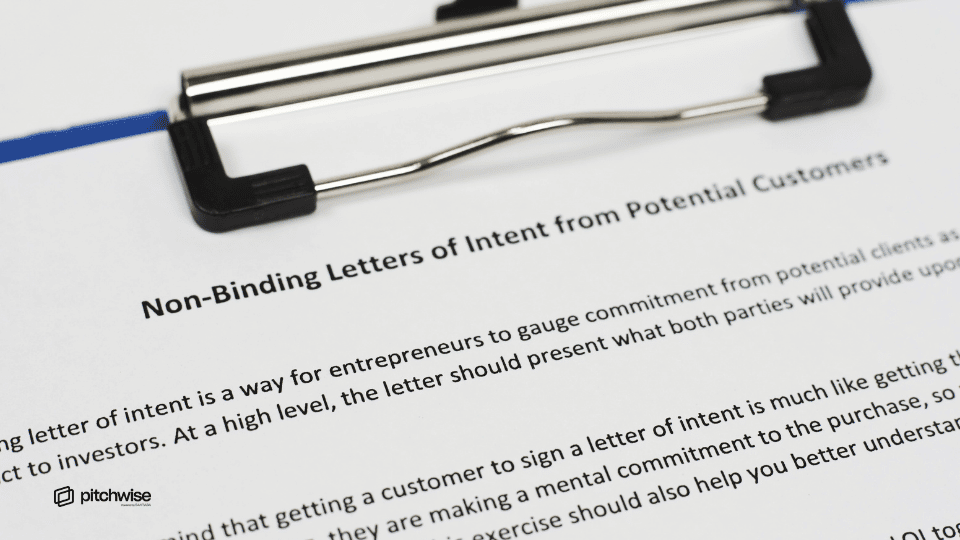
Include what you do have: letters of intent from potential customers, waitlist sign-ups, pilot commitments, or relevant research or domain expertise that explains why you are the right team for this problem. Never leave the traction section blank or skip it entirely. Something is always better than nothing, and "pre-revenue" with a strong early signal is a fundable position.