By clicking “Accept All Cookies”, you agree to the storing of cookies on your device to enhance site navigation, analyze site usage, and assist in our marketing efforts. View our Privacy Policy for more information.
A term sheet is a non-binding summary of the proposed terms of an investment. It covers two main areas: economic terms, which determine how much each party owns and what they earn in different exit scenarios, and control terms, which determine how much influence the investor gets over company decisions. Both matter, but founders often focus too much on valuation and too little on control.
Receiving a term sheet is one of the most significant moments in a fundraise. It is also one of the most misunderstood.
Most founders focus immediately on the valuation number. The valuation matters, but the terms that most affect your experience of having an investor – the control provisions, the liquidation preferences, and the anti-dilution clauses – are the ones that many founders barely read.
Is a term sheet legally binding?
Mostly no. A term sheet is typically a non-binding document. It records the proposed terms that both sides have agreed to in principle, but it does not create a legal obligation to invest or to accept investment. Either side can walk away from a term sheet without legal consequence, though doing so without good reason damages the relationship significantly.
The binding exceptions are almost always confidentiality and exclusivity. The exclusivity clause (sometimes called "no-shop") prevents you from soliciting other investors while the term sheet is in play and the legal documentation is being finalised. This clause typically runs for thirty to sixty days. Breaking it has real legal consequences even if the rest of the term sheet does not.
→ Key rule: Treat a term sheet as morally binding even where it is not legally binding. An investor who walks away without a material reason damages their reputation. A founder who does the same does the same.
Lorem ipsum dolor sit amet, consectetur adipiscing elit. Suspendisse varius enim in eros elementum tristique. Duis cursus, mi quis viverra ornare, eros dolor interdum nulla, ut commodo diam libero vitae erat. Aenean faucibus nibh et justo cursus id rutrum lorem imperdiet. Nunc ut sem vitae risus tristique posuere.
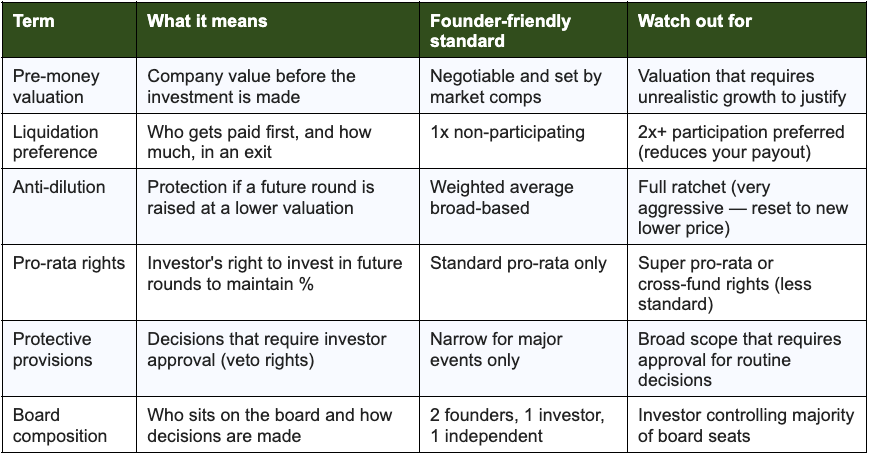
Term sheets have two distinct halves. Here is what the most important terms in each actually mean and what the founder-friendly standard looks like:
Key terms of a term sheet decoded.
What should founders pay attention to when reviewing a term sheet?
Start with the liquidation preference structure; 1x non-participating is standard and fair. Anything with a higher multiple or participation rights should be pushed back on. Then look at the protective provisions to understand what decisions require investor approval and whether that scope feels right for your stage.
Board composition deserves careful thought. A seed-stage board with two founders, one investor, and one independent is common and manageable. A board where the investor has effective control through seat allocation or veto rights creates friction that compounds over time, especially if the relationship becomes difficult.
Get a lawyer who has reviewed startup term sheets before. Pitchwise's investor database can help you find founders who have raised from the same investor; speaking to them about what the term sheet looked like in practice is due diligence you should not skip. Investor engagement signals that predict a term sheetcovers the signals that tell you when a term sheet is actually coming.
What happens after you sign a term sheet?
After signing, the investor's legal team will begin drafting the final transaction documents, typically a stock purchase agreement, an investor rights agreement, and amendments to the company's articles of incorporation. This process takes two to eight weeks depending on the complexity of the deal and how prepared your data room is.
During this period, the investor will complete formal due diligence. What goes in a Series A data room covers what they will want to see. The exclusivity window runs from term sheet signing through close; do not approach other investors during this period.
Frequently Asked Questions
Is a term sheet legally binding?
Mostly no. A term sheet records proposed terms in principle but creates no legal obligation to invest or accept investment. The binding exceptions are almost always confidentiality and the exclusivity clause, which prevents you from approaching other investors while the deal is being documented. Breaking these has real legal consequences.
What are the key terms in a term sheet founders should focus on?
Liquidation preference structure (1x non-participating is standard), anti-dilution provisions (weighted average is more founder-friendly than full ratchet), board composition, and the scope of protective provisions. Most founders focus on valuation; valuation matters, but these terms determine what the investment relationship actually feels like in practice.
What should a founder look for in a term sheet?
Watch for liquidation preferences above 1x, participating preferred provisions, board structures that give the investor effective control, and unusually broad protective provisions. All of these are negotiable; knowing which are market-standard is the first step.
What happens after you sign a term sheet?
Legal documentation begins: stock purchase agreement, investor rights agreement, and articles amendments. Formal due diligence runs in parallel. The exclusivity clause means you cannot approach other investors. The process takes two to eight weeks depending on deal complexity and data room readiness.
Lorem ipsum dolor sit amet, consectetur adipiscing elit. Suspendisse varius enim in eros elementum tristique. Duis cursus, mi quis viverra ornare, eros dolor interdum nulla, ut commodo diam libero vitae erat. Aenean faucibus nibh et justo cursus id rutrum lorem imperdiet. Nunc ut sem vitae risus tristique posuere.
Lorem ipsum dolor sit amet, consectetur adipiscing elit. Suspendisse varius enim in eros elementum tristique. Duis cursus, mi quis viverra ornare, eros dolor interdum nulla, ut commodo diam libero vitae erat. Aenean faucibus nibh et justo cursus id rutrum lorem imperdiet. Nunc ut sem vitae risus tristique posuere.