
Most founders sign a SAFE without fully understanding what it means for their cap table when the money converts. This simulator makes that clear before it happens.
You enter six inputs on the SAFE Simulator sheet:
- Investment amount
- Valuation cap
- Discount rate
- Shares currently issued
- Option pool size
- Predicted valuation at your next equity round
The model then calculates the price per share under each SAFE structure, clearly labelled by type. It shows the investor's shares, their ownership percentage, and what existing shareholders keep after conversion. Blue cells are your inputs. Everything else is calculated automatically.
The four SAFE structures it compares
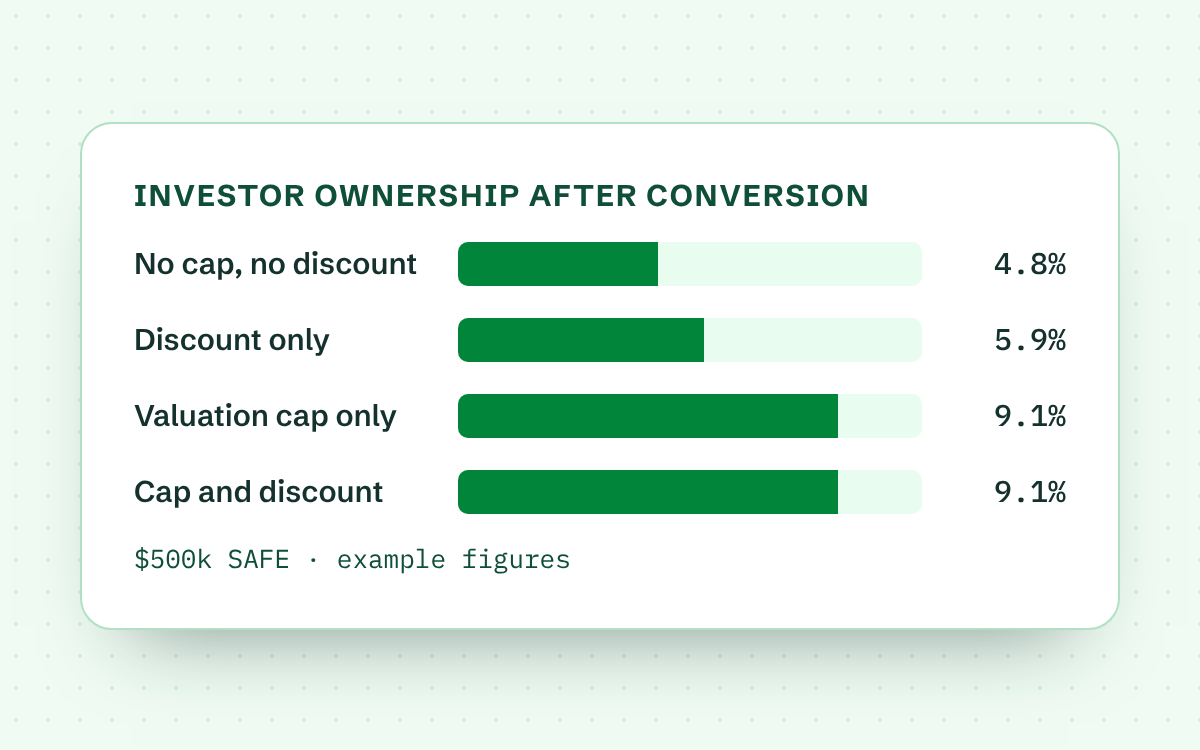
The simulator models all four structures side by side, so you can see how the same cheque produces very different ownership.
- No cap, no discount. The SAFE converts at the price of the next equity round.
- Valuation cap only. The SAFE converts at the cap price if the round is priced above the cap.
- Discount only. The SAFE converts at the round price less the agreed discount.
- Cap and discount. The investor gets whichever of the two gives the lower price per share. The glossary calls this the Most Favourable Price.
If you are still deciding how to raise, read SAFE vs Equity: What Should You Raise With? first.
Modelling several SAFEs at once
Real rounds rarely involve one SAFE. The Multi-SAFE sheet handles up to five investors converting at the same round, each with their own cap and discount. The model calculates shares and ownership for each, totals them, and gives you a clean post-conversion summary: SAFE investors combined against founders and existing shareholders.
Once you know the converted share counts, carry them into the Startup Cap Table Template to see the rounds that follow.
What's inside
- Single SAFE simulator with all four scenarios modelled side by side
- Calculated price per share for each SAFE type, clearly labelled
- Results section showing investor shares, ownership percentage and founder retention
- Multi-SAFE sheet for up to five investors converting at the same round
- Post-conversion cap table summary showing total dilution across all SAFEs
- Plain English glossary explaining Valuation Cap, Discount Rate, Most Favourable Price and Fully Diluted
Who it's for
- Founders who have signed or are about to sign a SAFE and want to understand the dilution impact
- Founders preparing for a priced equity round where existing SAFEs will convert
- Operators and advisors helping early-stage companies model their cap table
SAFE questions founders ask
What is a SAFE?
A SAFE is a Simple Agreement for Future Equity. The investor pays now and receives shares later, usually when you raise a priced equity round. Unlike a convertible note, a standard SAFE is not debt, so it carries no interest and no maturity date.
What is a valuation cap?
The cap is the highest valuation at which the SAFE converts. If your next round is priced above the cap, the SAFE investor converts as if the company were worth the cap, so they receive more shares for the same money.
What is a discount rate on a SAFE?
The discount lets the SAFE investor buy shares at a reduced price compared with the new investors in the next round. A discount of around 20 per cent is common, which means paying 80 per cent of the round price.
When does a SAFE convert?
A SAFE normally converts at your next priced equity round. It can also convert or pay out at a liquidity event such as an acquisition. The exact triggers are set out in the agreement, so read yours.
What is the difference between a pre-money and a post-money SAFE?
A post-money SAFE fixes the investor's ownership after all SAFEs have converted, so each new SAFE dilutes the founders and not the other SAFE holders. A pre-money SAFE is calculated before the other SAFEs are counted, which makes the final ownership harder to predict.
How much dilution do SAFEs cause?
It depends on the amount raised, the cap, and the price of the round they convert into. Enter your own terms in the simulator to see the answer for your company before you sign.
Can I use the simulator for SAFEs I have already signed?
Yes. Enter the terms from each signed SAFE on the Multi-SAFE sheet and set your expected next-round valuation. You will see what each investor converts into before the round is priced, which helps when you negotiate the new round.
What if I am not sure what my next valuation will be?
Run several scenarios. Change the predicted valuation and watch how ownership moves under each SAFE structure. The cap matters most when the next round is priced well above it.