

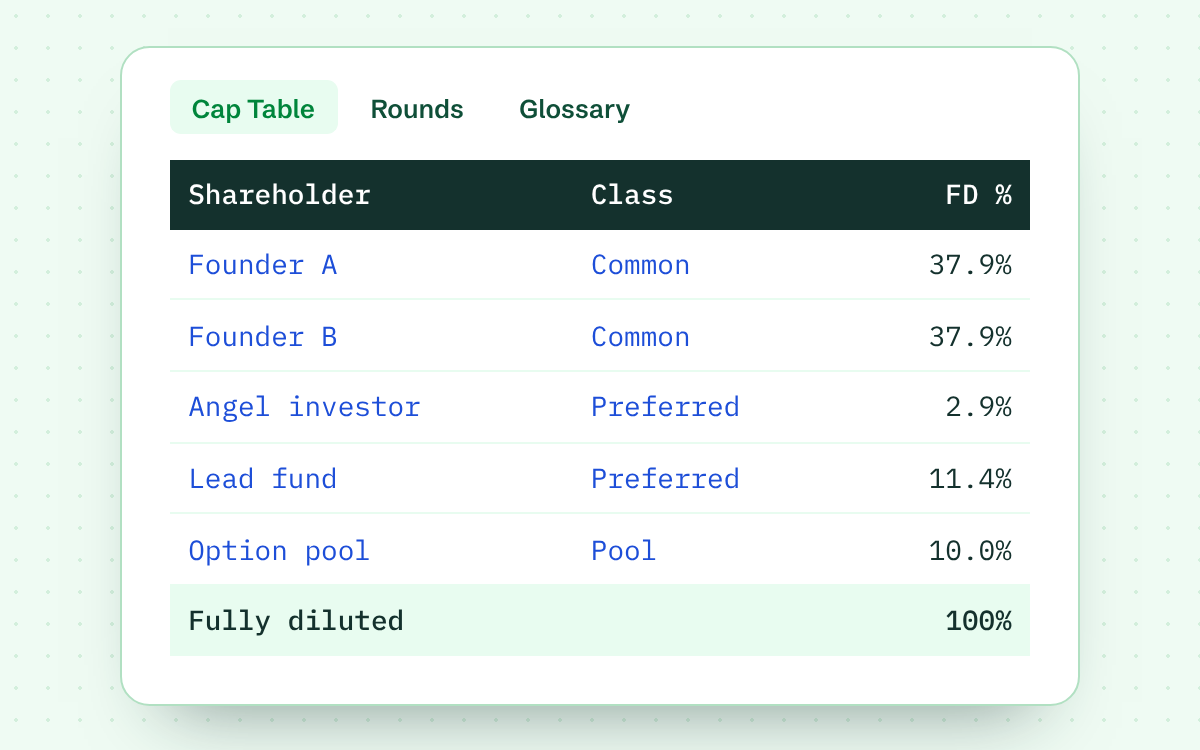
Most founders find out what a round actually costs them after they have signed it. This template is built to show you beforehand. It is an open shareholder ledger that runs from incorporation through Series B. Every shareholder gets their own row: founders, angels, funds, advisors and the option pool. There is room for 150 shareholders, so a long angel list or several rounds of follow-ons fit without touching a formula.
The model runs on two connected sheets.
- Price the round. On the Rounds sheet, set each round's pre-money valuation and target option pool. The model works out the price per share every investor in that round pays.
- List every holder. On the Cap Table sheet, give each shareholder a row. Pick their share class and the round they joined, then enter either a cheque size or a share count.
- Read your dilution. Fully diluted shares and ownership percentage fill in automatically for every holder.
Each round's total raise adds itself up from the cheques on the ledger, so the two sheets can never drift apart. Blue cells are your inputs. Everything else is calculated.
How the option pool and dilution are modelled
The template handles the option pool the way real term sheets do. The pool is topped up before each round closes, so the new options dilute the existing holders and not the incoming investor. This is the detail many home-made cap tables get wrong, and it is why founders are often surprised by their ownership after a priced round.
The Rounds sheet also tracks combined founder ownership after every round. You can read your whole dilution journey in a single line, from 90 per cent at founding down to whatever the last round left you with.
Rounds you have not raised yet stay dormant. Leave the pre-money blank, and that stage sits quietly until you need it. The same file works whether you are three weeks past incorporation or closing a Series B. If you have raised on SAFEs, model the conversion first with the SAFE Ownership Simulator.
What's inside
- Open shareholder ledger with 150 rows, one row per holder
- Rounds engine covering Founding, Pre-Seed, Seed, Series A and Series B
- Automatic price per share for each round, calculated from your pre-money valuation
- Fully diluted share count and ownership percentage for every shareholder
- Option pool modelled with the standard pre-close top-up
- Combined founder ownership tracked after every round
- Dropdown share classes: Common, Preferred, Pool, SAFE, Warrant and Advisory
- Dormant rounds you can activate as you raise them
- Plain English glossary covering every term in the model
Who it's for
- Pre-seed and seed founders building their first proper cap table
- Founders modelling what a round will cost them in ownership before they sign
- Operators preparing for a raise who need a clean, current ownership record
- Angels and advisors tracking their position across successive rounds
- Accelerator teams and advisors helping portfolio companies get their equity in order
Cap table questions founders ask
What is a cap table?
A capitalisation table is the record of who owns your company. It lists every shareholder, the class and number of shares they hold, and their percentage of the total. Investors ask for it early in diligence, so it needs to be current and correct.
What does fully diluted mean?
Fully diluted ownership counts every share that exists or could exist. That means issued shares, the whole option pool, and anything that converts into shares later, such as SAFEs and warrants. Investors use this figure because it shows ownership after everything has been exercised or converted.
Does the option pool come out of the pre-money or the post-money?
In most priced rounds the pool is created or topped up before the round closes, which puts it in the pre-money. Existing holders carry that dilution. The template follows this convention.
How do SAFEs appear on the cap table?
SAFE is one of the share classes in the dropdown, so you can list each holder on the ledger. A SAFE only becomes shares when it converts, so work out the converted share count first and enter that.
How much do founders usually give up in each round?
It varies by market and stage. A common rule of thumb is that each priced round sells between 10 and 25 per cent of the company, before any option pool top-up. Use the Rounds sheet to test your own numbers instead of relying on averages.
How should I share my cap table with investors?
Send it from a place you control. Pitchwise is a secure document and virtual data room tool, so you can share the file by link, decide who may open it, and see who viewed it.