By clicking “Accept All Cookies”, you agree to the storing of cookies on your device to enhance site navigation, analyze site usage, and assist in our marketing efforts. View our Privacy Policy for more information.
Not every investor should see everything in your data room, and not every investor should get access at the same time. Access should be tiered by role and stage of the process – early-stage conversations get a lighter view, and confirmed diligence gets the full room. Granting full access too early is one of the most common data room mistakes founders make.
Most founders think of the data room as a single thing you either share or you do not. In practice, a well-run data room has layers, and the question of who sees what matters as much as what is in it.
Giving every interested party full access to every document is a liability. Sensitive financials, customer lists, and IP documents shared too broadly before a deal is confirmed create risk with no corresponding upside.
Should you give all investors access to your data room?
No. Access should be earned by the stage of the conversation. An investor who has expressed general interest in a first call does not need the same view as one who has signed an NDA and started formal diligence. Treating all interested parties as full diligence partners wastes your time fielding questions from people who may never invest and exposes sensitive information to relationships that have not been confirmed.
The right rule of thumb: share the data room only after an investor has demonstrated genuine intent to move forward. That usually means a second or third meeting, an explicit request to proceed to diligence, or a signed term sheet. Before that point, your pitch deck and a summary document are enough.
What investors check in a data room first explains how investors actually use the room once they have access, which informs why you want to control the timing carefully.
Lorem ipsum dolor sit amet, consectetur adipiscing elit. Suspendisse varius enim in eros elementum tristique. Duis cursus, mi quis viverra ornare, eros dolor interdum nulla, ut commodo diam libero vitae erat. Aenean faucibus nibh et justo cursus id rutrum lorem imperdiet. Nunc ut sem vitae risus tristique posuere.
How should data room access be structured by role?
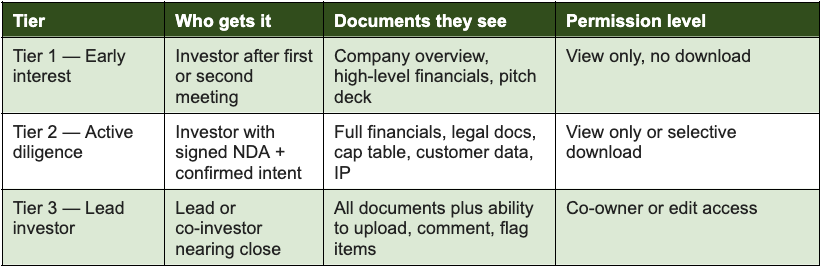
A useful structure has three tiers. Pitchwise lets you configure each tier through folder-level permissions so you never have to build multiple versions of the room.
How should data room access be structured by role
Lead investors who are putting in a significant portion of the round often want to feel more embedded in the process; co-owner access supports that without compromising control over what other parties see.
⚠ Watch out: Never give full data room access to an investor you have only spoken to once. A first-call request for the data room can mean genuine enthusiasm, or it can mean they are gathering competitive intelligence. Read the context before you share.
When should you share your data room with investors?
The clearest signal is an investor who explicitly asks to see diligence materials and has demonstrated real interest in the deal. A useful test: has the investor told you what would make them want to invest? If they have been specific, share the data room. If the conversation has been vague, ask what specific information they need and share only that before opening the full room.
Timing also matters in the context of your round. If you are early in the fundraise and have not yet anchored terms with a lead, sharing the full data room with a large number of investors simultaneously can create awkward situations if one of them starts circulating information before a deal is in place.
How do you control who sees what in a data room?
Pitchwise lets you set permissions at the folder level, so you can give one investor access to your financial statements and another access only to your product and team documentation. You can also set view-only access to prevent downloads of sensitive documents and add dynamic watermarks that embed each viewer's identity into every page they open.
The access log is as useful as the permissions themselves. Pitchwise shows you exactly which documents each investor has opened, how long they spent on them, and whether they have shared the access link with anyone else. That information tells you where an investor's attention is focused and flags anything unusual before it becomes a problem.
Customer lists with names, contact details, or contract values should always be view-only with watermarking enabled and shared only at the confirmed diligence stage. Competitors do occasionally conduct diligence on startups under the guise of investor interest, and a customer list that escapes is a meaningful competitive disadvantage.
Detailed IP documentation like source code, patent applications in process, and proprietary algorithms falls in the same category. Share it only with investors who have a clear reason to need it and a signed NDA in place.
Employee compensation details, including option grants and salary ranges, are also sensitive. If an investor requests them, consider whether the question is about understanding your cost structure (which can be answered with a summary) or about individual employees. The Series A due diligence checklist covers what investors typically ask for and in what sequence.
✓ Tip - Rule of thumb: if a document would be damaging in a competitor's hands, it needs watermarking + view-only permissions regardless of who is asking for it.
Frequently Asked Questions
Should you give all investors access to your data room?
No. Access should be tiered by stage of the conversation. Early-stage interested parties get a curated subset of documents. Investors in confirmed diligence get full access. Sharing everything with everyone at once is unnecessary and creates real exposure before a deal is confirmed.
When should you share a data room with investors?
After an investor has demonstrated genuine intent to move forward, typically after a second or third meeting, an explicit request to proceed to diligence, or a signed NDA. Sharing the full data room after a first call is usually premature unless the investor has been very specific about what they need to see.
How do you control who accesses your data room?
Through folder-level permissions, view-only settings, download restrictions, and dynamic watermarking. Pitchwise supports all of these and shows you an access log of which investor has opened which document and for how long, giving you visibility into engagement and any unusual access patterns.
What documents should always be restricted in a data room?
Customer lists with contract details, detailed IP documentation, and employee compensation data should be view-only with watermarking and shared only at the confirmed diligence stage and only with investors who have signed an NDA. A summary version of each is usually sufficient for early-stage review.
Lorem ipsum dolor sit amet, consectetur adipiscing elit. Suspendisse varius enim in eros elementum tristique. Duis cursus, mi quis viverra ornare, eros dolor interdum nulla, ut commodo diam libero vitae erat. Aenean faucibus nibh et justo cursus id rutrum lorem imperdiet. Nunc ut sem vitae risus tristique posuere.
Lorem ipsum dolor sit amet, consectetur adipiscing elit. Suspendisse varius enim in eros elementum tristique. Duis cursus, mi quis viverra ornare, eros dolor interdum nulla, ut commodo diam libero vitae erat. Aenean faucibus nibh et justo cursus id rutrum lorem imperdiet. Nunc ut sem vitae risus tristique posuere.