Quick answer: For a typical seed raise with two co-founders, around 40 investors and a data room for diligence, all three tools do the core job: tracked links, page-level analytics and a room for documents. The difference is what you pay and what you can do with the signals. Over a four-month raise on monthly billing, the plans that cover email verification and a data room cost $1,000 on DocSend, €596 on Papermark and $172 on Pitchwise ($96 if only one founder manages documents). Pitchwise also has a free plan and a 14-day free trial, and lets investors message you or book a call from inside the deck. DocSend’s edge is brand recognition and NDA gating; Papermark’s is its open-source option.
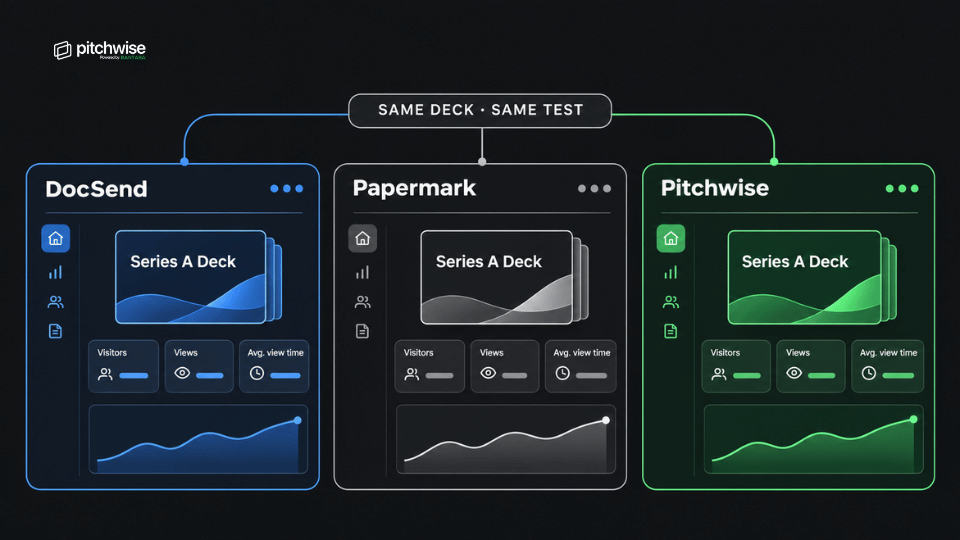
Most comparisons list features in a table. That’s useful, but founders don’t buy features; they run a raise. So we took one realistic seed round and worked through what it takes to run it on each tool, using each provider’s published plans and prices.
How we compared: Prices and features come from each provider’s public pricing page, checked on 23 November 2026. Pitchwise is our product, so we’ve stuck to published facts and said where the others do better. We haven’t quoted engagement numbers from a single test, because one raise on three tools wouldn’t give fair, comparable investor behaviour. Where we cite engagement data, it comes from Pitchwise’s State of Fundraising 2026 report.
The raise
| Detail |
Assumption |
| Stage | Seed |
| Team using the tool | 2 co-founders |
| Investors contacted | 40 |
| Documents | Deck for outreach; data room with model, cap table, incorporation documents, metrics, customer evidence (about 12 files) |
| Length | 4 months |
| Controls wanted | Email verification, download blocking, one link per investor |
| Billing | Monthly, because the raise has an end date |
Step 1: Sending the deck to 40 investors
All three tools let you upload a deck, create a tracked link per investor and see page-level analytics.
|
DocSend |
Papermark |
Pitchwise |
| Free to start | No free plan (14-day trial) | Free plan: 50 documents, 50 links | Free plan, plus a 14-day free trial on signup |
| Plan for 40 per-investor links | Personal, $15/user/month | Free | Pro, $24/month (unlimited links) |
| Email verification on links | Advanced only | Business (€59/month billed annually) | Pro ($24/month) |
| Download blocking | Yes | Yes | Starter and above |
Verdict for step 1: Pitchwise and Papermark both let you start free; DocSend doesn’t. Papermark’s free plan covers more links, but without email verification, so you can’t be sure who’s behind each open. Pitchwise lets you start on its free plan and 14-day trial, then move to Pro, the lowest-priced plan of the three with email verification, when outreach scales. In the State of Fundraising data, 77% of links require an email before opening, so this is the norm, not an extra.
Step 2: Reading the signals
Once decks go out, all three show who opened, time per page and repeat visits. What matters is what you can do next.
- DocSend shows visits, page time and location, with a clear activity log.
- Papermark shows page-by-page analytics on every plan, including free.
- Pitchwise shows page-level time per viewer, and on Pro lets an investor message you or book a call from inside the deck.
Why that last point matters: the average investor viewing session in the State of Fundraising data lasts 126 seconds, and the average visitor views a deck 2.7 times. The moment of interest is short. Giving an investor a way to act while they’re reading removes a step between interest and a meeting.
Verdict for step 2: analytics are close on all three. Pitchwise is the only one of the three with in-deck messaging and call scheduling.
Step 3: Opening a data room for diligence
Six investors ask for more. You need a room with the model, cap table and legal documents, with each investor on their own link.
|
DocSend |
Papermark |
Pitchwise |
| Plan needed | Advanced | Data Rooms | Pro |
| Price (monthly billing) | $250/month for 3 users | €149/month for 3 users | $24/month, $19 per extra user |
| Rooms included | Lightweight data rooms | Unlimited | 1 |
| NDA gating | Yes | Yes | Not listed |
| Dynamic watermarking | Yes | Yes | Teams plan |
Verdict for step 3: a single seed raise needs one room. All three offer watermarking (Pitchwise on Teams), and DocSend and Papermark add NDA gating, though NDAs aren’t standard in seed diligence (most VCs won’t sign an NDA at this stage). Pitchwise covers the room at a fraction of the price.
Step 4: What the raise costs
Two co-founders, four months, monthly billing, on the cheapest plan that gives email verification and a data room:
| Tool |
Plan |
Monthly cost for 2 users |
4-month total |
| DocSend | Advanced (3 users included) | $250 | $1,000 |
| Papermark | Data Rooms (3 users included) | €149 | €596 |
| Pitchwise | Pro + 1 extra user | $43 | $172 |
| Pitchwise | Teams (3 users, 3 rooms, watermarking, audit logs) | $69 | $276 |
If only one founder needs to manage documents, Pitchwise Pro alone is $24 a month, $96 for the four months. If you want watermarking, audit logs and room for a third teammate, Pitchwise Teams is $69 a month for 3 users, still about a quarter of DocSend Advanced for the same three seats. On annual billing, DocSend Advanced is $150 a month and Pitchwise Pro $17, but founders raising for a few months rarely want a twelve-month commitment.
Sources: DocSend pricing, Papermark’s pricing page and Pitchwise pricing, checked 23 November 2026.
Step 5: After the raise
|
DocSend |
Papermark |
Pitchwise |
| Free plan to keep between raises | No | Yes | Yes |
| Use for investor updates | Yes | Yes | Yes |
Both Papermark and Pitchwise let you drop to a free plan between rounds and keep your account. DocSend doesn’t have one.
What each tool is best at
|
DocSend |
Papermark |
Pitchwise |
| Strongest point | Brand recognition with investors | Large free plan and open source | Free plan and trial, lowest price for a data room, in-deck follow-up |
| Weakest point for seed founders | $250/month for a data room on monthly billing | Email verification needs Business, €59/month billed annually | NDA gating not listed; watermarking needs Teams |
| Best for | Teams whose investors expect DocSend | Technical teams, many rooms at once | Founders raising one round who want a room |
Set-up time
Set-up is quick on all three. Uploading a deck and creating a tracked link takes minutes on each. A data room takes longer because of the documents, not the software: gathering a seed room of around 12 files usually takes a few days, mostly spent on the cap table and incorporation documents. Use the investor data room checklist and the data room index template to speed it up.
What to check before you choose
- Which plan includes email verification? It’s the control most founders use.
- What does a data room cost on monthly billing? A raise lasts months, not years.
- How are extra users priced? Co-founders and a CFO add up.
- Is there a free plan to keep between raises?
- What can investors do from inside the deck?
The honest verdict
Choose DocSend if your target investors expect DocSend links, you need NDA gating, and the cost isn’t a concern.
Choose Papermark if you want open source or run several data rooms at once.
Choose Pitchwise if you want to start free, then get email verification and a data room for a seed raise at the lowest price of the three, and you want investors to be able to message you or book a call from inside the deck.
Our pick for this raise: Pitchwise
Pitchwise is a secure document and virtual data room tool. For a seed raise, it covers tracked links, email verification, download blocking and a data room for $24 a month, or $17 billed annually, and keeps your account free between rounds. Start free
Related: DocSend pricing 2026, DocSend alternatives, Pitchwise vs Papermark and DocSend vs Pitchwise.
Frequently asked questions
Which is cheapest for a seed raise: DocSend, Papermark or Pitchwise?
For a raise that needs email verification and a data room, Pitchwise. On monthly billing, Pro is $24 a month, against €149 for Papermark’s Data Rooms plan and $250 for DocSend Advanced. Pitchwise and Papermark both let you start for free; DocSend doesn’t.
Do all three tools show page-level analytics?
Yes. All three show time spent per page and repeat visits. Pitchwise adds in-deck messaging and call scheduling on Pro.
Which tools have a free plan?
Pitchwise and Papermark both have free plans; DocSend doesn’t. Papermark’s free plan covers more documents and links. Pitchwise’s free plan covers 10 documents and 1 active link, and every signup also gets a 14-day free trial, so you can try the paid features before you pay. Both let you keep a free account between raises.
Do I need NDA gating for a seed raise?
Rarely. Most VCs won’t sign NDAs for early diligence. Email verification, download blocking and staged access are the usual controls. See data room NDAs.
Why didn’t you publish open rates from the test?
Because investor behaviour varies by deck, sector and timing, numbers from one raise on three tools wouldn’t be a fair comparison. The engagement figures here come from the State of Fundraising 2026 report, which covers 38,830 opens.