By clicking “Accept All Cookies”, you agree to the storing of cookies on your device to enhance site navigation, analyze site usage, and assist in our marketing efforts. View our Privacy Policy for more information.
Yes, but keep it lean. Seed investors don't need 200 documents, but they do expect organised, secure access to core materials once diligence begins. A seed data room typically covers your pitch deck, financials, cap table, legal docs, and key traction metrics. Have it ready before active diligence starts, not from day one of conversations.
The data room has a reputation as a Series A thing, a polished suite of documents you build once you have lawyers and a CFO and 18 months of clean financials. In practice, seed investors expect one too. The expectations are just different.
Not having a data room ready when a seed investor asks for diligence materials sends a signal you do not want to send. It suggests the company is disorganised or that you have not been planning for this moment. And in a process that moves fast, losing momentum because you need two weeks to pull documents together is an avoidable cost.
Do you need a data room for a seed round?
If you are running a process with multiple investors simultaneously (which is most seed rounds), yes. A data room is the most efficient way to share materials securely, track who has seen what, and keep control over sensitive information throughout the process.
You do not need it from day one. The first conversation with a seed investor is about the pitch, the team, and the market. The data room becomes relevant when that conversation progresses to diligence, when an investor has expressed genuine intent and wants to review the underlying materials before committing.
What investors check in a data room first explains how investors actually move through a data room once they have access, which helps you prioritise what to put in it and in what order.
Lorem ipsum dolor sit amet, consectetur adipiscing elit. Suspendisse varius enim in eros elementum tristique. Duis cursus, mi quis viverra ornare, eros dolor interdum nulla, ut commodo diam libero vitae erat. Aenean faucibus nibh et justo cursus id rutrum lorem imperdiet. Nunc ut sem vitae risus tristique posuere.
How is a seed data room different from a Series A?
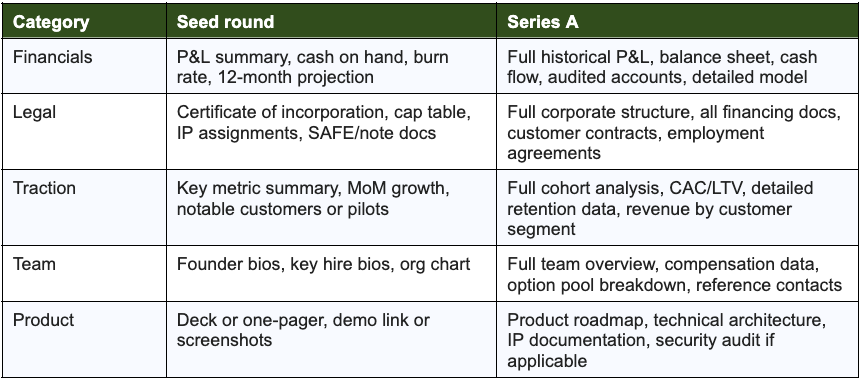
The fundamental difference is depth, not structure. Both need the same core categories: financials, legal, team, product, and traction. The Series A version goes significantly deeper within each. Seed investors are making a bet with less information available, so they are looking for a smaller number of signals rather than a complete picture.
How is a seed data room different from a Series A
The temptation at the seed stage is to over-prepare, to build a Series A room before you need one. This creates two problems. It takes time away from building the business, and it can make the room harder to navigate for investors who are looking for a handful of clear signals, not a comprehensive archive.
What should go in a seed round data room?
A well-organised seed data room covers five areas. Everything else can be added on request.
☐ Pitch deck: the version you are actively presenting, updated to current metrics
☐ Financial summary: revenue to date, burn rate, cash runway, and a 12-month projection
☐ Cap table: clean and reconciled, showing all shareholders, SAFEs, and option pool
☐ Legal foundation: certificate of incorporation, IP assignment agreements, prior financing documents
☐ Traction evidence: the single strongest metric you have, plus supporting context (customer names, retention data, growth rate)
☐ Team bios: short, relevant, highlighting domain expertise and why this team can execute this idea
Past investor updates (if you have them) are one of the most underused items in a seed data room. They demonstrate transparency, show how the business has evolved, and give investors a sense of how you think and communicate. Include the last two or three if they show positive momentum.
When should you share your data room with seed investors?
After a second or third meeting, when an investor has signalled genuine intent to move forward. An investor who asks for the data room after a first call may be showing enthusiasm or may be collecting materials on companies they have no real intention of backing. Ask what specific information they need before sharing the full room.
Pitchwise lets you share a controlled link to your data room rather than a static folder. You can see exactly which investor has opened which documents, how long they spent on each one, and whether they have come back for a second look. That engagement data tells you who is genuinely diligent and who is just browsing.
Who should have access to your data room covers the tiering logic in detail, how to give different investors access in detail, including levels of access without building multiple versions of the room.
What to avoid in a seed data room
⚠ Watch out: Do not share your full data room in a generic Google Drive folder. Drive links can be forwarded without your knowledge, files download automatically to the recipient's device, and you have no audit trail of who saw what. For seeding diligence materials, use a platform that gives you access control and visibility.
Pitchwise is built specifically for this. You set up the room once, assign each investor to a tier with the right folder permissions, and share a controlled link. Every time an investor opens a document, you get a notification. When they stop opening things, you know the diligence has stalled before they have to tell you.
Also avoid including documents you are not ready to defend. Projections with no clear assumptions, competitive analyses that undersell the market, or legal documents with unresolved issues are better left out until they are in good shape. A data room that raises more questions than it answers slows the process rather than accelerating it.
Yes, if you are running a process with multiple investors simultaneously. Seed investors expect organised, secure access to core materials once diligence begins. You do not need it from day one, but you should have it ready before any investor progresses beyond a second meeting.
What should be in a seed round data room?
Pitch deck, financial summary (burn rate, runway, and a 12-month projection), cap table, legal foundation (incorporation docs, IP assignments, and prior financing), traction evidence, and short team bios. Past investor updates are a strong optional addition. Keep it lean; a seed data room is not a Series A data room.
When should you share your data room with seed investors?
After a second or third meeting, once an investor has signalled genuine intent to proceed to diligence. Sharing the full room after a first call is usually premature. Ask what they specifically need to see first; it tells you a lot about where they are in their decision process.
How is a seed data room different from a Series A data room?
Same categories, significantly less depth. Seed investors are making a bet with less information available, so they look for a handful of clear signals rather than a complete picture. A seed data room should cover the essentials cleanly and allow investors to request more if needed.
Lorem ipsum dolor sit amet, consectetur adipiscing elit. Suspendisse varius enim in eros elementum tristique. Duis cursus, mi quis viverra ornare, eros dolor interdum nulla, ut commodo diam libero vitae erat. Aenean faucibus nibh et justo cursus id rutrum lorem imperdiet. Nunc ut sem vitae risus tristique posuere.
Lorem ipsum dolor sit amet, consectetur adipiscing elit. Suspendisse varius enim in eros elementum tristique. Duis cursus, mi quis viverra ornare, eros dolor interdum nulla, ut commodo diam libero vitae erat. Aenean faucibus nibh et justo cursus id rutrum lorem imperdiet. Nunc ut sem vitae risus tristique posuere.