Quick answer: When an enterprise customer or partner runs due diligence on you as a supplier, they’ll ask for company documents, financial stability evidence, security and data protection policies, insurance, certifications and references. Package these once in a data room with numbered folders, share it through a link per company with email verification and download blocking, and track which documents each reviewer opens. It turns weeks of email back-and-forth into one link.
Startups selling to larger companies meet procurement and security reviews early. Being ready can take weeks off a sales cycle.
What enterprise buyers ask for
| Area |
Typical documents |
| Company | Certificate of incorporation, ownership structure, directors, registered address |
| Financial | Recent accounts or a summary, evidence of funding, bank reference |
| Security | Information security policy, access control, encryption, incident response, pen test summary |
| Certifications | SOC 2 report, ISO 27001 certificate, or a roadmap to them |
| Data protection | Privacy policy, data processing agreement, sub-processor list, data residency |
| Continuity | Business continuity and disaster recovery plans, uptime history |
| Insurance | Professional indemnity, cyber and general liability certificates |
| Legal and compliance | Anti-bribery, modern slavery and sanctions policies, standard terms |
| References | Customer references and case studies |
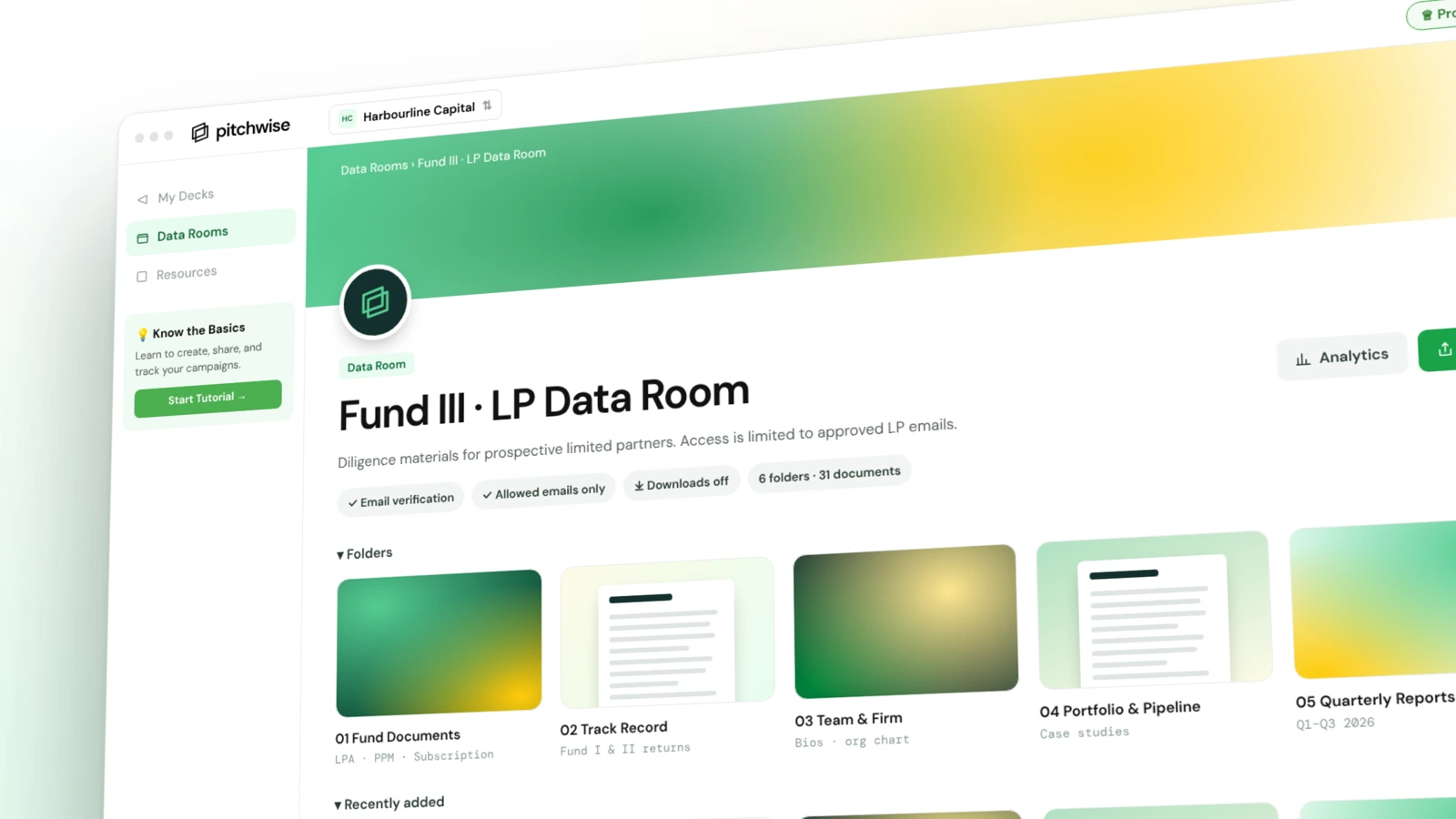
Package it as a data room
| Folder |
Contents |
| 00 Read me | What's included, contacts, last updated date |
| 01 Company | Incorporation, ownership, directors |
| 02 Financial | Accounts summary, funding evidence |
| 03 Security | Policies, pen test summary, architecture overview |
| 04 Certifications | SOC 2, ISO 27001 or roadmap |
| 05 Data protection | DPA, privacy policy, sub-processors |
| 06 Continuity | BCP, DR plan, uptime |
| 07 Insurance | Certificates |
| 08 Policies | Anti-bribery, sanctions, modern slavery, code of conduct |
| 09 References | Case studies, reference contacts |
Keep a standard version ready and update it each quarter. When a request arrives, send the link the same day.
Control access to sensitive material
Security and financial documents are sensitive. Pen test results and architecture diagrams could help an attacker.
- One link per company, so you can revoke access when the review ends.
- Email verification so you know which reviewer opened what.
- Download blocking on pen test summaries and architecture.
- NDA first for the most sensitive material. See data room NDAs.
- Expiry once the review is complete.
More in data room security for founders.
Use engagement to move the deal
Procurement reviews stall quietly. Tracking shows where things stand:
- Security team opened the policies and pen test → review is under way.
- Nothing opened after a week → chase your champion.
- Legal opened the DPA several times → expect redlines.
A typical enterprise procurement timeline
| Step |
What happens |
How long |
| Vendor onboarding form | Company details, bank details, tax forms | 1 to 2 weeks |
| Security review | Questionnaire, policies, certifications | 2 to 6 weeks |
| Legal review | Master agreement, DPA, liability terms | 2 to 6 weeks |
| Financial check | Accounts, credit check, insurance | 1 to 2 weeks |
| Approval | Procurement and budget sign-off | 1 to 4 weeks |
These steps often run in parallel. A ready-made pack lets each team start the day they ask, which can take weeks off the total.
What to include if you’re early stage
Startups often don’t have everything a large company expects. Be honest and show a plan:
- No SOC 2 yet: share your security policies, a summary of your controls, a recent pen test and a dated roadmap to certification.
- No audited accounts: share management accounts and evidence of funding, such as a letter from your lead investor or a bank statement summary.
- Limited insurance: check what cover the customer requires and quote for it early; it can be added quickly.
- Few references: offer pilot customers or advisers who can speak to how you work.
Buyers usually accept gaps that come with a credible plan. They don’t accept surprises.
Keep the pack current
Assign one owner for the pack, usually operations or the CTO for security material. Review it every quarter and whenever a policy, certification, insurer or sub-processor changes. Date each document and update the read me file, so reviewers know they’re seeing the latest version.
Answering security questionnaires
Many enterprises send a questionnaire as well. Answer once in a master document, reference the data room folder for evidence, and reuse it. Keep answers consistent with your policies; reviewers check.
Share your due diligence pack in Pitchwise
Pitchwise is a secure document and virtual data room tool. Keep a standard due diligence pack in a data room, share it with each company through its own link, and see which reviewers open what. Pro includes a data room for $17 a month billed annually. Start free
See also Pitchwise for partner due diligence and Pitchwise for sales.
The 15 security questions procurement teams ask most
- Where is customer data stored, and in which countries?
- Is data encrypted in transit and at rest, and how are keys managed?
- How is access to production systems controlled, and is multi-factor authentication enforced?
- How often are access rights reviewed?
- Do you run penetration tests, and how often?
- How do you manage vulnerabilities and patching?
- What is your incident response process, and how quickly will you notify us?
- Have you had a security incident in the last three years?
- Which sub-processors handle our data?
- How do you back up data, and how quickly can you restore it?
- What are your uptime commitments and history?
- How do you vet and train employees on security?
- How is customer data deleted at the end of the contract?
- Do you hold SOC 2 or ISO 27001, or have a plan to?
- Do you carry cyber insurance?
Write a standard answer to each in your master questionnaire document, link each answer to the evidence in your data room, and reuse it for every request. Keep answers consistent with your written policies, because reviewers compare them.
Frequently asked questions
What is vendor due diligence?
Vendor due diligence is the review a customer or partner runs on a supplier before signing a contract. It usually covers company details, financial stability, information security, data protection, compliance policies, insurance and references. For startups selling to larger companies, it’s a normal part of the sales cycle and often the longest part.
What if we don’t have SOC 2 or ISO 27001?
Share what you do have: security policies, a summary of controls, a recent penetration test, and a dated roadmap to certification. Many enterprise buyers accept that from an early-stage supplier, especially for a pilot or a limited scope. Be clear about timelines, and don’t claim certifications you don’t hold.
Should we email due diligence documents?
Avoid it. Attachments get forwarded inside the customer’s organisation and beyond, and you lose track of who has what, including sensitive material such as pen test results. A data room link per company keeps control, lets you block downloads on sensitive files and shows which reviewers have read what.
How often should we update the pack?
Every quarter, and whenever something material changes: a new certification, a policy update, a new sub-processor, renewed insurance or a security incident. Date each document and keep a change note in the read me file, so reviewers know they’re seeing current information.
Can the same room be used for investors?
Use a separate room. The audience and documents are different: investors want financials, cap table and strategy, while procurement teams want security, compliance and insurance. Keeping them apart also means you never accidentally share investor documents with a customer.
How do we speed up a stalled security review?
Check which documents the reviewer has opened. If they haven’t opened the pack, your champion may need to nudge them. If they’ve read the policies but not the pen test, offer a short call with your CTO. Engagement data turns “we’re waiting” into a specific next step.