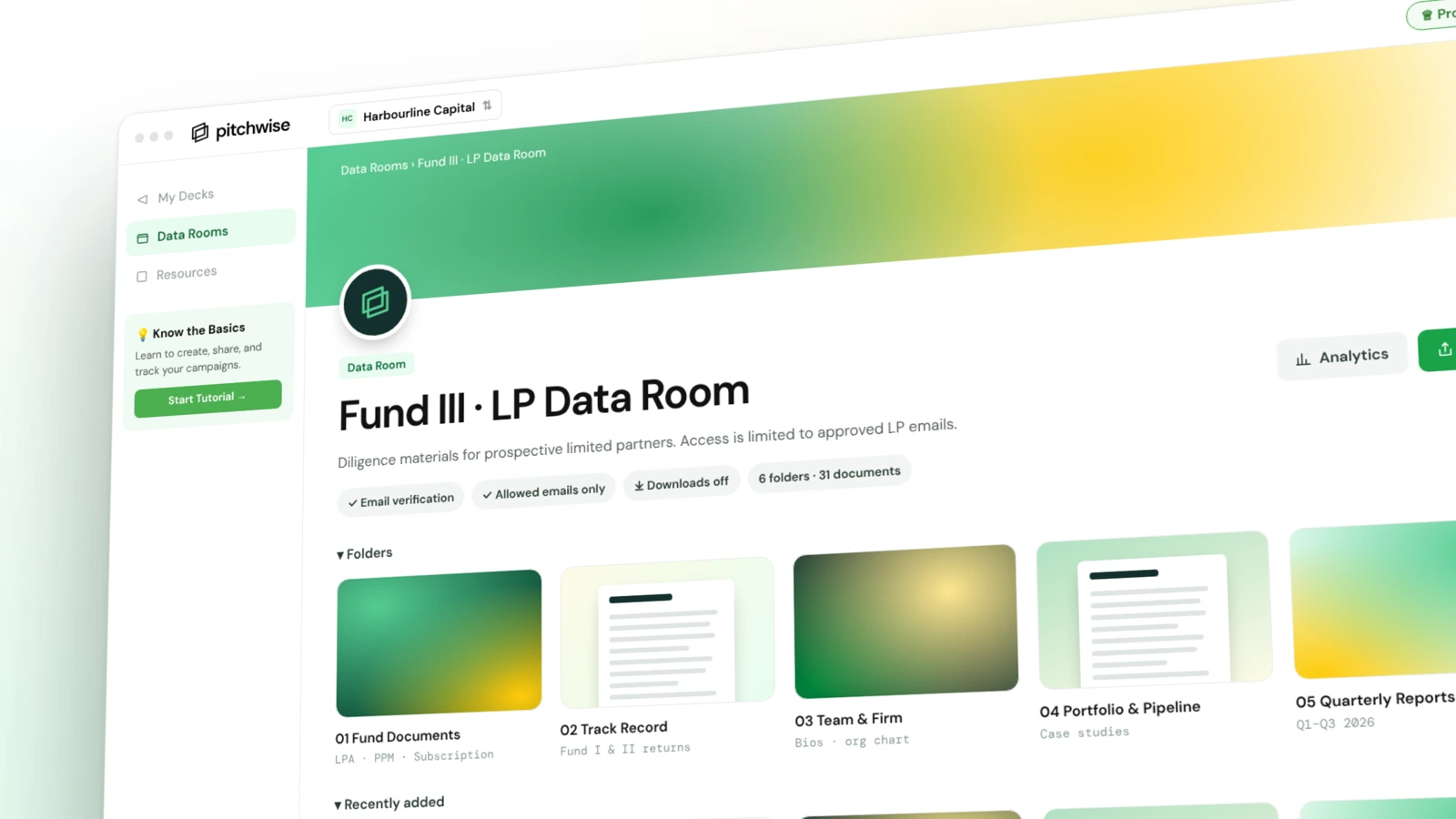
Quick answer: A fund data room is where limited partners review a fund before committing. It holds the pitch deck, private placement memorandum (PPM), limited partnership agreement (LPA), track record, team information, investment process, operational and compliance documents, and references. GPs share it with prospective LPs through per-LP links, with email verification and download blocking, and track which LPs are reading the LPA and track the record, the clearest sign of a serious allocator.
Raising a fund is a fundraise like any other, with longer diligence and more documents. Emerging managers in particular need to look institutional from the first LP conversation, and the data room is where that impression is made.
What LPs look for
LP diligence usually covers four areas:
- Team. Who the partners are, how long they’ve worked together and how carry is split.
- Track record. Past investments, attributions and performance, backed by data.
- Strategy and process. What you invest in, how you source, decide and support.
- Operations and terms. Fund administration, compliance, reporting and the LPA terms.
Fund data room checklist
| Folder |
Documents |
| 01 Overview | Fund deck, one-pager, cover letter |
| 02 Offering documents | PPM, LPA, subscription documents, side letter policy |
| 03 Team | Partner bios, org chart, references, carry allocation |
| 04 Track record | Investment list, attribution, performance metrics, case studies |
| 05 Strategy and process | Investment thesis, sourcing, IC process, portfolio support |
| 06 Pipeline | Current pipeline and warehoused deals, anonymised where needed |
| 07 Operations | Fund administrator, auditor, legal counsel, valuation policy |
| 08 Compliance | Registration, AML and KYC policies, ESG policy |
| 09 Reporting | Sample quarterly report and capital account statement |
| 10 Previous funds | Audited financials and reports for earlier vehicles |
Stage access for LPs
| Stage |
What LPs see |
| First meeting | Deck and one-pager |
| Interest confirmed | Track record, strategy, team, sample reporting |
| Due diligence | PPM, LPA, operations, compliance, previous fund financials |
| Pre-commitment | Subscription documents, side letter discussions |
Keeping the LPA and detailed track record back until an LP is engaged protects sensitive information and keeps the early experience simple.
Reading LP engagement
Allocators review many funds at once, and many won’t tell you where you stand. Engagement data fills the gap:
- An LP reading the LPA and track record in depth is doing real diligence.
- Repeat visits before an IC meeting suggest you’re on the agenda.
- A new viewer from the same institution means your materials are being shared internally.
- No opens after a meeting is a sign to follow up or move on.
This is the same pattern founders see with investors. In our State of Fundraising 2026 data, the average visitor views a deck 2.7 times; the repeat visits carry the signal.
How LP diligence differs by LP type
| LP type |
What they focus on |
What to prepare |
| Family offices and high-net-worth individuals | Team, thesis, relationship | Clear deck, references, simple terms summary |
| Funds of funds | Track record, attribution, process | Detailed track record data, IC memos, portfolio support evidence |
| Institutions (pensions, endowments) | Operations, compliance, governance, terms | Full operational due diligence pack, policies, LPA, audited financials |
| Corporate LPs | Strategic fit, deal flow access | Sector pipeline, co-investment policy |
Emerging managers usually start with family offices and individuals, then add funds of funds and institutions in later funds. Building an institutional-grade room from fund one makes that step easier.
Track record: how to present it
Track record is the section LPs read most closely, and the one most often challenged.
- List every investment, not just the winners. Selective lists damage trust once discovered.
- Show attribution. Make clear which deals you led or sourced, especially if your record comes from a previous firm.
- Use consistent metrics: entry date, amount, current valuation basis and multiple on invested capital.
- Explain valuation policy for unrealised positions.
- Back it up. Keep supporting documents ready for LPs who want to verify.
Operational due diligence
Larger LPs run a separate operational review covering the fund administrator, auditor, legal counsel, valuation process, cash controls, compliance policies and cybersecurity. Prepare a short operations memo that answers the standard questions, and keep the supporting policies in folders 07 and 08 of the room.
A fund data room timeline
| Stage |
Typical length |
What happens in the room |
| Pre-marketing | 1 to 3 months | Deck and one-pager shared with a few anchor LPs for feedback |
| First close marketing | 3 to 9 months | Full room opened to LPs in diligence; Q&A log running |
| First close | | Subscription documents executed; side letters agreed |
| Subsequent closes | 6 to 12 months | Room updated with first portfolio investments and reporting |
| Final close | | Room archived; reporting moves to LP portal or tracked reports |
Update the room as the fund progresses. New LPs joining at a later close will want to see the first investments and early reporting.
Common mistakes GPs make with fund data rooms
- Opening everything on day one. LPs who haven’t engaged don’t need the LPA.
- An unclear track record. Inconsistent metrics or missing deals raise more questions than modest returns.
- Out-of-date documents. A deck from three months ago next to a newer one confuses readers.
- No index. LPs review many funds; make yours easy to navigate. Use our data room index template.
- Emailing attachments. You lose track of who has what, and documents travel further than intended.
Security for fund materials
- Email verification on every link, so each view is a named person.
- Download blocking for the PPM, LPA and track record.
- One link per LP, so you can revoke access individually.
- Watermarking for track record and offering documents where your counsel requires it.
See data room security.
After the close: using the room for LP reporting
The same tool can carry quarterly reports, capital account statements and annual meeting materials, with tracking that shows which LPs are reading them. See Pitchwise for investor reporting.
Run your fund raise in Pitchwise
Pitchwise is a secure document and virtual data room tool. Share your fund materials through per-LP links with email verification and download blocking, and see which LPs read what. Pro includes a data room for $17 a month billed annually; Teams, coming soon, adds 3 rooms, watermarking, granular permissions and audit logs. Start free
Frequently asked questions
What goes in an LP data room?
The core set is the fund deck, private placement memorandum, limited partnership agreement, track record with attribution, team biographies and references, investment strategy and process, a sample quarterly report, and operational and compliance documents. Larger LPs also expect audited financials from earlier funds and an operations memo. Our checklist table above gives a folder-by-folder structure you can copy.
When should a GP share the data room?
Share the deck first and keep early conversations simple. Open the data room once an LP confirms interest and starts diligence, and stage the most sensitive documents, such as the LPA and detailed track record, until they’re engaged. This keeps information under control and lets you see which LPs are moving forward.
Do emerging managers need a data room?
Yes. LPs compare emerging managers against established firms, and an organised, institutional-quality room is one of the clearest ways to close that gap. It also shortens diligence: an LP who finds everything in one place moves faster than one waiting on emails.
Should the track record be downloadable?
Usually not at first. Let LPs view it in the room with downloads blocked, and provide copies on request once they’re in serious diligence. Watermarking adds protection if your counsel requires it. Track record data is sensitive and easy to misrepresent once it leaves your control.
How do I know which LPs are serious?
Look at what they read, not just whether they opened the link. An LP who reads the LPA and track record in depth, returns before their investment committee, or shares the room with a colleague is doing real work. One who opened the deck once after a meeting is not there yet.
Can I use the same tool for portfolio companies?
Yes. GPs also use Pitchwise to share deal documents with co-investors, run data rooms for portfolio company sales, and send LP reporting. See Pitchwise for investor reporting.