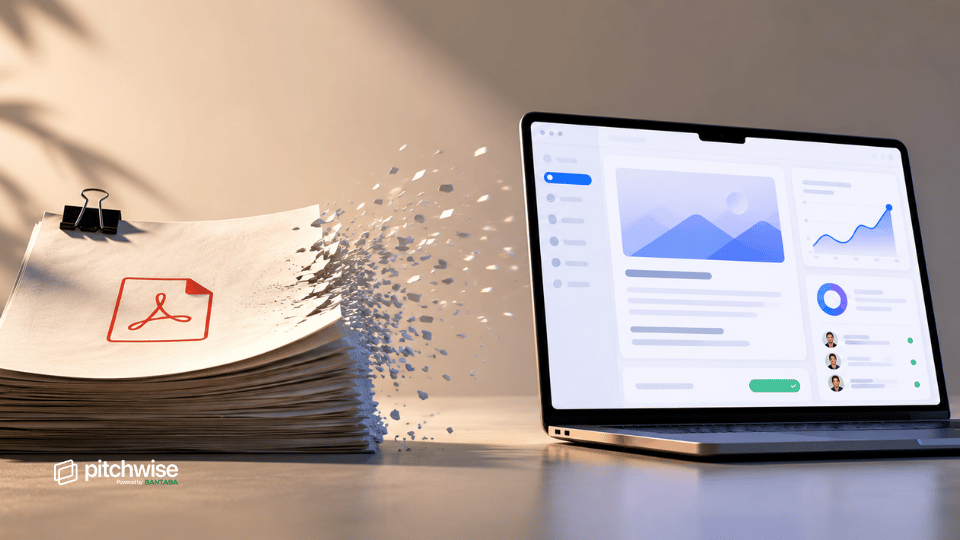
The PDF sales proposal had a 30-year run. In 2026, it's losing B2B teams 30 to 50% of their winnable deals.
That's not a hot take. It's what the data has been saying for two years. Analysis of 2.6 million proposals by Qwilr and others shows that 5-page interactive proposals close around 50% of the time, while 30-page PDF-style proposals drop to 35%. Across the broader B2B sales benchmark, the average sales team wins 21% of deals. The teams that win more aren't smarter. They've moved off PDFs.
Here's why the PDF is dying and what's replacing it.
Why the PDF format is losing in 2026
1. The PDF is a dead artifact
Once you send a PDF, you have no idea what happens next. Did the buyer open it? Did they share it with their team? Did they spend three minutes on the pricing page or skip past it? The PDF doesn't tell you. The PDF format is, by definition, write-once and forget.
Modern B2B buying takes 7-12 stakeholders inside the buyer organisation. The PDF you sent the champion gets forwarded into a Slack channel. You're flying blind.
2. You can't update a PDF after you send it
A typo in your pricing? A scope clarification three days into the eval? A version change because the buyer asked for a different SLA? With a PDF, every change means a new attachment, a new email thread, and a 50/50 chance the buyer is still looking at v1.
The new format is a link. The link points to a live document. You update once; every viewer sees the latest.
3. PDFs leak
Your pricing, your terms, and your differentiators end up forwarded to competitors. No watermark, no link expiration, no audit trail. The PDF was designed in an era before SaaS existed and before deal cycles ran through 12 people in Slack.
4. Buyers actually prefer the new format
This is the part most sales leaders haven't caught up to. Research on modern proposal software shows that 79% of revenue leaders want to increase win rates, but 33% of teams still send PDFs. Buyers reward sellers who make their evaluation easier. Interactive proposals let the buyer click around, drill into pricing, watch a 45-second product video, and accept terms – all in one tab.
What's replacing the PDF in 2026
The proposal that wins in 2026 isn't a document. It's a workspace. Five components:
- A secure, tracked link instead of an email attachment
- Page-level analytics so you know which sections each stakeholder read
- Embedded supporting documents where appropriate
- E-signature at the end, native to the document
- Real-time updates so you can adjust pricing or scope without resending
You can build this on dedicated proposal tools or on a secure-document-sharing platform that adds analytics on top of any file, like Pitchwise. The principle matters more than the tool: the proposal needs to be a tracked, updatable, watermarked link, not an attachment.
The 5-page rule (and why long proposals lose)
This is the data point that surprises sales leaders the most: Research shows that 5-page proposals close at roughly 50%, while 30-page proposals close at 35%.
The reason isn't mysterious. Buyers don't read the appendix. The longer your proposal, the more chances you give the buyer to find a reason to say no. The teams that win in 2026 ship a 4–6 page proposal with an option to drill deeper, not a 30-page document the buyer has to fight through.
The structure that works:
- Page 1: The outcome you're delivering (the buyer's words, not yours)
- Page 2: How you'll deliver it (3-5 bullets, not an architecture diagram)
- Page 3: Investment and terms
- Page 4: Why your team (3 customer references, by name, with their results)
- Page 5: The signature page
How modern closers run a proposal
A modern proposal cycle looks nothing like the 'attach the PDF, wait, follow up, attach v2' loop from 2015. The cadence:
- Day 0: Send the proposal as a tracked link. Don't attach a PDF as 'backup'. Make the link the only way in.
- Day 1: Check the analytics. Did the champion open it? Which stakeholders did they share it with? Which pages did they re-read?
- Day 2-3: Call only the buyers who actually engaged. Stop wasting calls on the ones who didn't open.
- Day 5: Update pricing or terms live in the link if the buyer asked for changes. Don't resend.
- Day 7-10: E-sign inside the same link. No 'sending you the contract' email.
What you can't get from an email open rate
Email opens tell you the buyer opened your message. Page-level analytics tell you which sections of your proposal each stakeholder read, how long they spent there, who they shared it with, and whether they came back. That's the difference between guessing and knowing.
For B2B teams running 6-12 proposals a month, that signal is what separates the reps who hit 65% close rates from the ones stuck at the 21% average.
The most common founder/sales mistake: you send the PDF, hear nothing for three days, and write the 'just checking in' follow-up. The buyer has no signal; you're doing this thoughtfully. You have no signal on whether they read what you sent.
With analytics on the document, you skip that email entirely. You know they opened the proposal twice and spent eight minutes on the pricing page. You call them with context, not a check-in.
What to do with your next 5 proposals
- Stop attaching PDFs. Send a tracked link, even if you have to convert your existing template.
- Cut to 5 pages. If you need more detail, link out; don't pad the proposal.
- Watch the analytics for 48 hours. Call only the buyers who actually engaged.
- Add e-signature inside the document. Don't send a separate contract email.
- Measure the win rate over the next 30 days. The teams who do this see 15-40 point lifts within a quarter.
FAQ
What's a good sales proposal win rate in 2026?
The B2B average is around 21%. Teams using interactive proposals with page-level tracking typically hit 35-50%. The top performers, with the 5-page rule plus video, hit 50-65%.
Are PDFs ever the right choice?
For one-page price quotes and order confirmations, yes. For anything where you need to know what the buyer engaged with, including all real sales proposals, RFP responses, statements of work, and renewals, no.
How do I switch my team off PDFs?
Pick one rep, give them an interactive proposal tool, run a 30-day pilot, and compare close rates against the rest of the team. The data does the persuading. Once one rep sees the analytics on their own deals, you don't need a mandate.
Won't buyers be annoyed by a tracked link?
No. Buyers are already using interactive proposals from dozens of vendors. The tooling is normalised. What annoys buyers is being asked to download a 30-page PDF and find the pricing page on their own.
Send your next proposal as a tracked link, not a PDF
Pitchwise turns every sales proposal into a secure, tracked link with page-by-page analytics so you can see exactly who's reading and who's closing. Start for free.