.png)
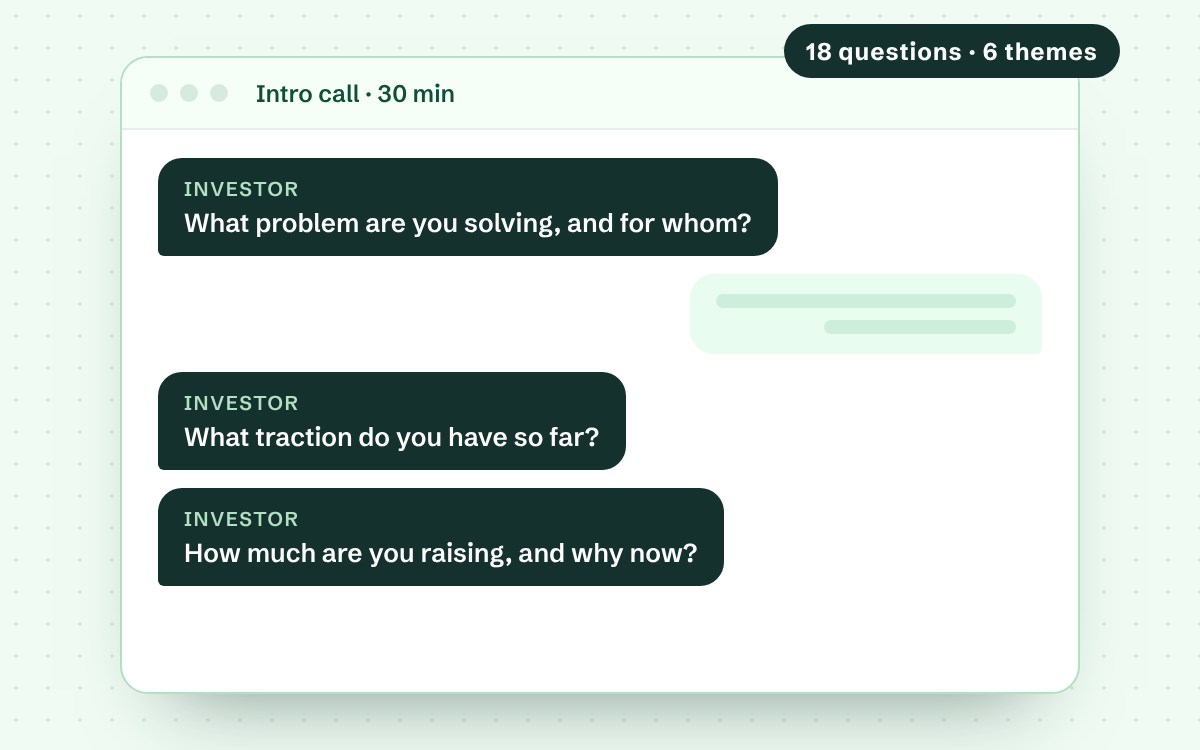
An intro call is short, and investors use it to decide whether to spend more time on you. This guide walks through the 18 questions VCs most often ask in introductory meetings. Each question comes with context on what the investor is really looking for, practical tips and sample answers, so you can prepare with confidence.
The six themes
- Opening the conversation. How you introduce yourself and the company.
- Problem and solution. Whether the problem is real and your answer to it is convincing.
- Traction, users and success. The evidence that the market wants what you are building.
- Market and competition. How big the opportunity is and why you can win it.
- Team and execution. Why your team is the one to build this.
- Funding, risk, focus and next steps. What you are raising, what could go wrong and what happens next.
How to prepare for an intro call
The founders who do best on intro calls are not the most polished. They are the ones who know their numbers, answer directly and make the investor's job easy.
- Research the investor. Read their portfolio, recent investments and anything they have written. Know why they might care about your company.
- Prepare a two-minute story. What you do, for whom, why now and what you have achieved. Practise it until it sounds natural.
- Know your key numbers cold. Revenue, growth, burn, runway, customers and the size of your raise. Hesitation on basic figures raises doubts.
- Rehearse the hard questions. Competition, risks, and why you might fail. Practise with a friend who will push back.
- Prepare your own questions. Ask about their process, timeline, how decisions are made and how they support founders. It shows you are choosing too.
- Agree next steps before you hang up. Ask what they need from you and when you will hear back.
The guide pairs each of the 18 questions with what the investor is really trying to learn. Read it the day before, not the hour before, so the answers feel like yours.
What investors are really testing
Behind the 18 questions, investors are judging a few things.
- Clarity. Can you explain the business simply and precisely?
- Self-awareness. Do you see the risks and weaknesses as clearly as the strengths?
- Command of the numbers. Do you know your metrics without checking?
- Ambition with realism. Is the vision big, and is the plan to get there believable?
- Coachability. How do you respond to a challenge or a question you did not expect?
Answer each question with these in mind, and your answers will address what the investor actually wants to know.
Who it's for
- Early-stage founders preparing for investor calls
- Founders raising pre-seed, seed or Series A
- Startup advisors, accelerators and pitch coaches
- Anyone building investor-ready communication skills
Intro call questions founders ask
How long is a typical VC intro call?
Often around 30 minutes. That leaves little time, so lead with your strongest points and keep answers short.
Should I present my deck on the call?
Many investors prefer a conversation. Have your deck ready to share, but be prepared to talk through it without slides.
How do I answer a question about risks?
Name the real risks and explain how you are managing them. Investors trust founders who see problems clearly more than founders who claim there are none.
What should I send after the call?
A short thank-you, answers to anything you could not cover and your deck as a Pitchwise link. Pitchwise is a secure document and virtual data room tool, so you will see when the investor reviews it.
What if I do not know the answer to a question?
Say so, and say how you will find out. Promise a follow-up and send it quickly. Guessing does more damage than admitting a gap.
Should my co-founder join the call?
Often, yes, especially if the investor will want to judge the team. Agree beforehand who answers which kinds of questions so you do not talk over each other.
How do I know if the call went well?
A good sign is a clear next step: a second meeting, a request for more information or an introduction to a partner. Vague interest with no next step often means a polite no.
Should I send my deck before the call?
If the investor asks for it, yes. Sending a link means you can see whether they read it and which slides held their attention.
How many intro calls should I expect in a raise?
Often dozens across a round. Each one is practice, so expect your answers to improve as you go.