

A startup's growth is capped by the size of its future market, which is why investors examine market sizing closely before they commit. This guide walks through the essentials, helping you define, estimate and present your opportunity convincingly.
- Clear definitions of TAM, SAM and SOM
- Why market size matters to investors at different stages
- Step-by-step methods to estimate your market accurately
- Investor insights on market sizing in Africa
- A worked market sizing example
TAM, SAM and SOM in brief
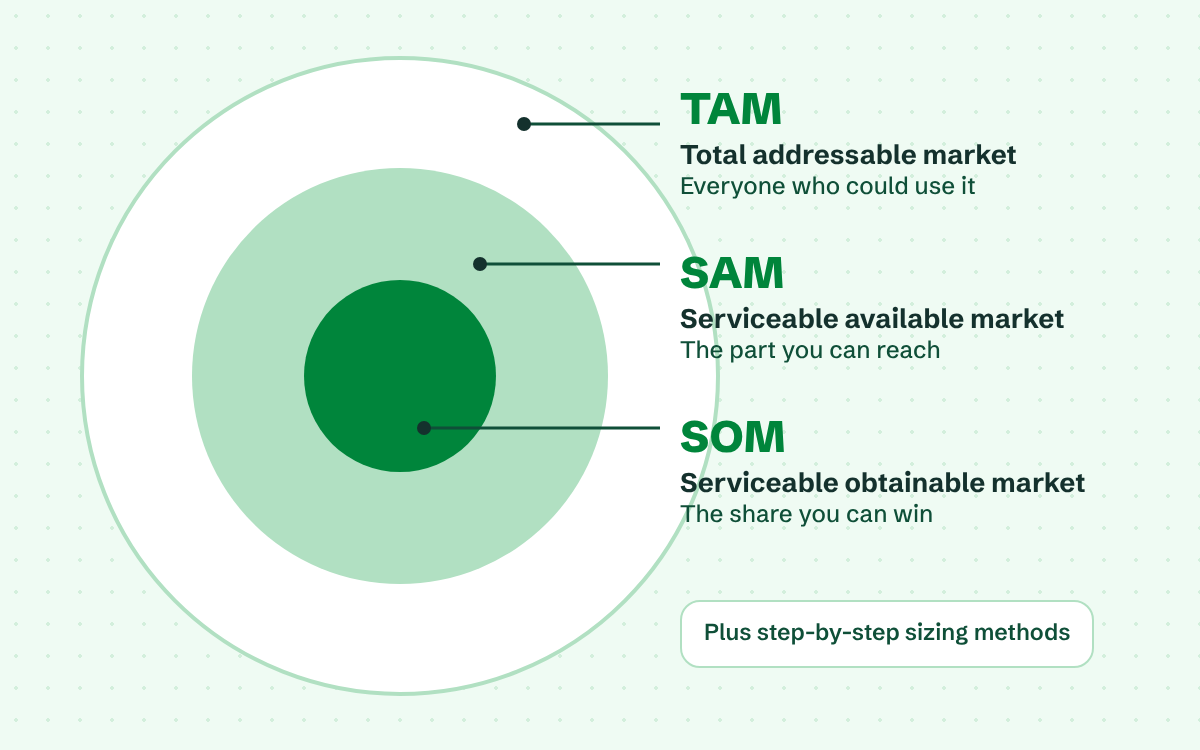
- TAM, total addressable market. The total demand for your product if everyone who could use it did.
- SAM, serviceable available market. The part of that market your business model and geography can actually reach.
- SOM, serviceable obtainable market. The share you can realistically win in the next few years.
A simple bottom-up example
Bottom-up sizing starts from customers you can count, not from a headline industry figure. This illustrative example uses invented numbers to show the method.
Imagine software that helps private clinics manage appointments.
- Count the customers you could serve. Say there are 20,000 private clinics in the countries you plan to cover.
- Set the price. Your plan costs $100 a month, or $1,200 a year.
- Multiply. 20,000 clinics × $1,200 = $24 million a year. That is your serviceable available market.
- Estimate your realistic share. If you expect to win 5 per cent of those clinics within a few years, your serviceable obtainable market is 1,000 clinics, or $1.2 million a year.
- Widen the lens for TAM. Count every clinic that could use the product across all markets you might eventually enter.
Investors trust this approach because every number can be checked and challenged. Show your sources for each input, such as government registries, industry associations or your own sales data, and explain why your share assumption is realistic.
The guide covers both top-down and bottom-up methods step by step, along with what investors in Africa look for when they judge market size.
Mistakes investors spot in market sizing
- The "1 per cent of a huge market" claim. It shows no plan for how you win customers.
- Using the wrong market. Quoting the size of an entire industry when you serve one small part of it.
- No sources. Numbers without a source look invented, even when they are not.
- Mixing currencies or years. Inconsistent figures undermine trust in everything else.
- Ignoring how customers buy. A market only counts if you can realistically reach and sell to it.
A credible bottom-up number, clearly sourced and tied to your go-to-market plan, will always land better than a large headline figure.
Who it's for
- Founders preparing for fundraising and investor discussions
- Entrepreneurs who want to understand their market potential
- Startup teams refining their go-to-market strategy
Market sizing questions founders ask
What is the difference between top-down and bottom-up sizing?
Top-down starts from a large industry figure and narrows it. Bottom-up multiplies the number of customers you can reach by what each one pays. Investors usually trust bottom-up more, because it shows your own assumptions.
How big does my market need to be?
Big enough to support the returns your investors need. Venture investors look for markets that can produce a very large company, so a small niche may suit other funding better.
Where do I find market data?
Industry reports, government statistics, competitor results and your own customer research. Show your sources and assumptions on the slide.
Where does market size go in my pitch deck?
Usually straight after the problem and solution. See How to Build a Killer Pitch Deck for the full structure.
What is CAGR?
Compound annual growth rate: the average yearly growth of a market over several years. It shows whether your market is expanding, which matters as much as its current size.
How often should I update my market size?
Before every fundraise, and whenever you enter a new market or launch a new product. Old figures undermine an otherwise strong deck.
Is a huge TAM always better?
Not if it is not credible. A realistic, well-sourced market that is large enough is more convincing than an enormous number nobody believes.