
Venture capital dominates the headlines, but it is not the only way to fund a startup, and often not the best fit. This guide unpacks non-equity funding: paths that fuel growth without giving up ownership. Debt, grants and alternative financing can give founders more control and flexibility and may suit your business model better.
- A plain-English explanation of what non-equity funding is and why it matters
- Deep dives into four key funding paths
- Real-world examples and tips for finding the right fit
- Practical advice on when non-equity funding is the better bet and how to combine it with VC later
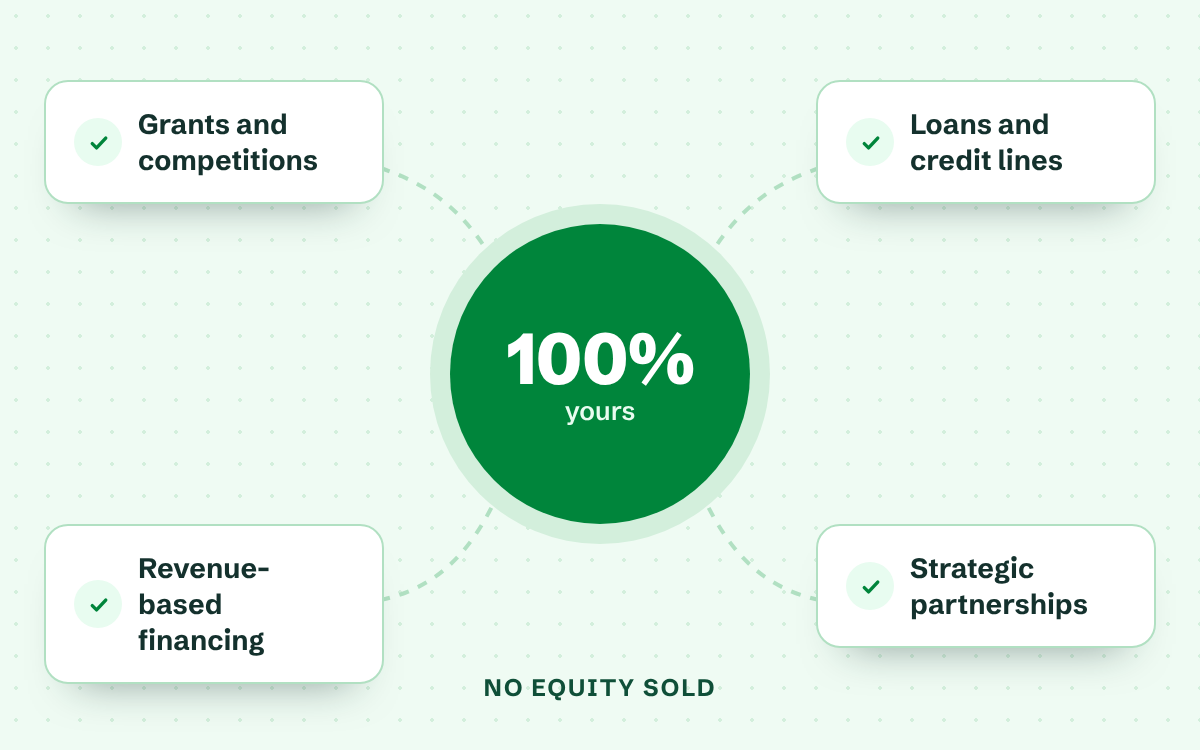
The four funding paths
- Grants and competitions. Money you do not repay, usually tied to a purpose or outcome.
- Revenue-based financing. Capital repaid as a share of your future revenue.
- Loans and credit lines. Borrowing, you repay with interest on an agreed schedule.
- Strategic partnerships and corporate programmes. Funding or resources from companies that benefit from your success.
For public and development funders, see Development Funders in Africa.
Combining non-equity funding with venture capital
Non-equity funding and venture capital are not opposites. Used together in the right order, they can help founders keep more of their company.
- Grants before your first round. A grant can fund early research, a prototype or a pilot. The progress it buys can raise your valuation when you do take equity.
- Revenue-based financing for growth spend. Once revenue is steady, it can fund marketing or inventory that pays back quickly, without selling shares.
- Loans for working capital. Debt can cover the gap between paying suppliers and getting paid by customers, so equity funds growth instead.
- Partnerships for distribution. A corporate partner may offer customers, data or infrastructure that would otherwise cost you money and equity.
There are trade-offs. Debt must be repaid whatever happens, and too much of it can worry future equity investors. Grants often come with reporting duties and restrictions on how the money is used. Partnerships can create dependence on one company.
The guide explains when each path is the better bet and how to combine it with traditional VC later, so you choose deliberately rather than taking whatever money appears first.
Keep every agreement organised. Future investors will ask about any loans, grants or partnership terms during diligence.
Is non-equity funding right for you?
Non-equity funding tends to suit companies that:
- Have steady, predictable revenue that can service repayments
- Need money for a specific purpose, such as inventory, equipment or a pilot
- Work on problems that grant makers and development funders support
- Want to grow without giving up control or ownership
It tends to suit less well when revenue is uncertain, when the company needs a large amount for long-term product development, or when growth depends on taking big risks that only equity investors will fund.
Who it's for
- Founders and early-stage teams in Africa who need capital but are not ready to sell equity
- Entrepreneurs in sectors such as fintech, healthtech or social impact who may qualify for grants or revenue-based funding
- Any startup team that wants sustainable, ownership-friendly ways to grow
Non-equity funding questions founders ask
What is non-dilutive funding?
Funding that does not reduce your ownership. Grants, loans and revenue-based financing are all non-dilutive.
Is revenue-based financing right for an early startup?
Usually only once you have steady revenue, because repayments come from it. Pre-revenue companies tend to look at grants first.
Can I combine grants with venture capital?
Yes. Many founders use grants or debt to reach milestones, then raise equity at a higher valuation.
What do grant funders ask for?
Typically a clear plan, evidence of impact and solid financial records. Keep them organised in a data room: Pitchwise is a secure document and virtual data room tool that lets you control and track access.
What is venture debt?
A loan for companies that have already raised venture capital. It can extend runway between equity rounds, but it must be repaid and often comes with conditions.
Will taking debt put off future VCs?
Not if it is sensible and well understood. Investors mainly worry about debt that is large relative to revenue or that has terms which could take priority over their investment.
How do I win a grant or competition?
Read the criteria closely, answer exactly what is asked and show measurable outcomes. Strong applications are specific about what the money will achieve.
Is non-equity funding only for small businesses?
No. Companies of all sizes use debt and grants. Many fast-growing startups combine them with equity at different stages.