

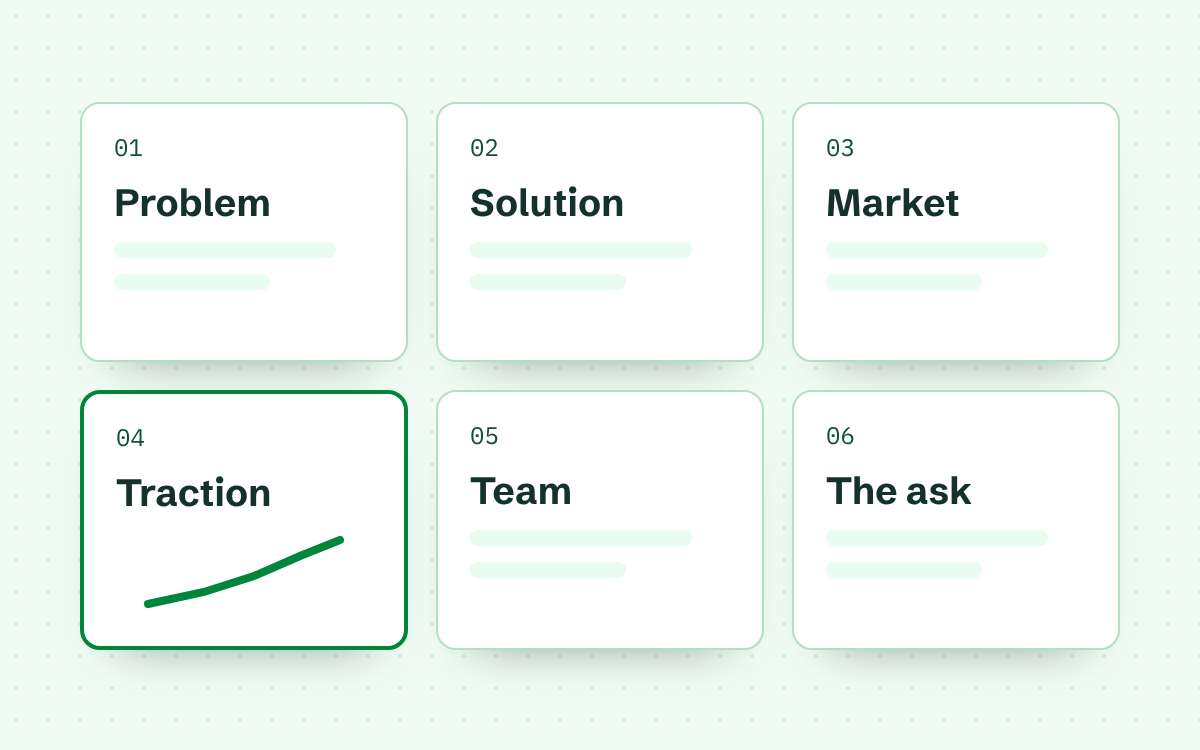
A blank slide is the hardest place to start a pitch deck. This collection gives you 15 samples and templates to work from, chosen for companies at different stages. Use the samples to see how other founders told their story and the templates to build your own without starting from nothing.
The collection also includes tips on structuring your deck, so you know what belongs on each slide and what to leave out.
How to use the samples and templates
- Find the decks closest to your stage. A pre-seed deck sells the team and the insight. A Series A deck sells the numbers.
- Study the structure before the design. Note the order of the slides and how much each one says.
- Build your own. Start from a template, then replace every line with your own story and figures.
Most decks follow a familiar order: problem, solution, product, market, traction, business model, competition, team and the ask. Investors expect to find those answers quickly, so originality belongs in your story and not in the structure. For a slide-by-slide breakdown, read How to Build a Killer Pitch Deck.
What's inside
- 15 pitch deck samples and templates for companies at different stages
- Tips on structuring your deck for the strongest effect
What separates a deck that raises
Study the samples, and you will notice the decks that work share a few habits.
- One idea per slide. Each slide makes one point an investor could repeat to a partner.
- Numbers over adjectives. "Revenue up 3× in six months" beats "rapid growth".
- A clear ask. The amount, what it funds and the milestones it reaches.
- A story, not a list. The strongest decks move from problem to proof to opportunity.
- Design that gets out of the way. Clean layouts and readable type matter more than visual flair.
Who it's for
- Founders preparing for a fundraising round
- Entrepreneurs who want to tell a clear, convincing story about their startup
- Startup teams who want their presentations to look professional
Pitch deck questions founders ask
How many slides should a pitch deck have?
Most investor decks run to between 10 and 15 slides. That is enough to cover the essentials without losing the reader. If a slide does not help an investor decide to take a meeting, cut it or move it to an appendix.
What should a pitch deck include?
Cover the problem, your solution, the product, the market size, traction, the business model, the competition, the team and how much you are raising. For help with the market slide, see the Market Size Guide.
Should I copy a successful company's pitch deck?
Copy the structure, not the content. A deck worked because of the company behind it. Borrow the order and the clarity, then make every claim your own.
Do I need a different deck for sending and for presenting?
Usually, yes. A deck you send must make sense without you in the room, so it carries more text. A deck you present can be lighter because you supply the detail out loud.
What do investors look at first?
Investors tend to skim a deck quickly on the first read, looking for the problem, the traction and the team. Put your strongest evidence early and make each slide's point clear from its title.
Should I send my deck as a PDF or as a link?
A link gives you more control. Pitchwise is a secure document and virtual data room tool, so you can share your deck by link, decide who may open it, update it without resending, and see which pages each investor viewed.
How long should I spend on my pitch deck?
Long enough to rewrite it several times. Most founders revise their deck after every few investor meetings, as questions reveal what is unclear.
What belongs in the appendix?
Detail that supports the main story without slowing it down: deeper financials, product screenshots, customer case studies and team biographies.
Should I tailor my deck for each investor?
Keep the core the same, but adjust the emphasis. A sector specialist may want more on the market; a generalist may need more context on the problem.
Should my deck look different at each stage?
Yes. A pre-seed deck leans on the team, the insight and the early signals. By seed and Series A, investors expect traction, unit economics and a clear plan for the money. Use the samples closest to your stage as your reference.