
Investors speak a language of their own, and not knowing it costs founders credibility in the room. This guide breaks down 50 essential investment and startup terms so you can communicate clearly with investors, hold your own in negotiations and make informed decisions.
- Funding rounds, valuations and equity basics
- The financial metrics investors analyse
- Term sheet and cap table language
- Practical examples of how each term applies in fundraising
A few of the terms inside
- Pre-money valuation. What the company is worth before new money comes in.
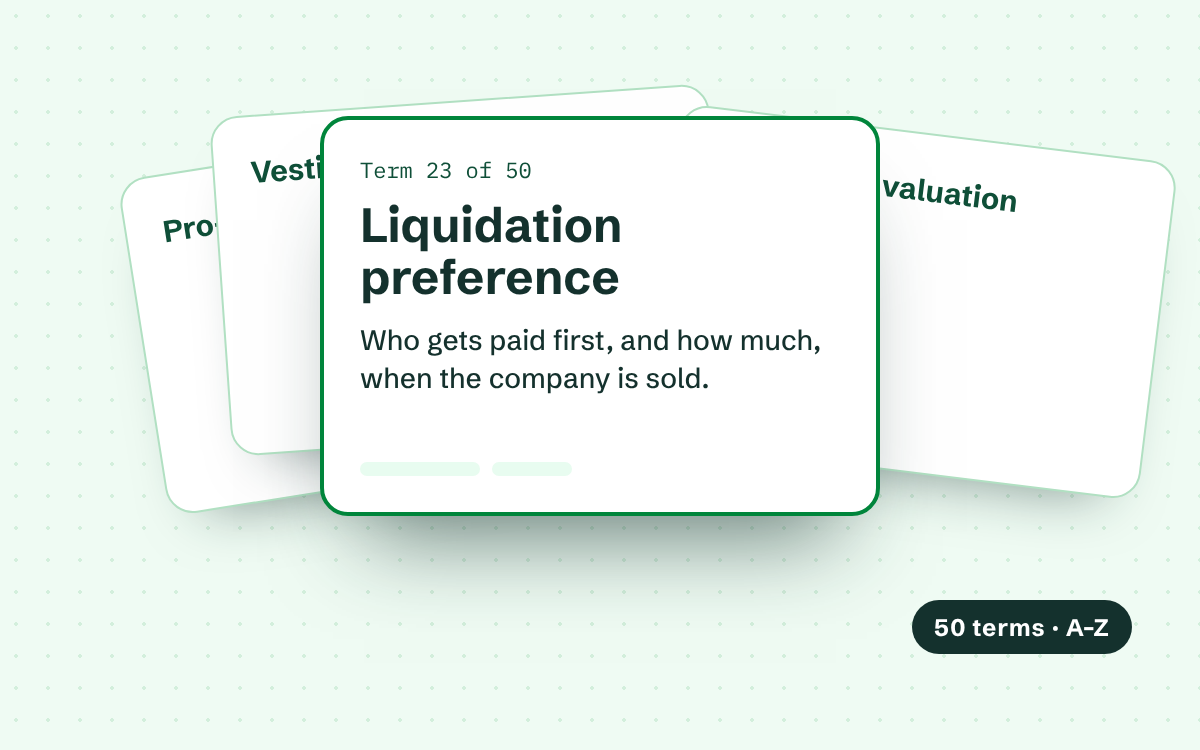
- Liquidation preference. Who gets paid first, and how much, when the company is sold.
- Pro-rata rights. An investor's right to keep their percentage in later rounds.
- Vesting. How founders and staff earn their shares over time.
To see several of these terms at work in one document, read YC's Series A Term Sheet.
When you will meet these terms
The vocabulary of fundraising arrives in stages. Knowing which terms come up when helps you learn them in a sensible order.
- Before you pitch. Pre-money and post-money valuation, dilution, burn rate, runway and the names of funding rounds. You will use these in your first investor conversations.
- When you choose an instrument. SAFE, convertible note, valuation cap, discount and priced round. These decide how your early money turns into shares.
- When you receive a term sheet. Liquidation preference, participation, anti-dilution, pro-rata rights, board seats and protective provisions. These shape control and outcomes for years.
- When you manage ownership. Cap table, fully diluted shares, option pool and vesting. These track who owns what as the company grows.
- When investors check your numbers. MRR, ARR, gross margin, CAC, lifetime value and churn. These are how investors judge the health of the business.
You do not need to memorise all 50 at once. Learn the first group before your first pitch, and return to the guide as each new stage arrives. When a term comes up in a meeting that you do not recognise, ask what the investor means. It is better than guessing and agreeing to something you do not understand.
How to learn the terms quickly
- Start with your own company. Apply each term to your situation: your valuation, your burn rate, and your cap table.
- Read a real document. A standard term sheet or SAFE shows how the terms fit together in practice.
- Explain them out loud. If you can explain a term simply to a co-founder, you understand it.
- Ask when unsure. Investors respect founders who ask what a term means more than those who nod along.
- Keep the guide to hand. Return to it whenever a new term appears in a conversation or a document.
Fluency with these terms does more than help in negotiations. It signals to investors that you take fundraising seriously and understand what you are signing.
Who it's for
- Founders pitching investors
- Entrepreneurs who want to strengthen their financial literacy
- Startup teams in funding discussions
Fundraising terms questions founders ask
What is the difference between pre-money and post-money valuation?
Pre-money is the company's value before the investment. Post-money is the pre-money value plus the new money raised.
What is dilution?
The drop in your ownership percentage when the company issues new shares. Your shares stay the same, but they become a smaller slice of a bigger company.
What is a cap table?
The record of who owns what in your company. Build one with the Startup Cap Table Template.
Do I need to know every term before I pitch?
No, but you should be comfortable with the ones that affect your round. Knowing them helps you ask the right questions and spot a bad deal.
What is an option pool?
Shares set aside to give future employees as equity. Investors often ask for it to be created or increased before a round, which dilutes existing shareholders.
What does fully diluted mean?
A count of every share that exists or could exist, including the full option pool and anything that will convert into shares. It is the basis for most ownership percentages.
What is a convertible note?
A loan from an investor that converts into shares at a later round, usually with interest and a maturity date.
What is a discount rate on a SAFE?
A reduction on the price new investors pay, given to SAFE holders when their SAFE converts. It rewards them for investing earlier.
What is runway?
How many months your company can operate before it runs out of cash at its current burn rate.