

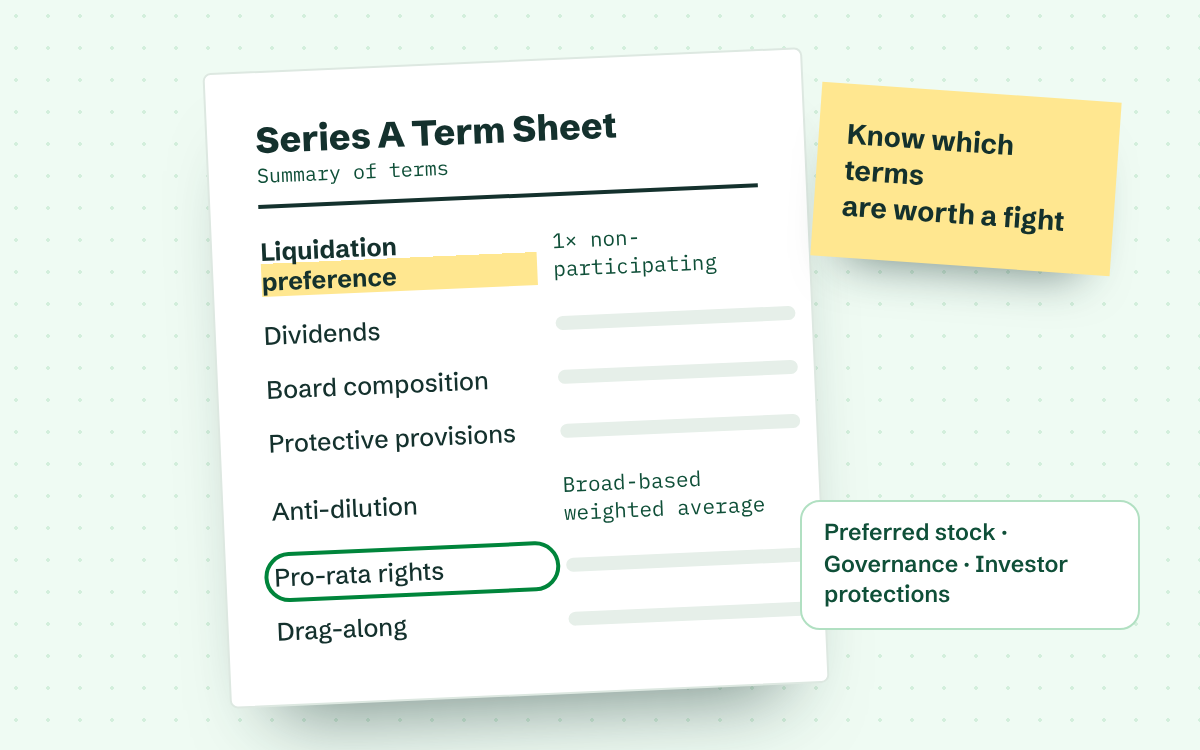
A Series A term sheet sets the rules for your company long after the money arrives. This guide breaks down the essential components of a standard Series A term sheet, using Y Combinator's template as the reference, so founders and investors can align on valuation, preferred stock rights, governance and protections.
The five areas it explains
- Valuation and ownership. Pre-money and post-money valuation, and the dilution that follows.
- Preferred stock rights. Liquidation preferences, participation rights and dividend structures.
- Governance and control. Board composition, voting rights and protective provisions.
- Investor protections. Anti-dilution clauses, pro-rata rights and drag-along provisions.
- Negotiation insights. How to structure fair, founder-friendly terms while attracting strong investors.
For a deeper look at one of these clauses, read Anti-Dilution Protection in Down Rounds.
Reading a term sheet as a founder
A term sheet can look like a wall of legal language. Reading it in a set order makes it manageable.
- Start with the economics. Amount raised, pre-money valuation, option pool size and liquidation preference. Together these decide how much of any exit you actually receive.
- Check where the option pool sits. If the pool is created or increased before the round, existing shareholders carry that dilution. Model it in the Startup Cap Table Template.
- Read the control terms. Board composition, voting rights and protective provisions decide who makes which decisions after the round.
- Read the investor protections. Anti-dilution, pro-rata and drag-along terms shape future rounds and any sale of the company.
- Note what is binding. Exclusivity and confidentiality clauses usually apply as soon as you sign, even though the rest does not.
- List your questions before you negotiate. Decide which terms matter most to you and where you can be flexible.
YC's template is a useful benchmark because it is widely used and generally balanced. If a term sheet departs from the standard, ask why, and get a lawyer who has done many venture deals to review it.
The guide's negotiation section covers how to push for fair, founder-friendly terms without putting off the investors you want.
Terms worth a closer look
- Liquidation preference multiple. 1× is standard. Anything higher means investors take more than their money back before founders see any return.
- Participation. Participating preferred lets investors take their money back and also share in what remains. Non-participating is more founder-friendly.
- Board balance. Check how many seats founders, investors and independents hold, and who decides on future appointments.
- Protective provisions. These list decisions that need investor approval. Make sure they cover genuinely major events, not day-to-day running.
- Option pool size. A larger pool created before the round dilutes existing shareholders. Ask for the size to be based on your actual hiring plan.
Who it's for
- Early-stage founders preparing for a Series A
- Investors who want clarity on standard term sheet structures
- Startup advisors, legal teams and fundraising consultants
- Anyone who wants to approach venture financing with confidence
Term sheet questions founders ask
Is a term sheet legally binding?
Most of it is not. A term sheet sets out the agreed terms, while the binding legal documents come later. Clauses such as confidentiality and exclusivity are often binding, so read it carefully.
What is a liquidation preference?
It decides who gets paid first, and how much, when the company is sold. A 1× non-participating preference, common in founder-friendly deals, returns the investor's money first, or lets them convert to common shares if that pays more.
Which terms matter most to founders?
Valuation gets attention, but liquidation preferences, board control and anti-dilution often matter as much over time.
How should I share term sheet drafts?
Keep drafts and supporting documents in one controlled place. Pitchwise is a secure document and virtual data room tool, so you choose who sees each version.
What are pro-rata rights?
An investor's right to invest in future rounds so they can keep their percentage ownership. Most institutional investors ask for them.
What is a drag-along provision?
A clause that lets a majority of shareholders require the rest to join a sale of the company, so a small group cannot block a deal most owners support.
What is a no-shop clause?
A promise not to seek other investors for a set period while the deal is finalised. It is usually binding, so agree to a reasonable length.
How long does it take to go from term sheet to close?
Often several weeks, sometimes more. Legal documents, confirmatory diligence and signatures all take time, so keep the business running strongly throughout.