

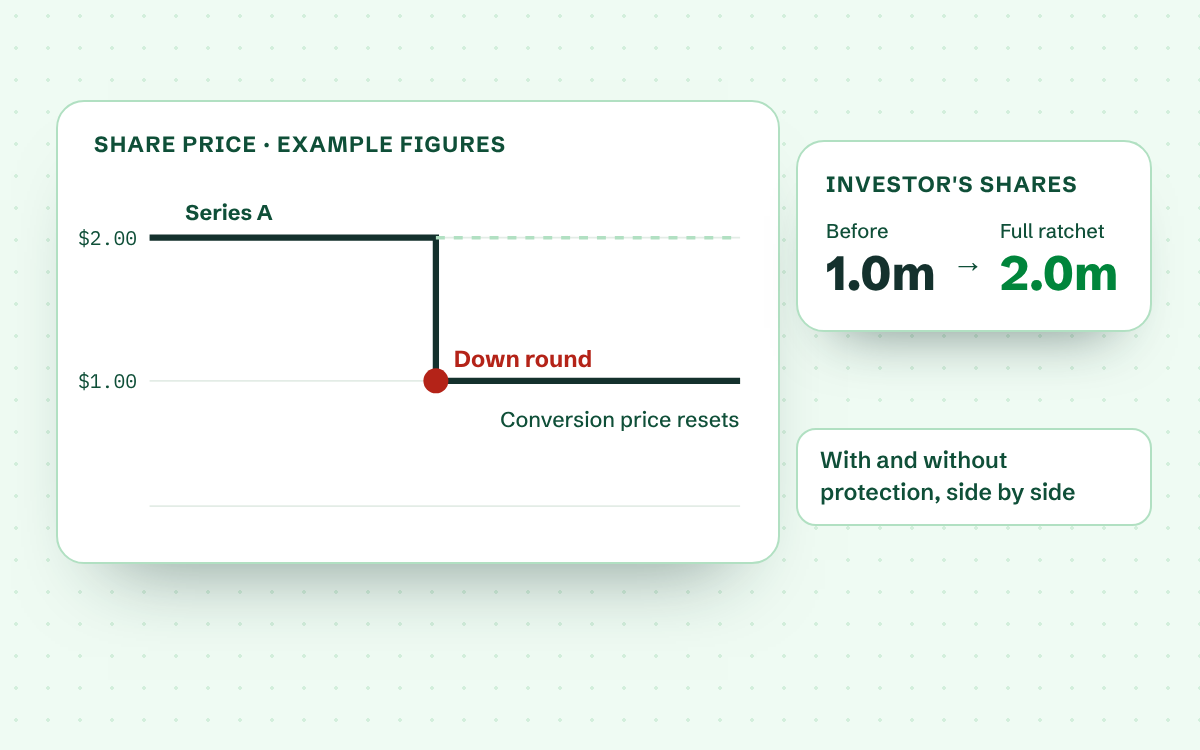
Anti-dilution clauses sit quietly in a term sheet until a down round makes them very expensive for founders. This guide explains full ratchet anti-dilution protection using a real-world Series A and Series B funding scenario. It shows how the clause works, why investors push for it in down rounds, and what it means for founder ownership and valuation.
- A plain-language explanation of down rounds
- A step-by-step breakdown of full ratchet anti-dilution maths
- Side-by-side ownership scenarios, with and without protection
- A table summarising the impact on investor and founder stakes
- Key takeaways to consider before you sign a term sheet
How a full ratchet works
In a down round, new shares are sold at a lower price than earlier investors paid. A full ratchet resets the earlier investors' conversion price to the new, lower price, as if they had invested at it. Their share count rises, and the extra shares come mostly from founders and other holders. The guide walks through the numbers step by step.
To model your own rounds, use the Startup Cap Table Template.
What founders can negotiate
Anti-dilution terms are not fixed. They are negotiated like any other part of a term sheet, and small changes can make a large difference if a down round ever happens.
- The formula. Ask for broad-based weighted average protection instead of a full ratchet. It adjusts the price partly, based on how much new money comes in, rather than all the way down.
- Carve-outs. Make sure routine share issues, such as employee options, do not trigger the protection.
- Pay-to-play. Some terms require investors to take part in future rounds to keep their protection. This rewards investors who keep backing the company.
- Time limits. In some deals, protection only applies for a set period or to a specific next round.
- Waivers. In a difficult round, existing investors sometimes agree to waive their protection so the new round can happen. Good relationships make that conversation easier.
The guide's side-by-side scenarios show how much ownership is at stake in each case. Run your own numbers before you sign, using your real share counts rather than round figures.
The best protection against anti-dilution is avoiding a down round. Raise enough to reach strong milestones, and keep a realistic valuation rather than the highest possible one.
Full ratchet and weighted average side by side
- New conversion price. A full ratchet resets it to the down-round price. A broad-based weighted average adjusts it only partly, based on how many new shares are issued.
- Effect on the investor. Full ratchet protects the investor fully; a weighted average protects them partly.
- Effect on founders. Full ratchet causes the largest extra dilution; weighted average causes less.
- How common it is. Full ratchet is less common. Weighted average is more usual in founder-friendly deals.
The guide's worked scenario shows the full ratchet case in numbers, so you can see the size of the difference.
Who it's for
- Founders raising Series A or beyond
- First-time entrepreneurs working through term sheets
- Investors and advisors supporting early-stage deals
- Operators involved in cap table and legal conversations
Anti-dilution questions founders ask
What is a down round?
A funding round priced below the previous one. It usually happens when growth has slowed or market conditions have changed.
What is the difference between full ratchet and weighted average?
A full ratchet resets the conversion price all the way to the new price. A weighted average adjusts it partly, based on how many new shares are issued. Weighted average is generally considered more founder-friendly.
Can I negotiate anti-dilution terms?
Yes. Founders often push for broad-based weighted average protection instead of a full ratchet or for limits on when it applies.
Where else does anti-dilution appear?
It is a standard section of a term sheet. See YC's Series A Term Sheet for how it sits alongside other investor protections.
What is pay-to-play?
A term that requires existing investors to invest in a future round to keep their preferred rights, such as anti-dilution protection. Investors who do not take part may lose those rights.
Does anti-dilution protect founders?
No. It protects the investors who hold it. Founders and other common shareholders usually absorb the extra dilution.
Can a high valuation lead to a down round later?
Yes. A valuation that runs far ahead of the business makes it harder to raise the next round at a higher price. A realistic valuation often protects founders better.
Should I accept a full ratchet to close a round?
Only after modelling the worst case and taking legal advice. It may be the right trade in a difficult market, but understand the cost first.