By clicking “Accept All Cookies”, you agree to the storing of cookies on your device to enhance site navigation, analyze site usage, and assist in our marketing efforts. View our Privacy Policy for more information.
Median Series A Round Size by Industry in 2026 (Data)
by
Oluwadamilare Akinpelu
According to the Pitchwise 2026 Funding Benchmark, the median Series A in 2026 is $15 million, at a median post-money valuation of $78.7 million, up 37% year-over-year. That's the headline. The story under the headline is more interesting: 2026 Series A is a bifurcated market, and the median figure hides a 5x spread between sectors.
AI and healthcare rounds regularly exceed $50M. Fintech and consumer rounds typically sit between $8M and $14M. The implication for founders is that the right benchmark to plan against isn't the global median; it's the median in your sector.
This is the Series A companion to our median seed round size by industry guide, using the same methodology. Below is the data, broken down by industry, with the ARR thresholds and the valuation multiples that go with each.
The headline numbers
These figures are compiled by the Pitchwise 2026 Funding Benchmark, drawing on PitchBook and Dealroom data across Series A rounds closed between January and September 2025.
Median Series A round size: $15M (upper quartile $25M, lower quartile $7M).
Median post-money valuation: $78.7M, up 37% YoY from $57.5M.
Lorem ipsum dolor sit amet, consectetur adipiscing elit. Suspendisse varius enim in eros elementum tristique. Duis cursus, mi quis viverra ornare, eros dolor interdum nulla, ut commodo diam libero vitae erat. Aenean faucibus nibh et justo cursus id rutrum lorem imperdiet. Nunc ut sem vitae risus tristique posuere.
Median round size, median post-money valuation, and typical ARR threshold by sector. Numbers reflect Series A deals closed in 2026.
Median Series A by industry
Two patterns stand out. First, AI is its own category; the median AI Series A is roughly 1.7x the cross-industry median, and AI startups command a 38% valuation premium at this stage (the firms behind these deals are mostly on our list of AI/ML investors that aren't just chasing hype). Second, consumer and fintech have moved in opposite directions since 2022: consumer marketplaces are funding at lower medians than they did three years ago, while fintech is finding its footing again after the 2023 correction.
How the medians shifted: 2024 → 2025 → 2026
The 37% jump in median post-money valuation between 2025 and 2026 isn't evenly distributed. The lift is concentrated at the top of the market — AI, defence tech, and frontier healthcare — while the rest of the market is roughly flat. The headline median moves because the top decile drags it up.
How the medians for Series A have shifted: 2024 → 2025 → 2026
Compared to the seed round size data, the Series A bar has moved more dramatically. The median seed round in 2026 grew about 12% YoY; the median Series A round grew 15%, and the median Series A valuation grew 37%. The takeaway: investors are paying up for Series A quality, but the bar to qualify has hardened.
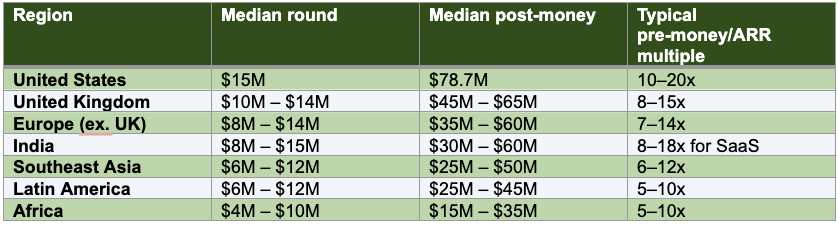
Series A by geography
The US is the global Series A benchmark, but regional Series As are priced differently. For founders raising outside North America, the relevant playbook is geography-specific.
Series A fundraises by geography
Geographic markets that previously were priced 30-50% below US comparables (Europe, India) have narrowed to a 15-30% discount in 2026. The closure of this gap is driven by US capital flowing into non-US Series As, particularly into AI, healthtech, and vertical SaaS in Europe and India.
AI Series A deals are pricing at multiples no other category gets:
Median AI Series A post-money valuation of $120M – $250M vs $78.7M cross-industry.
AI valuation premium at Series A: roughly 38%.
AI infrastructure and AI-native healthcare rounds regularly cross $50M, with several over $100M.
The market is willing to fund pre-revenue AI startups at Series A on the basis of research breakthroughs, team strength, or strategic customer pilots.
The discipline this requires of non-AI founders is sharp. Investors comparing your Series A pitch against an AI deal happening down the hall need a clear reason your category deserves their dollar. This is usually a moat (regulatory, distribution, or technical), an outsized retention curve, or a unit-economics profile AI startups can't match. The funds writing the largest AI checks are documented in our list of AI/ML investors that aren't just chasing hype.
Round structure: what's actually in the term sheet
Series A term structure has shifted meaningfully since 2021, with tighter dilution targets and more consistent use of pro-rata rights across the deals in this dataset. The typical 2026 Series A term sheet, by the numbers:
Round size: $10M – $20M, single tranche.
Pre-money valuation: $25M – $50M for B2B SaaS, $50M – $150M for AI, $20M – $40M for fintech.
These five categories drive 80% of Series A pass-or-proceed decisions. Hit them, and you'll close at the higher end of your sector's range. Miss any one of them, and you'll close at the bottom or not at all.
From the first VC meeting to the closed round, the median Series A in 2026 takes 14 weeks, up from 12 weeks in 2024. That includes 4-6 weeks of diligence and another 4-6 weeks of legal close.
The implication: start the process at least 6 months before you run out of cash, not 3 months. Series A processes that start with 3 months of runway routinely become bridge rounds at materially worse terms.
How you apply this data depends on where you are in the fundraising process. Whether you are building your first deck or stress-testing a term sheet that has already arrived. Three practical applications, in order of how often founders get them wrong:
Set your target round size in the lower half of your sector range. The headline median includes outsized rounds at the top. Targeting the sector median (not the upper quartile) materially raises your odds of closing.
Use the geography table to sanity-check term sheets from non-US investors. A $10M Series A at a $35M post-money valuation in Europe is on-market. The same offer in the US is below-market.
FAQ
What's the average Series A round size in 2026?
The Pitchwise 2026 Funding Benchmark puts the US median at $15M, with the upper quartile at $25M and the lower quartile at $7M. The median has moved up steadily from $11M in 2024 to $15M in 2026.
What ARR do I need for a Series A in 2026?
Across most B2B SaaS sectors, $2.5M–$3M ARR is the median. Tier-one funds typically want $3M+ with 100%+ YoY growth. Fintech is the highest bar at $3M+ with proven unit economics. AI deals can close pre-revenue or at $1M+ ARR on research and team strength. Full breakdown in our Series A traction requirements piece.
What's the median Series A valuation?
The Pitchwise 2026 Funding Benchmark puts the 2026 median US Series A post-money valuation at $78.7M, up 37% YoY. Pre-money valuations typically sit at $25M–$50M for B2B SaaS, $50M–$150M for AI, and $20M–$40M for fintech.
Why are AI Series As bigger than other industries?
AI startups command roughly a 38% valuation premium at Series A. The combination of larger addressable opportunities, scarce technical talent, and competition between funds for AI deals is pushing AI rounds to median post-money valuations of $120M–$250M, with several rounds crossing $100M.
How much dilution should I expect at Series A?
18–25% is the typical range. Competitive processes with strong metrics can pull this to 15–18%. Diluted rounds with multiple investors or complex structure push it to 28%+. To model the impact on your ownership, see our post-money valuation guide.
How long does a Series A take to close in 2026?
Median time from the first VC meeting to the closed round is 14 weeks. That's 4-6 weeks of diligence plus 4-6 weeks of legal close. Plan to start the process at least 6 months before runway runs out.
How does this compare to seed round sizes?
The 2026 median seed round is materially smaller; see the full breakdown in our median seed round size by industry analysis. The Series A median is roughly 4-5x the seed median, with the valuation step-up typically running 2-3x from seed post-money to Series A pre-money.
Open a Series A-ready data room in 60 seconds
Whether you're raising at the AI premium or the fintech median, the diligence process runs through your data room. Pitchwise gives you an investor-ready data room with page-level analytics – so you know which partners are doing real diligence and which are still browsing. Get started now.
Lorem ipsum dolor sit amet, consectetur adipiscing elit. Suspendisse varius enim in eros elementum tristique. Duis cursus, mi quis viverra ornare, eros dolor interdum nulla, ut commodo diam libero vitae erat. Aenean faucibus nibh et justo cursus id rutrum lorem imperdiet. Nunc ut sem vitae risus tristique posuere.
Lorem ipsum dolor sit amet, consectetur adipiscing elit. Suspendisse varius enim in eros elementum tristique. Duis cursus, mi quis viverra ornare, eros dolor interdum nulla, ut commodo diam libero vitae erat. Aenean faucibus nibh et justo cursus id rutrum lorem imperdiet. Nunc ut sem vitae risus tristique posuere.