By clicking “Accept All Cookies”, you agree to the storing of cookies on your device to enhance site navigation, analyze site usage, and assist in our marketing efforts. View our Privacy Policy for more information.
Startup Runway Calculator: How to Know When You Need to Raise
by
Oluwadamilare Akinpelu
Most founders know their cash balance. Fewer know their net monthly burn with any precision. And almost none account for the lead time a fundraising process actually takes when they decide it is time to raise. Runway is not just a number. It is a countdown with a built-in fundraising process. This article covers the formula, a worked example, and a status guide for knowing what your number means and what to do about it. There is also a free Startup Runway calculator at the end that does the arithmetic for you.
What runway actually means
Runway is the number of months of cash your company has left if nothing about your revenue or spending changes. It is a snapshot, not a forecast. A company with $500,000 in the bank and $50,000 in net monthly burn has ten months of runway.
The number matters because it sets a hard deadline on your decision-making. Everything about how you operate, hire, and prioritise sits inside that window.
Gross burn vs net burn
Gross burn is your total monthly expenses: payroll, software, office, legal, and everything else your business spends. Net burn is gross burn minus your revenue. Net burn is the number that determines runway.
A company spending $80,000 a month but bringing in $33,000 in revenue has a net burn of $47,000. That is the number to use in your runway calculation, not the gross figure. Using gross burn overstates how quickly you are consuming cash and will lead you to raise earlier than you need to.
Lorem ipsum dolor sit amet, consectetur adipiscing elit. Suspendisse varius enim in eros elementum tristique. Duis cursus, mi quis viverra ornare, eros dolor interdum nulla, ut commodo diam libero vitae erat. Aenean faucibus nibh et justo cursus id rutrum lorem imperdiet. Nunc ut sem vitae risus tristique posuere.
Runway (months) = Current Cash Balance / Monthly Net Burn
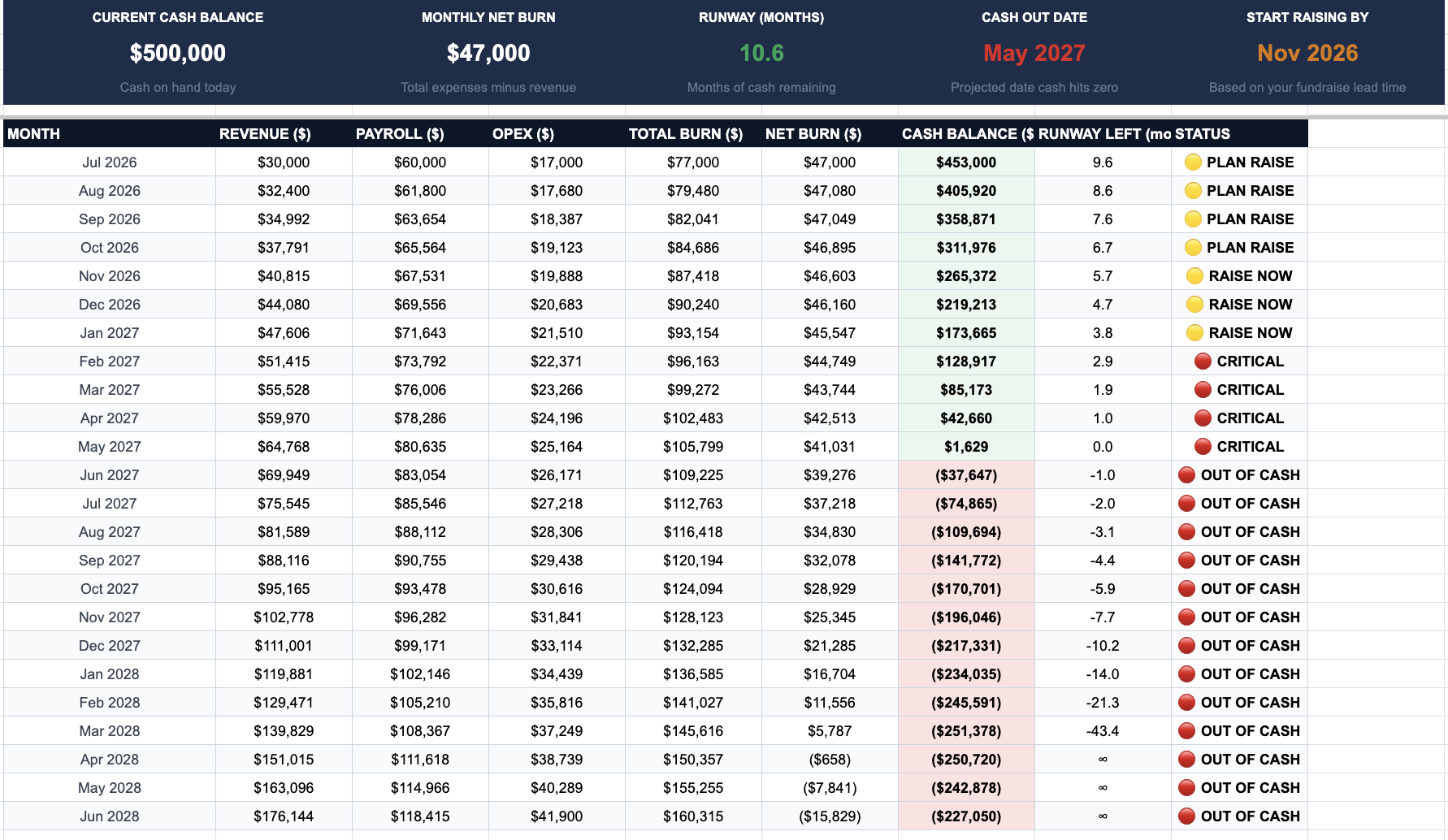
Using the example above: $500,000 / $47,000 = 10.6 months of runway.
To get your net burn figure, take your total monthly expenses and subtract your total monthly revenue. If your expenses and revenue vary significantly month to month, use a three-month average rather than a single month. A single unusually high or low month will skew the result.
Why 10 months of runway is not as comfortable as it sounds
The mistake most founders make is treating runway as time to spend before they need to think about fundraising. A fundraising process does not start and close in a week. From the first investor meeting to a signed term sheet typically takes three to six months for a seed round. Due diligence and closing add another one to two months on top.
If your process takes six months from start to close and you want at least one month of cash buffer after the round, you need to begin raising when you have seven months of runway left. On 10.6 months of runway, that means starting in about three and a half months.
The Runway Calculator by Pitchwise accounts for this. You set your fundraising lead time in the Assumptions tab, and the model calculates your "Start Raising By" date automatically. With $500,000 in cash, $47,000 in net burn, and a six-month lead time, the calculator puts that date at November 2026.
What your runway number means
What your startup runway number means for you.
The variables that change your runway
Revenue growth
If your revenue is growing, your net burn decreases each month even if spending stays flat. A company with 8% month-on-month revenue growth will find that burn falls faster than the flat model suggests. The runway calculator lets you set a monthly revenue growth rate so the projection reflects this rather than assuming a static burn figure.
Planned hires
Payroll is usually the largest driver of burn, and planned hires change the picture significantly. Adding a full-stack engineer and a growth marketer mid-year at a combined $170,000 in annual salary adds about $14,000 to monthly net burn from the day they start. That hire plan shortens your runway in the months after those roles start, even if your top-line numbers are growing.
The calculator includes a Hiring Plan tab where you log planned roles, salaries, and start dates. The payroll impact flows through to the monthly burn figures automatically.
One-time revenue
Services revenue, professional fees, and one-time payments can create months where net burn looks unusually low. The model separates recurring and one-time revenue so you can see what your baseline burn looks like without the distortion of a single large payment.
How to use the Runway Calculator by Pitchwise
The calculator has four tabs. You only need to fill in the blue cells.
Start in the Assumptions tab. Enter your current cash balance, your monthly revenue growth rate, headcount growth rate, and how many months your next fundraise is likely to take. The model start date should be today or the first of the current month.
Move to the P&L tab and enter your monthly revenue and expense line items across the next twelve months. Use your actuals for the current month and your best estimates for the months ahead. The more accurately you fill in the P&L, the more useful the Dashboard output will be.
If you have planned hires, fill in the Hiring Plan tab with each role, their annual salary, and their planned start month. The monthly cost is calculated automatically.
Most founders know their cash balance. Fewer know their net monthly burn with any precision. And almost none account for the lead time a fundraising process actually takes when they decide it is time to raise. Runway is not just a number. It is a countdown with a built-in fundraising process. This article covers the formula, a worked example, and a status guide for knowing what your number means and what to do about it. There is also a free Startup Runway calculator at the end that does the arithmetic for you.
What runway actually means
Runway is the number of months of cash your company has left if nothing about your revenue or spending changes. It is a snapshot, not a forecast. A company with $500,000 in the bank and $50,000 in net monthly burn has ten months of runway.
The number matters because it sets a hard deadline on your decision-making. Everything about how you operate, hire, and prioritise sits inside that window.
Gross burn vs net burn
Gross burn is your total monthly expenses: payroll, software, office, legal, and everything else your business spends. Net burn is gross burn minus your revenue. Net burn is the number that determines runway.
A company spending $80,000 a month but bringing in $33,000 in revenue has a net burn of $47,000. That is the number to use in your runway calculation, not the gross figure. Using gross burn overstates how quickly you are consuming cash and will lead you to raise earlier than you need to.
The runway formula
Runway (months) = Current Cash Balance / Monthly Net Burn
Using the example above: $500,000 / $47,000 = 10.6 months of runway.
To get your net burn figure, take your total monthly expenses and subtract your total monthly revenue. If your expenses and revenue vary significantly month to month, use a three-month average rather than a single month. A single unusually high or low month will skew the result.
The Runway Calculator by Pitchwise has four tabs. You only need to fill in the blue cells.
Frequently Asked Questions
What is a good runway for a startup?
Eighteen months is the benchmark most experienced investors and operators use. It gives you enough time to execute without the pressure of a fundraising process hanging over every decision. Twelve months is workable but leaves limited buffer for a process that takes longer than expected. Below nine months, the fundraising becomes the primary focus by necessity.
Should I use gross burn or net burn for runway?
Net burn. Gross burn ignores your revenue and overstates how fast you are consuming cash. The only situation where gross burn is the more relevant number is if your revenue is entirely unpredictable or you are pre-revenue, in which case gross burn and net burn are the same thing.
How long does a seed round actually take?
The honest range is four to eight months from the first investor conversation to cash in the bank. Four months is fast and usually requires warm introductions and a strong existing network. Six months is typical. Eight months or more is common when the market is slower or the round requires more conversations to fill.
Most founders underestimate this by two to three months. Building that buffer into your runway calculation is the single most useful adjustment you can make.
What if my burn is increasing every month?
The calculator accounts for this. The monthly revenue growth rate in Assumptions applies a compounding growth figure to revenue each month, and the headcount cost growth rate does the same for payroll. If your burn is increasing because of planned hires, add them in the Hiring Plan tab, and the model will reflect the higher burn from each start date.
Can I use this for a Series A projection?
Yes. The model works for any stage. Change the round type in the Assumptions tab and adjust the fundraise lead time accordingly. Series A processes typically take longer than seed rounds, so setting the lead time to eight or nine months gives a more realistic start date.
Download the free runway calculator
The Pitchwise Runway Calculator is a free Google Sheets model with a live dashboard, P&L model, and hiring plan. Download it here. Fill in your numbers, and you will know your runway, your cash-out date, and the month you need to start raising before you finish your coffee.
If you want to see how investors are engaging with your pitch deck while you raise, Pitchwise gives you slide-level document analytics and a data room at $24 a month.
Lorem ipsum dolor sit amet, consectetur adipiscing elit. Suspendisse varius enim in eros elementum tristique. Duis cursus, mi quis viverra ornare, eros dolor interdum nulla, ut commodo diam libero vitae erat. Aenean faucibus nibh et justo cursus id rutrum lorem imperdiet. Nunc ut sem vitae risus tristique posuere.
Lorem ipsum dolor sit amet, consectetur adipiscing elit. Suspendisse varius enim in eros elementum tristique. Duis cursus, mi quis viverra ornare, eros dolor interdum nulla, ut commodo diam libero vitae erat. Aenean faucibus nibh et justo cursus id rutrum lorem imperdiet. Nunc ut sem vitae risus tristique posuere.






.png)